Brick Lane's salt beef beigel tradition is best experienced on a quiet weekday morning — avoid Sundays when the market crowds and uneven paving make the walk harder. Allow half a day. The defining experience is a hand-cut salt beef beigel with mustard and pickle from the 24-hour Beigel Shop at 155 Brick Lane, costing roughly $8–10 AUD. Mobility rating: Easy to Moderate (flat street, but standing-only counter). From Sydney, Melbourne, Brisbane or Perth, expect 22–24 hours flying via one hub; build in a recovery day before exploring.
Getting there: the honest flight picture from Australia
There are no direct flights from any Australian city to London. That's simply the reality, and it's worth sitting with it before booking. From Sydney or Melbourne, the most common routings go via Singapore (Changi) or Dubai, with total travel time — door to departure gate at Heathrow — sitting at roughly 22 to 24 hours including the stopover. From Perth, the Emirates non-stop to Dubai is a useful option that keeps the total journey closer to 20 hours. From Brisbane, expect similar hub connections through Singapore or Doha. Qantas, Singapore Airlines, Emirates and Qatar Airways all operate these routes; check current schedules directly with each airline, as codeshare arrangements shift.
A 22-hour journey is not something the body simply shakes off with a good night's sleep. For a traveller in her late 60s, the honest advice is to build in at least one full recovery day — ideally two — before attempting any sightseeing that requires sustained walking or navigation. Book a London hotel close to a Tube station with lift access, spend day one eating lightly and walking no more than a few blocks, and let the East End wait. It will still be there Thursday morning, which is exactly when you want to visit Brick Lane anyway.
Travel insurance is non-negotiable for this journey. If you're managing any pre-existing conditions — blood pressure, joint issues, anything that required a GP conversation before departure — you need a policy that covers those conditions explicitly. Read the Product Disclosure Statement before purchase, not after. The Australian Government's Smartraveller website (smartraveller.gov.au) carries current UK advisories and is worth bookmarking on your phone before you leave.
Getting to Brick Lane from central London: Tube, bus or taxi
Brick Lane sits in Shoreditch, E1 — east of the City of London and very straightforward to reach from most central hotel areas. The simplest Tube option is the Overground to Shoreditch High Street station, which puts you almost directly onto the southern end of Brick Lane. Alternatively, the District or Circle line to Aldgate East leaves a flat ten-minute walk north. Both routes are accessible; confirm lift availability at your specific departure station on the TfL journey planner at tfl.gov.uk before you go, because not every central London station has step-free access throughout.
A licensed black cab or an Uber from, say, Covent Garden or South Kensington will cost roughly £12–18 each way depending on traffic — around $23–35 AUD at current exchange rates, though that shifts. For a solo traveller who finds the Tube map mildly stressful after a long-haul flight, a cab is a perfectly sensible choice. Black cabs are wheelchair accessible and the drivers know the area well. The cost is real but so is the convenience, and there's no shame in paying for a smooth start to the morning.
One practical note: if you're using a cane or a walker, the Tube platform gaps and escalators at some stations can be genuinely awkward. The TfL 'Turn Up and Go' assistance service operates at staffed stations — no advance booking required, though a call ahead is welcomed. Confirm current arrangements at tfl.gov.uk/transport-accessibility.
Brick Lane itself: what the street is actually like
Brick Lane runs roughly north–south, flat for almost its entire length. That's the good news. The less good news is that on Sundays — when the famous market is in full swing — the pavement becomes genuinely crowded, the kerbs are cluttered with stalls, and the cobbled sections near the northern end can catch an unwary foot. For anyone managing balance issues or using a walking aid, a Sunday visit is not the time to attempt this street. A Tuesday or Wednesday morning between 9 and 11 is a different experience entirely: calm, navigable, with actual space to look around.
The street has a layered character that rewards slow walking. The southern stretch nearest Whitechapel is predominantly Bangladeshi — curry houses, fabric shops, phone repair stalls. Moving north, the neighbourhood shifts toward the old Jewish East End, with the Beigel Shop appearing on the left as you approach the Bethnal Green Road end. Neither stretch demands you cover it at pace. A comfortable half-kilometre from Shoreditch High Street station to the Beigel Shop takes perhaps fifteen minutes at an easy walk, with plenty to look at along the way.
The Beigel Shop: what to expect inside
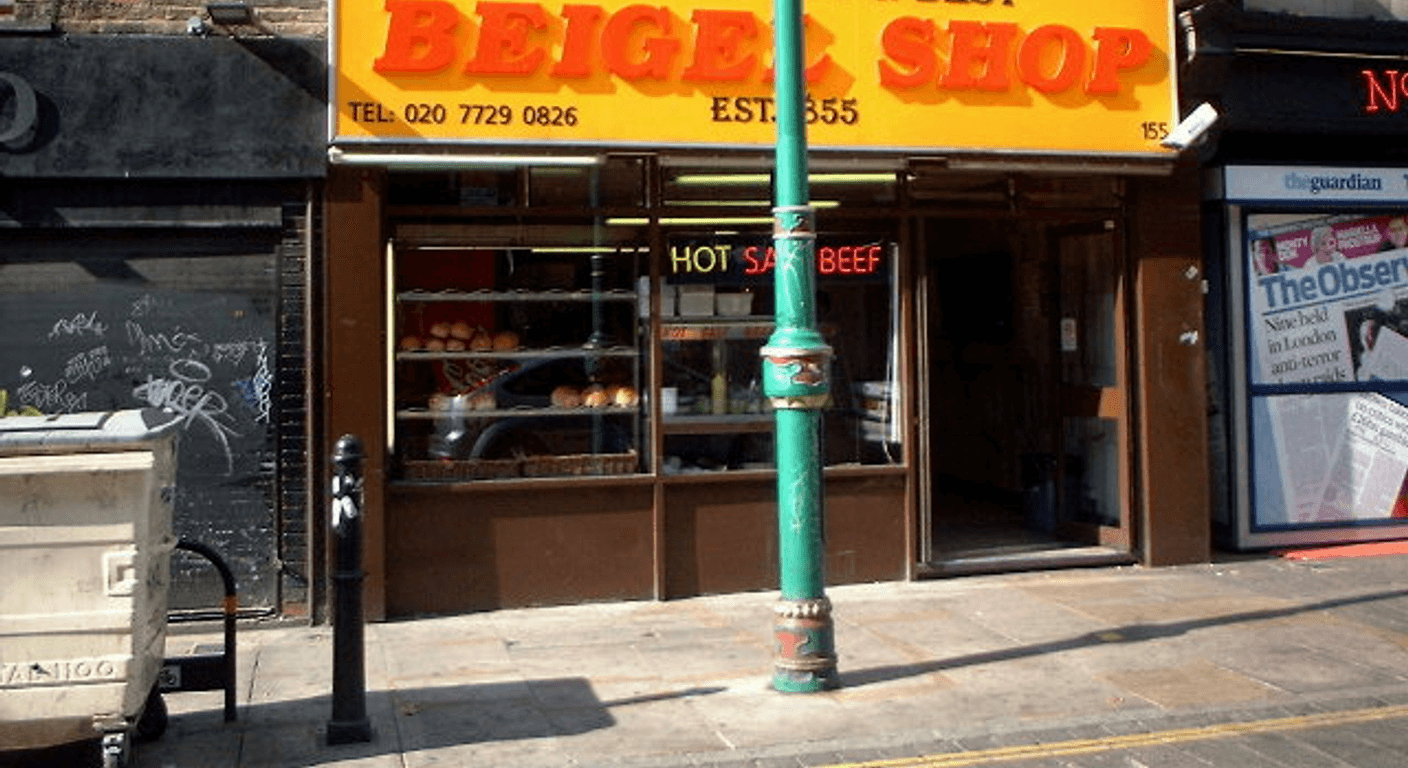
The Beigel Shop at 155 Brick Lane is the one with the yellow signage and, on most days, a short queue that moves quickly. It operates 24 hours a day, seven days a week — a genuinely remarkable fact for a small bakery that has been running since 1974. The salt beef beigels are made to order at the counter: a freshly baked ring of chewy bread, a generous hand-cut pile of slow-cooked salt beef, a streak of English mustard, and a slice of pickled cucumber. That's it. Order it, pay for it (cash is accepted; card may incur a small surcharge — yes, even here), and you're done in under two minutes.
The shop has no seating. This is not an oversight; it's simply how it works. You stand at the counter or step outside. For a traveller who finds standing for more than a few minutes uncomfortable, the practical solution is to take your beigel across the road to Bethnal Green Road where there are public benches, or walk half a block south to a cafe with chairs and order a tea or coffee to go alongside it. The beigel itself travels well for at least twenty minutes. A salt beef beigel costs roughly £3.50–4.50 in GBP — work that out at today's exchange rate and you're looking at approximately $8–10 AUD, though that figure shifts with the currency and you should confirm current pricing at the counter.
A practical food note for anyone managing blood pressure or sodium intake: salt beef is heavily cured, the mustard is sharp, and the pickle adds another layer of salt. This is not a low-sodium meal. It's a wonderful, historically resonant, culturally specific meal — but if your GP has you watching sodium carefully, have half and savour it, or consider one of the plainer beigel options (plain cream cheese is available and perfectly good). Standard travel food-safety sense applies: the shop's turnover is very high and its reputation long-established, but if you're feeling unwell or your digestion is unsettled after the flight, give it a day.
What a morning here actually looks like, hour by hour
Arrive at Shoreditch High Street Overground by 9:30 on a weekday. The station exit puts you almost onto the street — turn left and you're walking south on Brick Lane within a minute. At this hour the street is quiet, the light is good, and the curry house signage looks considerably less garish than it does at midnight. Allow yourself a genuinely slow fifteen-minute walk south, stopping to look in whichever windows catch your attention. You're at the Beigel Shop by roughly 9:45 to 10:00.
The queue, if there is one, typically moves within five minutes at this hour. Order at the counter, step outside, and find somewhere to sit — a nearby bench, a low wall, or walk the fifty metres back to a cafe on Bethnal Green Road for a proper chair and a hot drink. Budget thirty to forty minutes for eating without rushing. By 10:30 or 11:00 you've had the experience, you're not tired, and the rest of the morning is yours. The Whitechapel Gallery is a ten-minute walk south and has seating throughout. The Museum of London Docklands is a twenty-minute walk east and is free to enter.
If you want to extend the morning without adding kilometres, the Old Truman Brewery complex just north of the Beigel Shop has courtyard seating and independent coffee shops open from mid-morning on weekdays. It's a reasonable place to sit, people-watch, and decide whether you want to keep walking or call a cab back to your hotel. The skippable parts of this walk are anything that feels like an obligation — the third curry house, the vintage clothing stalls, the art galleries if art isn't your thing. There is no itinerary here. You're eating a beigel and walking a flat street. That's the whole plan, and it's enough.
Gentler alternatives: guided food tours and sit-down Jewish deli options
Not every traveller wants to navigate an unfamiliar neighbourhood solo, even a flat and friendly one. A guided small-group food walk in the East End is a legitimate and often more rewarding option — you get context, company, and someone else making the routing decisions. Several operators run East End food tours that include Brick Lane and the surrounding Jewish and Bangladeshi food traditions, with most tours lasting two to three hours and including multiple tastings. Eating London Food Tours (eating-london.com) is one of the more established operators; indicative pricing sits around $90–120 AUD per person at current exchange rates, though you should confirm current pricing and tour availability directly with the operator.
Guided tours typically include seating breaks, which matters. A two-hour standing food walk with no sit-down moment is genuinely tiring; a good operator builds in a deli stop or a cafe pause. Ask specifically about this when booking — 'are there seated tasting stops?' is a completely reasonable question and any decent operator will answer it clearly. Group sizes vary; smaller groups (under ten people) move more slowly and allow more conversation, which is generally preferable.
For a proper sit-down Jewish deli experience rather than a counter beigel, Monty's Deli in Hoxton (a short walk or taxi from Brick Lane) has table service and a menu built on the same Ashkenazi tradition — salt beef, pastrami, rye bread, latkes. A two-course brunch there runs roughly £20–30 per person, or around $38–58 AUD at current rates; confirm current menu pricing directly. It's a quieter, slower, more comfortable experience than the Beigel Shop counter, and there's nothing wrong with choosing comfort.
The solo traveller's reality: single supplements and practical logistics
The Beigel Shop doesn't care whether you're alone or in a group. Neither does Brick Lane on a Tuesday morning. The solo experience here is genuinely uncomplicated — you queue, you order, you eat, you walk. No one is pairing you with a stranger or charging you extra for occupying a single counter spot. This is one of the pleasures of self-guided food exploration: the economics are identical regardless of who you're with.
Where the solo pricing reality bites is in accommodation and guided tours. London hotels regularly charge single-occupancy rates that are 70–90% of the twin rate — not quite double, but close enough to sting. Budget around £150–250 per night for a comfortable, well-located hotel with a lift; that's roughly $290–480 AUD at current exchange, and yes, you're paying most of that alone. Serviced apartments can be better value for solo travellers staying more than three nights — you get a kitchen, more space, and a rate that doesn't pretend a single person needs twice the room service.
Guided food tours often charge a flat per-person rate, which is genuinely solo-friendly — no supplement, same price as everyone else. But confirm this when booking, because some operators do apply a small-group minimum or a solo surcharge. If a tour operator charges you extra simply for travelling alone, note it and consider another operator. Several good ones don't. It's also worth asking whether the tour group skews older — a food walk designed for 25-year-olds moving at pace is a different experience from one that builds in time to actually taste things.
Quick planning guide
| Ideal pace | Leisurely half-day, mid-morning start |
|---|---|
| Best months | April–June and September–October (mild, less crowded than summer peak) |
| Suggested stay | 2–3 nights minimum in London to absorb jet lag before East End day |
| Mobility level | Easy — Brick Lane is flat; Beigel Shop has standing counter only, nearby benches available |
| Cost level | Low for self-guided ($8–10 AUD per beigel); moderate for guided food tour ($60–120 AUD per person) |
| Comfort level | Moderate — busy shopfront, no seating inside, best on a quiet weekday |
| Best for | Curious solo travellers, culturally minded couples, food-focused itineraries |
| Main planning consideration | Jet lag recovery before the walk; confirm current GBP–AUD exchange rate for cost estimates |
Key takeaways
- A salt beef beigel at 155 Brick Lane costs roughly $8–10 AUD — one of London's most historically specific and inexpensive food experiences.
- Brick Lane is flat and walkable, but visit on a weekday morning to avoid Sunday market crowds and uneven-paved stalls.
- The Beigel Shop has no seating — plan to eat on a nearby bench or at a cafe a short walk away.
- Allow at least one full recovery day after your 22–24-hour flight before attempting any sightseeing in London.
- Guided East End food tours run roughly $90–120 AUD per person and typically include seated tasting stops — ask specifically before booking.
- Solo travellers pay the same flat rate on most guided food tours, but London hotels regularly charge near-twin rates for single occupancy — budget accordingly.
Recommended partners and links
Indicative prices only — always confirm with the operator before booking.
Frequently asked questions
Is Brick Lane easy to walk for someone using a cane or with mobility concerns?
Brick Lane itself is largely flat, which makes it manageable for most mobility levels. The main caution is Sunday market days, when stalls clutter the pavement and some sections have uneven surfaces. A weekday morning visit — Tuesday to Thursday between 9 and 11 — is significantly easier to navigate and far less crowded.
How much does a salt beef beigel cost in Australian dollars?
At current GBP–AUD exchange rates, a salt beef beigel with mustard and pickle at the Beigel Shop on Brick Lane costs roughly $8–10 AUD. This is an indicative figure only — confirm the current GBP price at the counter and check the exchange rate before you travel, as it shifts.
Does the Beigel Shop at 155 Brick Lane have seating?
No. The Beigel Shop operates as a counter takeaway only — you order, pay, and eat outside or find a nearby bench or cafe. For travellers who need to sit down to eat comfortably, plan to walk fifty metres to a cafe on Bethnal Green Road or find a public bench nearby. The beigel holds together well for at least twenty minutes.
What is the best way to get to Brick Lane from central London?
The London Overground to Shoreditch High Street station is the most direct option and leaves you a short flat walk from the Beigel Shop. Alternatively, the Tube to Aldgate East (District or Circle line) is a ten-minute walk north. For travellers who find the Tube stressful or need step-free access throughout, a licensed black cab or Uber is practical — budget roughly $23–35 AUD each way from central London, exchange-rate dependent.
Are there guided food tours of Brick Lane and the East End suitable for over-50 travellers?
Yes. Several operators run small-group East End food walks that include Brick Lane, with indicative pricing around $90–120 AUD per person at current exchange rates. When booking, ask specifically whether the tour includes seated tasting stops and what the group size is — smaller groups move at a more comfortable pace. Most operators charge a flat per-person rate with no solo supplement, but confirm this before booking.