Macau's UNESCO-listed historic centre is best visited October to December, when humidity drops and typhoon season has passed, with two to three days needed to properly explore Portuguese colonial squares, Jesuit ruins, and Macanese cuisine woven through Cantonese old-town lanes. The precinct is compact, flat, and easily walkable, rating easy for mobility. Australians reach it via a nine-to-ten hour flight to Hong Kong followed by a one-hour high-speed ferry, as no direct flights exist.
Why Macau's Old Town Deserves More Than a Day Trip
Most travellers arrive in Macau from Hong Kong on a fast ferry, spend three hours photographing the Ruins of St Paul's, and leave before sunset. That is a reasonable way to see the facade. It is not a reasonable way to understand the place. Macau's historic centre — a UNESCO World Heritage Site since 2005 — is a genuinely layered city, shaped by four and a half centuries of Portuguese administration, Cantonese culture, Jesuit missionaries, and a very specific kind of trading-port pragmatism. You need at least two full days to let that sink in.
The good news for travellers who value comfort and pace is that the heritage district is compact and largely flat. The distance from Senado Square to the Ruins of St Paul's is around 600 metres. Taipa Village, across the bridge, adds another half-day of quiet lanes and excellent food. None of this requires a hired guide or a punishing schedule. A good pair of walking shoes, a hat, and a willingness to stop at bakeries — and you have a fine itinerary.
Getting There from Australia: Flights, Stopovers, and Jet Lag
There are no direct flights from Australia to Macau. The practical route from Melbourne, Sydney, or Brisbane is to fly into Hong Kong International Airport — roughly nine to ten hours from the east coast — and then connect to Macau by ferry. The Cotai Water Jet and TurboJET services run frequently from the Hong Kong Airport Skypier (no need to clear Hong Kong immigration if you're transiting directly to Macau), with the crossing taking around an hour. Confirm schedules and current booking processes at cotaiwaterjet.com or turbojet.com.hk before departure.
A word on jet lag: Macau runs on Hong Kong Time, UTC+8, which puts it three hours behind the east coast of Australia in summer and two hours behind in winter. The time difference is manageable compared to European travel, but a recovery night — whether in Hong Kong or Macau itself — before launching into sightseeing is still a sound investment. Most travellers in this kind of trip find that arriving in Hong Kong, spending two nights there, and then crossing to Macau by ferry works beautifully. It also gives you the ferry journey in daylight, with views of the Pearl River Delta that are interesting in their own industrial way.
Travel insurance is non-negotiable, particularly for travellers with pre-existing conditions. Australian insurers vary significantly in what they cover in this region, so compare policies carefully and disclose everything. The Australian Government's Smartraveller page for Macau (smartraveller.gov.au) is the correct place to check current entry requirements, visa conditions, and any health or safety advisories. Do not rely on general travel forums for visa information — Macau's entry arrangements have specific rules for Australian passport holders that are worth confirming directly.
The Heritage Trail: Walking Macau's Portuguese Layers
Senado Square — Largo do Senado — is the natural starting point. The wave-pattern black-and-white limestone paving, imported from Portugal, is the image most associated with Macau's colonial identity, and it holds up in person. The square is framed by mustard-yellow and mint-green Baroque facades housing everything from government offices to the Leal Senado building, which is worth stepping inside for its courtyard garden and azulejo-tiled staircase. Arrive before 9am or after 4pm to see it without the cruise-ship crowds. Midday in high season can feel like a different city.
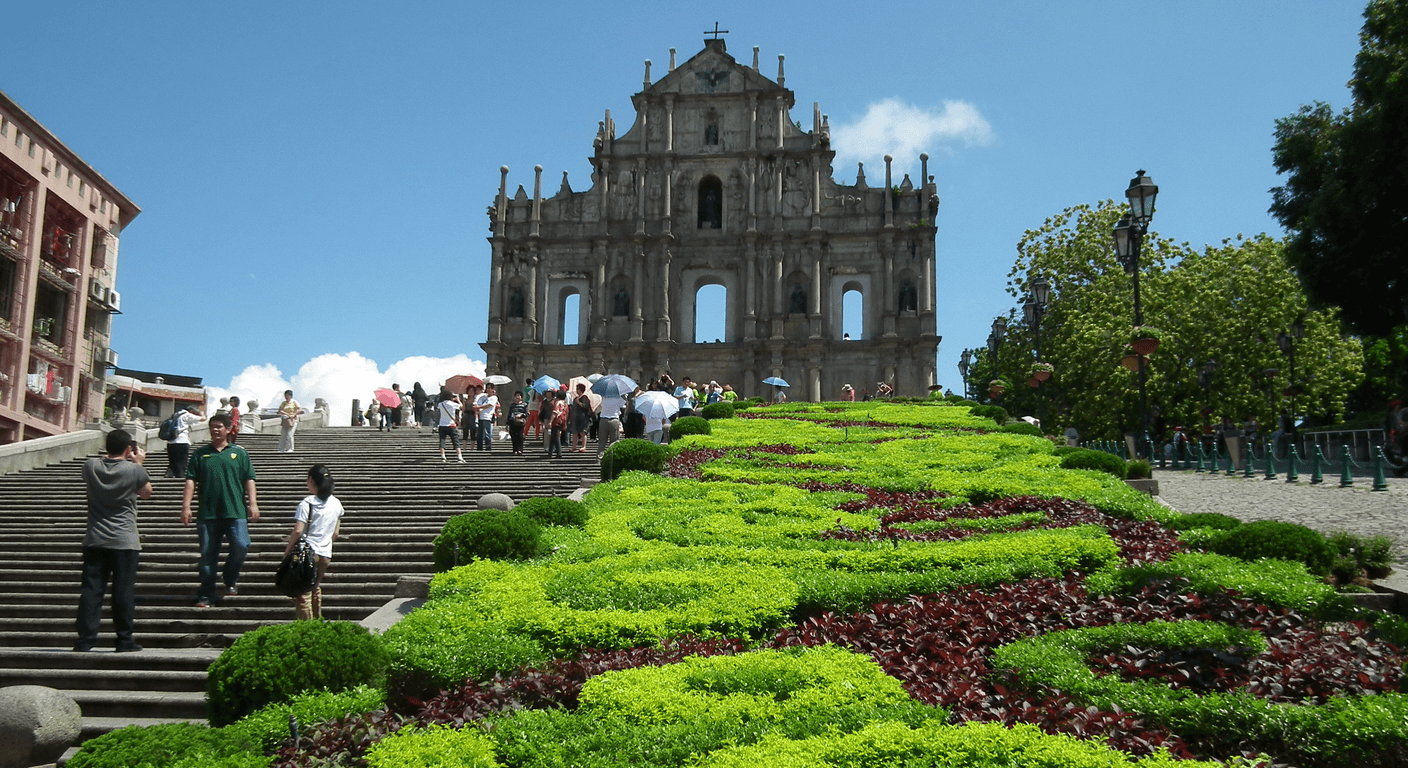
From the square, the pedestrianised Rua da Palha and its connecting lanes lead north toward the Ruins of St Paul's. The facade of the former Cathedral of the Mother of God — all that survived a catastrophic fire in 1835 — stands at the top of a broad stone staircase with enough carved detail to justify twenty minutes of quiet looking. The bronze statuary, the Jesuit symbolism, the Chinese dragons flanking the Virgin Mary — this is a genuinely strange and moving piece of architecture. The Museum of Sacred Art and Crypt beneath the ruins is free, small, and rarely crowded.
Continue uphill to the old Fortaleza do Monte — the 17th-century Portuguese fortress that once fired cannons at a Dutch invasion fleet — for the best elevated view over the historic centre. The Macau Museum sits within the fortress walls and offers a well-curated walk through the territory's layered history, from pre-colonial fishing villages through to the casino era. Allow ninety minutes. Entry fees are modest; confirm current prices at macaotourism.gov.mo.
Quiet Lanes, Egg Tarts, and the Pleasures of Eating Slowly
Macau's food culture is one of Asia's more specific pleasures, shaped by Portuguese, Cantonese, African, and Goan influences in combinations that don't exist anywhere else. The pastéis de nata — egg tarts — are the entry point that everyone mentions, and for good reason. Lord Stow's Bakery in Taipa Village is the most famous source, with a queue that moves quickly and a product that justifies the small wait. The tarts are best eaten warm, standing on the footpath, with a coffee from the adjacent café.
Beyond the egg tarts, Macanese cuisine proper is worth seeking out at a sit-down lunch. Dishes like African chicken (galinha à africana), caldo verde with Chinese sausage, and salt cod in a dozen preparations reflect centuries of trading-port improvisation. Restaurants in the Taipa Village area and along Rua do Cunha tend to be calmer and better value than those immediately adjacent to the tourist sites. A long lunch at a tiled-wall restaurant on a quiet Tuesday afternoon is one of Macau's better experiences, and it costs considerably less than it would at a casino resort.
For travellers who enjoy a proper coffee and a slow morning, the independent cafés tucked into the lanes off Senado Square — some in buildings with original Portuguese tile exteriors — offer a pace that the heritage district rewards. This is not a city that needs to be rushed. The neighbourhood around St Lazarus Church (Igreja de Santo Lázaro), slightly north of the main tourist circuit, has been quietly developing into a small creative precinct with galleries and studios in colonial-era houses. It's the kind of area that repays a wander without a fixed purpose.
Timing Your Visit: Crowds, Cruise Ships, and the Right Season
Macau's historic centre receives an enormous volume of visitors, and crowd management is a genuine part of planning. The Ruins of St Paul's in particular can feel overwhelmed on weekends, public holidays, and on days when multiple cruise ships are docked at the Outer Harbour terminal. Cruise arrivals are generally in the late morning; the crowds thin noticeably after 3pm on most days. A simple tactic is to spend mornings in the quieter southern and eastern parts of the heritage zone — the Maritime Museum, the A-Ma Temple, the Moorish Barracks area — and save Senado Square and St Paul's for the late afternoon.
October to December is the most comfortable season for Australian travellers. Humidity has dropped from its summer peaks, typhoon season has passed, and the light in the late afternoon is genuinely good for the pastel-coloured streetscapes. January and February bring cooler temperatures and the Chinese New Year period, which is festive but extremely busy — not ideal for anyone who finds large crowds tiring. July and August are hot, humid, and typhoon-prone; manageable with air-conditioned museums and midday rest breaks, but not the most comfortable months to be walking cobbled streets.
The Macau Grand Prix typically takes place in November, which transforms parts of the city and fills accommodation quickly. If that's not your scene, check the date and adjust your timing. If it is your scene — the street circuit runs through parts of the historic city — it's a genuinely unusual event to be near.
Where to Stay: Choosing the Heritage Side Over the Strip
This is the single most consequential decision in planning a Macau trip. The casino resorts on the Cotai Strip — the reclaimed land between Taipa and Coloane islands — are engineered for a particular kind of experience: vast, air-conditioned, self-contained, and very far from the old town in atmosphere if not always in distance. They are comfortable and efficiently run. They are also not the reason to come to Macau for its Portuguese heritage.
Staying in or near the historic centre changes the experience entirely. The Pousada de Mong-Há, operated by the Macau Institute for Tourism Studies, is a small heritage guesthouse on a quiet hillside above the city — simple, well-maintained, and staffed by hospitality students who are genuinely attentive. It books out, so plan ahead. Several boutique hotels have opened in and around Taipa Village in recent years, offering a more relaxed base with easy access to the village's restaurants and lanes. The Macau Government Tourism Office website (macaotourism.gov.mo) maintains a current accommodation directory.
Budget considerations: Macau accommodation ranges from genuinely affordable heritage guesthouses to extraordinarily expensive casino hotel suites. For heritage-focused travellers, the mid-range options in Taipa and the old town area represent good value compared to equivalent quality in Hong Kong. Indicative nightly rates for a comfortable, well-located guesthouse or boutique hotel start at around AUD 100–150; confirm current pricing directly with properties, as rates fluctuate with events and demand.
Practical Matters: Entry, Health, and Getting Around
Australian passport holders have historically been able to enter Macau without a visa for stays of up to thirty days, but entry requirements can change and the correct source is always smartraveller.gov.au, not travel blogs or forum posts. Macau operates under a 'one country, two systems' arrangement with its own immigration and customs procedures, separate from mainland China and from Hong Kong. If your itinerary crosses into mainland China at any point, that requires separate visa arrangements. Keep your routing clear before you travel.
The historic centre is navigable entirely on foot, which is one of its genuine advantages for travellers who prefer not to rely on taxis or apps. Free shuttle buses run between the ferry terminals and the major casino resorts; these are available to all passengers, not just guests, and are useful for reaching the Cotai area or the ferry terminal without paying for a taxi. Taxis are metered, generally inexpensive by Australian standards, and drivers usually have a basic card with major landmark names in Chinese characters — useful to show if communication is difficult.
The Macau pataca (MOP) is the local currency, but Hong Kong dollars are accepted almost everywhere in Macau at a near-equivalent rate, which simplifies things if you're combining the two destinations. ATMs are widely available. Medical facilities in Macau are adequate for most needs; the public Conde S. Januário Hospital is the main facility. Travel insurance that covers medical evacuation to Australia or Hong Kong is worth having, particularly for travellers with cardiac or respiratory conditions who are spending time in subtropical humidity.
Quick planning guide
| Ideal pace | Slow-paced, unhurried walking with regular food and rest stops |
|---|---|
| Best months | October to December, when humidity and crowds are most manageable |
| Suggested stay | Two to three days, including a half-day in Taipa Village |
| Mobility level | Easy – the heritage district is flat, compact and fully walkable |
| Cost level | Budget-friendly in the old town; guesthouses/boutique hotels from around AUD 100–150 a night |
| Comfort level | Comfortable, with air-conditioned museums and shaded lanes to offset humid months |
| Best for | Travellers who enjoy history, food and an easy walking pace over big-ticket attractions |
| Main planning consideration | Choosing to base in the historic centre or Taipa rather than the Cotai casino strip |
Key takeaways
- Macau's UNESCO historic centre is a flat, walkable Portuguese colonial precinct that operates entirely separately from the casino resorts — choose your base accordingly.
- October to December is the most comfortable time for Australian travellers: lower humidity, no typhoons, and manageable crowds.
- Cruise ships arrive late morning; the Ruins of St Paul's and Senado Square are significantly calmer before 9am or after 4pm.
- The practical route from Australia is a nine-to-ten hour flight to Hong Kong, then a one-hour high-speed ferry to Macau — a Hong Kong stopover adds real value.
- Australian passport holders should confirm current Macau entry requirements at smartraveller.gov.au before booking, as conditions can change.
- Staying in Taipa Village or the historic centre rather than the Cotai Strip changes the character of the trip entirely — and is often more affordable.
Recommended partners and links
Indicative prices only — always confirm with the operator before booking.
Frequently asked questions
Do Australians need a visa to visit Macau?
Australian passport holders have historically been able to enter Macau visa-free for stays of up to thirty days, but entry requirements can change. Always confirm current conditions at smartraveller.gov.au before booking. Macau has its own immigration system, separate from mainland China and Hong Kong.
How do you get from Hong Kong to Macau?
High-speed ferry services run between Hong Kong and Macau regularly throughout the day, with the crossing taking around 55–70 minutes. The most convenient option for travellers arriving at Hong Kong International Airport is the Skypier terminal within the airport, which allows direct boarding to Macau without clearing Hong Kong immigration. Services include Cotai Water Jet and TurboJET — confirm current schedules and fares before travel.
Is Macau's old town suitable for travellers with mobility considerations?
The main heritage area around Senado Square and the lanes leading to the Ruins of St Paul's is largely flat and well-paved, making it accessible for most travellers who can manage a moderate amount of walking. Some cobbled side streets are uneven, and the staircase to the Fortaleza do Monte is steep. Sturdy, supportive footwear is strongly recommended. The overall mobility rating for the heritage circuit is Easy to Moderate.
What is the best time of day to visit the Ruins of St Paul's without large crowds?
The Ruins of St Paul's are least crowded before 9am and after 4pm on most days. Cruise ship arrivals typically peak around mid-morning, bringing significant visitor volume to the main sites. Visiting the southern heritage sites — the A-Ma Temple and Maritime Museum area — in the morning and saving Senado Square and St Paul's for the late afternoon is a practical strategy.
Can you combine Macau and Hong Kong in one trip from Australia?
Yes, and it's a natural pairing. Most travellers fly into Hong Kong, spend two to three nights there, then cross to Macau by ferry for another two to three nights before returning to Hong Kong to fly home. The ferry journey is straightforward and the two destinations complement each other well. Confirm current entry requirements for both Hong Kong and Macau at smartraveller.gov.au, as they operate separate immigration systems.