New Caledonia offers Australian cruisers an overseas feel without long-haul flying: Sydney to Noumea takes about two and a half hours by air, or two to three sea days by ship, with May to October giving the most reliable weather. The defining highlight is the contrast between Noumea's walkable, French-flavoured town centre and the raw lagoons of Lifou and the Isle of Pines. Noumea is an easy, deep-water walk-off port, while the outer islands are tender stops, making overall mobility moderate and best suited to a multi-port cruise itinerary.
Why New Caledonia Works So Well for Australian Cruisers Over 50
New Caledonia is close — genuinely close. Sydney to Noumea is roughly two and a half hours by air, and cruise ships cover the distance in two to three sea days from the east coast. That matters when you're 69 and not particularly interested in arriving somewhere exhausted before the holiday has properly started. South Pacific itineraries typically depart from Sydney, Brisbane or Melbourne, and most include at least one New Caledonia port as a centrepiece call.
The French connection gives the destination a texture that other Pacific island stops don't quite match. Noumea has proper restaurants, a functioning art museum, patisseries, and a town centre laid out with colonial intention. It doesn't feel like a theme park version of France, but it doesn't feel like rural Queensland either. That cultural specificity — the baguettes, the Kanak art, the slightly formal café service — is genuinely interesting rather than merely photogenic.
The practicalities also stack up. No long-haul jet lag to recover from. Australian dollars convert straightforwardly (the CFP franc is the local currency, but euros and sometimes Australian dollars are accepted in tourist areas — confirm with your bank before departure). Travel insurance for pre-existing conditions is easier to arrange for a Pacific sailing than for a European river cruise. And the sea days between ports give you time to rest, read, or simply watch the Coral Sea pass by.
Noumea: What to Expect When the Ship Docks
Noumea is a proper deep-water port. The ship ties up at the Quai des Armateurs or nearby wharves in the main harbour, and in most cases you walk straight off without the complication of a tender. That alone is worth noting if mobility is any sort of consideration — no bobbing transfer boat, no climbing down a gangway into a small vessel. You're simply ashore.
The town centre is flat and walkable from the wharf. The Moselle waterfront precinct — with its restaurants and market stalls — is a short stroll away, and the Place des Cocotiers, Noumea's central square, is perhaps fifteen minutes on foot. The square has shaded benches, which is not a small thing on a warm Pacific morning. The Musée de Nouvelle-Calédonie on rue Anatole France holds a serious collection of Kanak and Pacific art; entry is inexpensive and the building is air-conditioned. Confirm current hours and admission costs directly with the museum before your sailing date.
A word on language: in the tourist precincts around the waterfront, English is spoken with reasonable frequency. Venture ten minutes further into ordinary suburban Noumea — a pharmacy, a supermarket, a local bakery — and French is the working language, full stop. Basic French phrases go a long way toward a warmer reception. 'Bonjour' and 'merci' are not optional courtesies; they're the price of entry to a decent interaction. A translation app with offline capability is a sensible addition to any shore-day kit.
Lifou: Understanding What a Tender Stop Actually Means
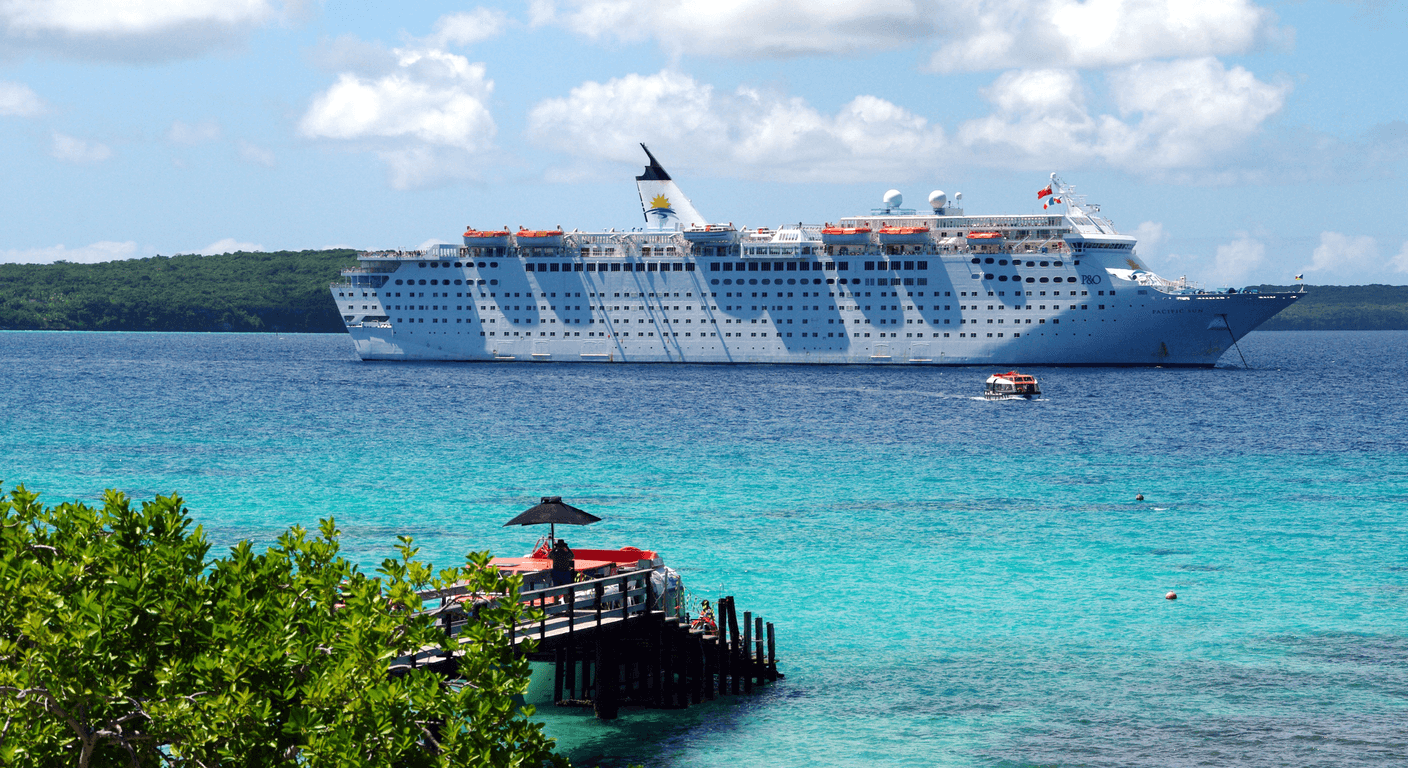
Lifou is the largest of the Loyalty Islands and one of the genuinely beautiful places in the South Pacific — low limestone cliffs, water the colour of a swimming pool advertisement, and a pace of life that makes Noumea feel like central Sydney by comparison. It also has no deep-water port. Ships anchor offshore and passengers transfer ashore by tender: small motorised boats that run back and forth throughout the day.
The tender process is worth thinking about before you decide how much you're looking forward to Lifou. You queue on the ship, board the tender (stepping across a gap between the tender and the ship's platform — often with a crew member's assistance), ride for five to fifteen minutes, and step off onto a floating pontoon or basic jetty. In calm weather and good swell conditions, it's fine. In any kind of chop, it's less comfortable. Ships can and do cancel tender operations if conditions are unsafe — check your ship's daily programme the night before, and don't make the tender call your only plan for the day.
Once ashore at Lifou — typically at Wé or Hnathalo Bay, depending on the itinerary — facilities are limited. There's usually a small craft market, some beach access, and operators offering snorkelling or cultural tours. There's no town to wander, no museum, no air-conditioned café to retreat to. The appeal is the water, the reef, and the quiet. If that's what you came for, Lifou delivers it honestly. If you're not confident in the water or find beach days tiring, a relaxed sea day on the ship might serve you better.
Isle of Pines: The Case for Staying on the Ship (and the Case Against)
The Isle of Pines — Île des Pins in French, Kunie in Kanak — is the one that tends to appear on promotional photographs: the transparent lagoon at Oro Bay, the columnar pines standing like sentinels along the shoreline, the canoes. It earns those photographs. It's also, like Lifou, a tender stop, with all the same caveats about conditions and limited infrastructure.
The main draw is Oro Bay and the natural pool at the Piscine Naturelle — a shallow tidal lagoon reached by a short walk through pine forest from the tender landing. The path is largely flat but can be uneven underfoot, and it's exposed in the middle of the day. The natural pool itself is remarkable: waist-deep, crystal clear, and calm enough for non-swimmers to feel comfortable wading. It's one of those places that genuinely rewards the effort of getting there.
The village of Vao has a small market and the Saint-Maurice Church, which dates to the 1860s and has a quiet dignity about it. English is spoken even less frequently here than in Noumea — the working languages are French and Kanak. That's not a problem, but it's worth knowing. The Isle of Pines is not a day for complex transactions or detailed conversations with locals unless you have some French. It's a day for the lagoon, a good book, and a long lunch back on the ship.
How to Check Exactly What Your Itinerary Includes
This is the detail that catches people out. Not every South Pacific cruise that markets itself as a 'New Caledonia sailing' calls at all three ports. Some include only Noumea. Some include Noumea and one outer island. A handful include all three. The port combination matters enormously in terms of what kind of experience you're buying.
Before booking, download the full itinerary PDF from the cruise line's website and read every port day carefully. Look for the word 'tender' next to any port name — it's usually disclosed in the fine print of the itinerary details, though not always prominently. If you're booking through a travel agent, ask them to confirm in writing which ports are included and which involve tender transfers. Cruise line websites generally publish this information on the individual sailing's itinerary page; the New Caledonia Tourism website (newcaledonia.travel/au) is also useful for understanding what each island offers before you commit.
It's also worth checking whether your cruise line offers pre-booked shore excursions for each port. At Noumea, independent exploration is easy and often preferable — the town is navigable without a guide, and ship's tours tend to be priced at a significant premium over doing the same thing yourself. At Lifou and the Isle of Pines, the calculus is different: a ship's excursion that includes tender priority boarding can be worth considering, particularly if mobility or time management is a factor.
Practical Matters: Currency, Health and Getting the Most from Sea Days
The local currency is the CFP franc (XPF), pegged to the euro. In tourist areas around the Noumea waterfront, euros and sometimes Australian dollars are accepted, but you'll get a better result using CFP or a card with no international transaction fees. Check with your bank before departure — some Australian travel cards perform well here, others less so. ATMs are available in Noumea; there are essentially none at the outer-island tender stops. Carry small amounts of local cash for market purchases ashore.
Health considerations are straightforward by Pacific standards. New Caledonia is generally low-risk for tropical illness, though dengue fever has been present in the region — confirm current health advice with the Australian Department of Foreign Affairs and Trade (smartraveller.gov.au) before sailing, as conditions change. Sun protection on tender days and at beach stops is not optional at this latitude; a broad-brimmed hat, high-SPF sunscreen and a light long-sleeved layer are the sensible kit. Travel insurance that covers pre-existing medical conditions is essential — not a suggestion. Several Australian insurers specialise in cover for travellers over 60; compare policies before you book the cruise, not after.
The sea days on a South Pacific itinerary are genuinely part of the experience. The Coral Sea has a particular quality of light — wide, soft, surprisingly not-tropical in the way it behaves — and watching it from a deck chair with something cold to drink is a legitimate way to spend a morning. If you've been travelling solo, sea days also tend to be when shipboard friendships consolidate over breakfast or a shared interest in whatever's showing in the cinema. Don't fill every sea day with activities. The ship is going somewhere interesting; you don't need to be going anywhere in particular.
Solo Travel Considerations on a South Pacific Cruise
Cruising solo from Australia to New Caledonia is one of the more socially comfortable travel formats available. The single-supplement question — that familiar irritant — varies considerably by cruise line and cabin grade. Some lines have introduced dedicated solo cabins at no supplement; others charge a supplement of 25 to 100 per cent on a double cabin rate. Ask specifically about solo cabin availability when you enquire, and compare across two or three lines before deciding.
Onboard, solo travellers over 50 are far from unusual on South Pacific sailings. Most ships of any size have a solo travellers' meet at the start of the voyage, and the dining room usually offers communal tables for those who want company rather than a table for one. Shore days at Noumea are uncomplicated solo — the town is safe, well-signed and easy to navigate independently. At the outer islands, joining a small group tour means you're not wandering alone on an island with limited facilities, which is a sensible precaution rather than a compromise.
The honest truth about cruising solo in your late sixties is that it's considerably less lonely than some alternatives. You have your own cabin, your own schedule, and a built-in social environment whenever you want it. New Caledonia's mix of French-inflected culture and Pacific quiet suits a traveller who's comfortable with his own company but open to conversation. The patisserie in Noumea doesn't require a travel companion. The lagoon at the Isle of Pines is no less beautiful for being enjoyed alone.
Quick planning guide
| Ideal pace | Slow-paced, with sea days built in for rest |
|---|---|
| Best months | May to October, for lower humidity and clearer skies |
| Suggested stay | Part of a broader multi-port South Pacific cruise itinerary |
| Mobility level | Easy at Noumea (flat, walk-off port); more demanding at Lifou and Isle of Pines, which require tender transfers over uneven paths |
| Cost level | Mid-range — CFP franc with limited ATMs at outer islands, so carry cash ashore |
| Comfort level | Good in Noumea (cafés, museum, shade); basic at Lifou and Isle of Pines, where facilities are limited |
| Best for | Australian cruisers over 50, including solo travellers, wanting a short-haul Pacific escape with a French cultural edge |
| Main planning consideration | Confirm the exact ports and whether each is a deep-water berth or tender stop before booking |
Key takeaways
- Noumea is a deep-water berth — you walk off the ship; Lifou and the Isle of Pines are tender stops with limited facilities and weather-dependent access.
- Not all New Caledonia cruises call at all three ports — confirm your itinerary's exact port list before booking.
- Basic French is genuinely useful beyond Noumea's tourist waterfront; a translation app with offline mode is practical kit.
- Travel insurance covering pre-existing conditions should be arranged before you book the cruise, not as an afterthought.
- Solo travellers over 50 are well accommodated on South Pacific sailings — ask specifically about solo cabin availability to avoid heavy supplements.
- May to October offers the most reliable weather for New Caledonia cruise calls, with lower humidity and clearer skies.
Recommended partners and links
Indicative prices only — always confirm with the operator before booking.
Frequently asked questions
Do all New Caledonia cruises include Noumea, Lifou and the Isle of Pines?
No. Itineraries vary significantly between cruise lines and voyage lengths. Some sailings call only at Noumea; others add one or both outer islands. Always read the full itinerary detail — including which ports involve tender transfers — before booking, and confirm in writing with your travel agent or cruise line.
What is a tender stop and does it affect passengers with limited mobility?
A tender stop means the ship anchors offshore and passengers transfer to the island by small motorised boat. Boarding involves stepping across a gap between the ship and the tender, which can be challenging with limited mobility or in rough conditions. Tender operations can be cancelled if sea conditions are unsafe. Passengers with significant mobility limitations should discuss tender stops with the cruise line before booking.
What currency should you use in New Caledonia?
The local currency is the CFP franc (XPF), pegged to the euro. Euros are accepted in some tourist areas, and a travel card with no international transaction fees is useful in Noumea. ATMs are available in Noumea but essentially absent at Lifou and the Isle of Pines — carry small amounts of local cash for market purchases at outer-island stops. Confirm currency arrangements with your bank before departure.
Is English widely spoken in New Caledonia?
English is spoken in tourist precincts around the Noumea waterfront, but French is the working language everywhere else — including ordinary shops, pharmacies and supermarkets in Noumea, and almost universally at Lifou and the Isle of Pines. Basic French phrases improve interactions considerably. A translation app with offline capability is a practical addition for shore days.
What is the best time of year to cruise to New Caledonia from Australia?
May to October is the dry season in New Caledonia, with lower humidity, lower rainfall and more reliably clear skies — the most comfortable period for both sea days and shore excursions. November to April is warmer and wetter, with a higher risk of tropical weather affecting tender operations. Most Australian cruise lines concentrate their Pacific schedules in the May-to-October window.
- New Caledonia Tourism — Official Tourism Site for Australian Visitors
- Smartraveller — New Caledonia Travel Advice (Australian Government, DFAT)
- Carnival Cruise Line Australia (formerly P&O Cruises Australia) — South Pacific Itineraries
- Princess Cruises Australia — Pacific Sailings
- Royal Caribbean Australia — Pacific Itineraries