Northern Vietnam's classic Hanoi–Ninh Binh–Ha Long Bay–Sapa circuit suits travellers over 50 best in September–October (cooler, clearer skies) or late March–April. Allow 10–12 days rather than the rushed seven. Mobility rating is Moderate to Active depending on choices: the Hang Mua climb and Ha Long cave steps are demanding; both can be skipped or modified. Access from Melbourne, Sydney, Brisbane or Perth requires one stop (Singapore, Kuala Lumpur or Bangkok), roughly 9–11 hours flying plus a layover, and a recovery night in Hanoi on arrival.
Getting There: The Flight Reality from Australian Cities
There are no direct flights from any Australian capital to Hanoi. Full stop. Every routing requires at least one stop — Singapore (Changi), Kuala Lumpur (KLIA), Bangkok (Suvarnabhumi) or Hong Kong are the most common hubs — and the total door-to-door time from Melbourne or Sydney runs roughly 14–18 hours depending on the connection. From Perth it's marginally shorter via Singapore. From Brisbane, allow a little longer. The flying itself is 9–11 hours in the air; the rest is waiting, walking and airports.
That matters not as a complaint but as a planning fact. A 10pm arrival into Noi Bai International Airport after a long day of travel is not the moment to start a seven-day sprint. Book a decent hotel for the first night — something close to the Old Quarter, roughly AUD $100–$180 a night for a solid three-star option — and treat Day 1 as a recovery day. Breakfast in the hotel, a gentle walk around Hoan Kiem Lake in the late afternoon, an early dinner of bun cha or pho at a proper sit-down restaurant. That's your Day 1. Anyone who tells you otherwise is selling you something.
Jet lag from Australia to Vietnam is less savage than Europe — the time difference from Melbourne is only three hours — but the accumulated fatigue of a long-haul connection is real. If you have a pre-existing cardiac or respiratory condition, factor that into your travel insurance. The Australian government's Smartraveller site (smartraveller.gov.au) has current health advisories for Vietnam; check it before you book and register your trip once you have.
Hanoi: Two Nights Minimum, Three is Better
Hanoi rewards people who slow down. The Old Quarter's 36 streets, the Temple of Literature, the Ho Chi Minh Mausoleum complex, the Vietnamese Women's Museum — none of these require athletic legs. What they require is time. Two nights gets you the surface. Three nights lets you actually sit in a bia hoi corner seat at dusk, watch the city negotiate itself, and feel like you've arrived.
The Old Quarter itself is not mobility-friendly by Western standards. Footpaths are narrow, often occupied by motorbikes and street vendors, and frequently broken. Comfortable walking shoes with a solid sole are essential — not sandals, not fashion trainers. The streets around Hoan Kiem Lake are flatter and easier to manage. If you're travelling with a partner whose knees are less reliable, a cyclo (the three-wheeled pedalled rickshaw) for an hour through the old streets is a legitimate and genuinely pleasant alternative to walking the whole thing.
For a 73-year-old traveller, Hanoi's food culture is one of the genuine pleasures. A cooking class here is far more practical than the onboard version offered on some Ha Long cruises — you're seated, the pace is set by the instructor, and the kitchens are purpose-built. Ask your hotel to recommend one near the Old Quarter rather than booking a generic tour-desk option.
Ninh Binh and the Hang Mua Climb: What the Videos Don't Tell You
Ninh Binh — about 1.5 hours south of Hanoi by private car or public bus — is legitimately one of the most beautiful places in northern Vietnam. Limestone karsts rise out of rice paddies. The Tam Coc boat ride through the caves is slow, flat and genuinely serene — a rower propels you through low cave openings and past water buffalo standing in the shallows. It's one of the great easy pleasures of the circuit.
Then there's Hang Mua. Every travel video about this route ends with a triumphant shot from the top of Hang Mua viewpoint: a sea of karsts, a river below, golden light. What the videos don't linger on is the 500-odd uneven stone steps to get there, many of them steep, some of them slick, most of them without adequate handrails. The descent is harder than the ascent. For anyone with knee replacements, hip issues, significant arthritis or a general wariness of uneven terrain — and that's a large portion of travellers over 70 — Hang Mua is a genuine risk, not a casual detour. The view from the rice paddies below, looking up at the karsts from the boat or from the flat path beside the Ngo Dong River, is its own reward. You don't need to climb anything to appreciate Ninh Binh.
Ninh Binh to Ha Long Bay is roughly four hours by road. That's a long coach or car day, particularly if you've already done Hanoi to Ninh Binh the day before. A private car is worth every dong over a shared minibus — you control the stops, the air conditioning, and the pace. Indicatively, a private car transfer for this leg runs around AUD $80–$130; confirm current pricing with your accommodation or a reputable local operator.
Ha Long Bay: Which Boat, and What the Standard Inclusions Actually Involve
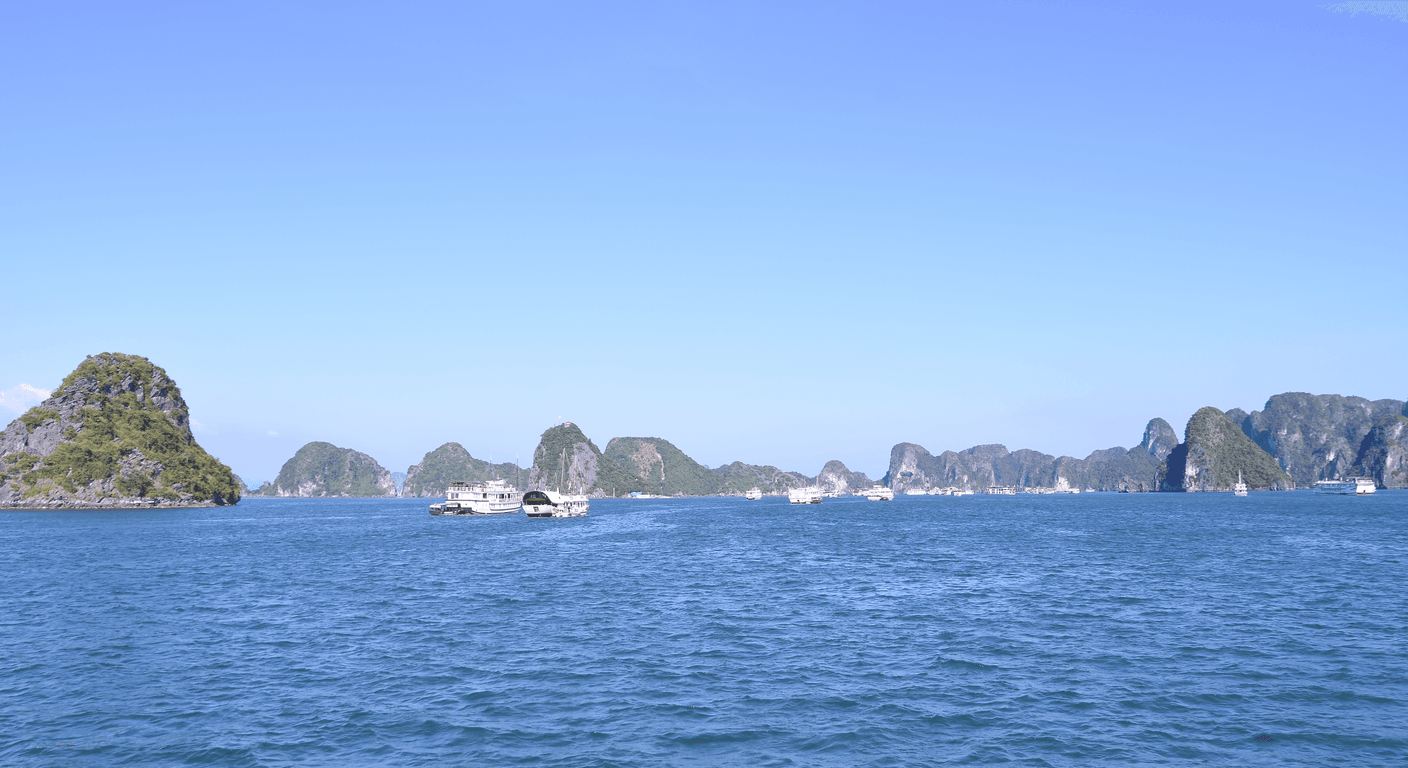
Ha Long Bay has more than 300 licensed overnight cruise boats operating simultaneously in peak season. That's not a criticism — it's a planning fact. The bay is vast enough to absorb them, but the cheaper, larger boats cluster in the most photographed spots and the result is a floating traffic jam at sunrise. The answer is a smaller boat, a longer itinerary (two nights rather than one), and a departure that goes into the less-visited Lan Ha Bay section. This costs more. It's worth it.
For a mid-range overnight cruise — the kind with proper en-suite cabins, a sundeck, and meals included — budget indicatively around AUD $400–$700 per person for two nights, depending on the operator and season. Confirm directly. The standard inclusions on most cruises include kayaking, a cave visit (Sung Sot Cave involves a steep, uneven climb of several hundred steps — ask about this specifically before booking), and sometimes a cooking demonstration. Kayaking from a low-sided kayak is a real physical demand; many operators offer bamboo boat alternatives. The cooking class is usually done seated and is perfectly manageable. Ask the operator specifically which activities are optional and which are built into the schedule.
Cabin access matters. Some older boats have steep internal stairs to the lower-deck cabins. Ask whether there's a lift or a cabin accessible without stairs. This is not a niche request — it's a reasonable question any reputable operator should answer without hesitation. If they can't, that tells you something.
The Sleeper Train to Sapa — or the Expressway. Which Suits Whom.
The overnight sleeper train from Hanoi to Lao Cai — the gateway town for Sapa — departs around 10pm and arrives before 6am. The journey takes roughly 8–9 hours on the standard service. A soft-sleeper cabin has four berths in a compartment; a private two-berth cabin costs more and is available on some carriages. The experience is genuinely atmospheric — the train climbs through the Red River valley in the dark, and you arrive in mountain cool with the ridge lines already catching the early light. For a traveller in good health who sleeps adequately on trains and has no significant mobility issues boarding and finding a berth, this is a memorable way to travel.
For everyone else — and that includes anyone with a bad back, a tendency toward insomnia in unfamiliar settings, or simply a preference for arriving rested — the new Hanoi–Lao Cai expressway has changed the calculus entirely. A private car on the expressway takes roughly 5–6 hours and a daytime departure means you see the valley you're passing through. You arrive in daylight, you can stop for lunch, and you step out at Sapa without the stiffness of a night folded into a train berth. The cost is higher than the train; roughly AUD $80–$150 for a private transfer, indicative only — confirm with operators.
Sapa itself sits at around 1,600 metres. The air is cooler and thinner than Hanoi. The hill-tribe villages — Cat Cat, Ta Van, Lao Chai — involve walking on uneven, often muddy paths through rice terraces. A guided walk to the nearest village is manageable at a moderate pace; the longer treks to the farther villages are genuinely strenuous. August brings the rice harvest, which is spectacular — bright green terraces ready to turn gold — but also peak humidity and afternoon rain. September–October is cooler and clearer. Both have their argument.
Seven Days or Ten? The Honest Case for Stretching It
The seven-day version of this circuit exists because it fits neatly into a fortnight's leave. It doesn't exist because it's the right pace for the distance involved. Hanoi to Ninh Binh to Ha Long to Sapa, done in seven days, means you're moving accommodation every one or two nights, spending significant time in cars and boats, and arriving in each place slightly too tired to fully enjoy it. The circuit is genuinely wonderful. The pace is the variable you can control.
Add three days and the whole thing breathes. An extra night in Hanoi to recover from the flight. A rest afternoon in Ninh Binh before the boat cruise. A second night on Ha Long to catch a different part of the bay. A full day in Sapa without an agenda. That's 10–12 days, and it costs more in accommodation and tour-day fees, but it's the version that comes home with good memories rather than a vague sense of having been rushed through something beautiful. For a 73-year-old traveller — or anyone over 60 who takes their body seriously — the rest day is not a luxury. It's the thing that makes the rest of the trip work.
The honest cost band for a well-organised 10-day version: indicatively AUD $5,000–$8,500 per person, including return economy airfares from Melbourne or Sydney, mid-range hotels throughout, private transfers, a quality two-night Ha Long cruise, and guided activities. Business-class flights add roughly AUD $2,000–$3,500 per person depending on the carrier and timing. All figures are indicative; confirm every component with your operator or travel agent. There's no shame in using a Vietnam specialist travel agent for this circuit — the logistics are real and the local knowledge saves more than the agency fee.
Solo or Together: Two Different Trips on the Same Route
A solo traveller's perspective. The Ha Long overnight cruise is where solo pricing bites hardest. Most cabin-style cruise boats price their cabins for two occupants; a solo traveller takes a double cabin alone and pays a single supplement. That supplement varies — some operators charge 50% extra, others charge the full double rate — but the result is that a two-night cruise that costs AUD $500 per person in a shared cabin can cost AUD $700–$850 for a solo booking. Ask directly before you book, and ask whether there's a share-match programme (rare on Ha Long boats, but worth asking). The sleeper train to Sapa has a similar dynamic: a four-berth soft sleeper means sharing with strangers, which some solo travellers enjoy and others don't. Private two-berth cabins exist on some services and are worth the premium for solo travellers who'd rather not work through that social negotiation at midnight. On safety: Vietnam is generally considered safe for solo travellers, but common sense applies in the Old Quarter at night — petty theft exists, and bag-snatching from motorbikes is a known risk. Keep your bag on the inside, away from the road.
A couple's perspective. The pace debate is real. On a circuit like this — moving through four distinct places in 10 days — the traveller who wants to linger and the traveller who wants to tick things off will eventually need to negotiate. The Hang Mua viewpoint is a classic flashpoint: one partner wants to climb it, the other's knees say no. The honest answer is that they don't both have to do the same thing. One person climbs; the other takes the flat riverside path and meets them at the bottom with a cold drink. This is not a compromise. This is a good travel partnership. The overnight cruise is genuinely romantic in the right conditions — a smaller boat, a quiet bay, a sundeck at dusk — and is probably the highlight of the circuit for most couples. Book the best cabin you can afford. The price difference between a standard and a deluxe cabin is often smaller than you'd expect, and the difference in experience is not.
Quick planning guide
| Ideal pace | 10–12 days with private transfers and at least one full rest day in Hanoi |
|---|---|
| Best months | September–October (Ha Long visibility, manageable heat); late March–April (Sapa greenery, mild). August for Sapa rice harvest but expect high humidity and crowds. |
| Suggested stay | Hanoi 2–3 nights, Ninh Binh 1–2 nights, Ha Long Bay 1–2 nights (overnight cruise), Sapa 2–3 nights |
| Mobility level | Moderate — Easy if you skip Hang Mua and choose a boat with good deck access; Active if you do the full climb and cave circuits |
| Cost level | Indicative AUD $3,500–$6,500 per person for 10 days (flights, mid-range hotels, guided tour or private transfers, Ha Long cruise). Confirm all current pricing with operators. |
| Comfort level | High if you book well. Mid-range overnight cruises and Sapa lodge hotels are genuinely comfortable. Budget choices on this circuit are harder on the body. |
| Best for | Couples seeking cultural depth; solo travellers comfortable with structured touring; those who prefer private transport over group coaches |
| Main planning consideration | No direct flights from any Australian city to Hanoi. A recovery night on arrival is non-negotiable. Stretching seven days to ten changes the whole experience. |
Key takeaways
- There are no direct flights from any Australian city to Hanoi — allow a one-stop connection of 14–18 hours total and book a recovery night on arrival.
- The Hang Mua viewpoint climb near Ninh Binh involves around 500 uneven stone steps with limited handrails; the Tam Coc boat cruise is a flat, accessible alternative that stands on its own.
- On Ha Long Bay, a smaller boat on a two-night itinerary in Lan Ha Bay is worth the higher cost over a budget one-night cruise with 300 other boats.
- The sleeper train to Sapa is atmospheric for healthy sleepers; the expressway by private car is the better choice for anyone who values arriving rested.
- Stretching the circuit from seven days to ten or twelve changes the quality of the experience more than any single upgrade to hotels or transport.
- Solo travellers should ask directly about single supplements on Ha Long cruises — some operators charge the full double-cabin rate, which can add AUD $200–$300 to the cruise cost.
Recommended partners and links
Indicative prices only — always confirm with the operator before booking.
Frequently asked questions
Do Australians need a visa for Vietnam in 2025–26?
As of 2025, Australian passport holders can apply for a 90-day e-visa through the official Vietnamese immigration portal (evisa.xuatnhapcanh.gov.vn). Visa rules can change; confirm current requirements at smartraveller.gov.au and with the Vietnamese embassy before you book flights.
What is the best time of year to visit Northern Vietnam for travellers over 50?
September and October are generally the most comfortable months for the full Northern Vietnam circuit — Ha Long Bay has clearer skies after the summer haze, temperatures in Hanoi and Ninh Binh are manageable, and Sapa's terraces are still green before the October harvest. Late March to April is also good. August is hot and humid throughout, with heavy afternoon rain in Sapa, though the rice harvest is at its most photogenic.
Is Ha Long Bay suitable for travellers with mobility limitations?
Ha Long Bay can be done comfortably if you choose the right boat and ask the right questions. The main mobility demands are cave steps (Sung Sot Cave in particular involves a steep climb), getting in and out of kayaks, and boarding the boat via a gangway that may not have a rail. Ask the operator specifically about cabin stair access, cave alternatives, and whether bamboo boat alternatives to kayaking are included. Many reputable operators accommodate these requests without fuss.
Is the overnight sleeper train to Sapa suitable for older travellers?
The overnight train from Hanoi to Lao Cai is a good option for travellers who sleep reasonably well on trains and have no significant back, hip or mobility issues. The berths are narrow, the compartments are shared in soft-sleeper class, and boarding requires working through a step up from the platform. For travellers who prefer to arrive rested and in daylight, a private car on the Hanoi–Lao Cai expressway (roughly 5–6 hours) is the more practical alternative.
What should I budget for a 10-day Northern Vietnam trip from Australia?
A well-organised 10-day Northern Vietnam circuit — including return economy airfares from Melbourne or Sydney, mid-range hotels, private transfers, a quality two-night Ha Long Bay cruise, and guided activities — runs indicatively around AUD $5,000–$8,500 per person. Business-class flights add roughly AUD $2,000–$3,500 per person on top. All figures are indicative only; confirm every component with your operator or travel agent before booking.