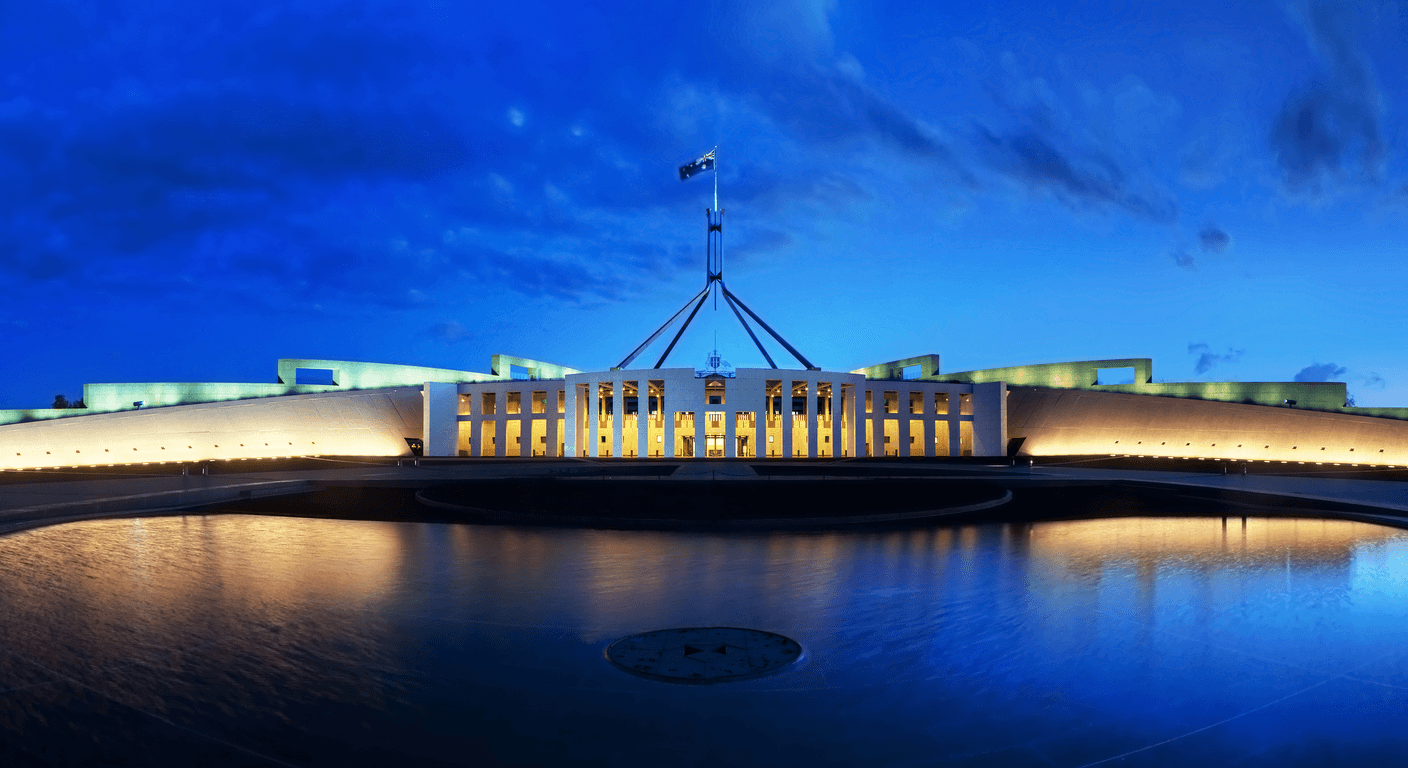
Parliament House in Canberra offers free daily guided tours through its marble foyer, Great Hall and both parliamentary chambers, best visited in autumn (March to May) when the city's deciduous trees turn and the weather stays mild and dry. Allow about two unhurried hours to properly take in the Sidney Nolan tapestry and Aboriginal-designed mosaic floor. The building is Easy-rated for mobility, with lifts, step-free entry and accessible seating throughout. From Melbourne, it's a 50-minute flight or a long day's drive via the Hume Highway.
Why Parliament House rewards a proper visit
There's a particular pleasure in walking into a building that belongs to every Australian and being told, firmly and politely, that it's yours to explore. Parliament House opened in 1988 after a design competition won by Romaldo Giurgola, and the building's most quietly radical idea is that the public walks over the top of it — the grass-covered roof is a lawned hill you can climb, looking out across the parliamentary triangle to the Brindabella Ranges.
Inside, the building is larger than it appears from the forecourt. The marble-floored foyer alone takes several minutes to cross properly, and the inlaid mosaic floor — based on an Aboriginal design by Michael Nelson Jagamara — is easy to rush past without realising what you're looking at. The guided tours exist precisely to stop that happening. A good guide will point out the symbolism woven into every corridor: the timber species chosen for each chamber, the reason the Senate is red and the House green, the quiet argument being made in stone and glass about who holds power in this country.
For travellers who spent decades watching the six o'clock news and wondering what the building actually looked like inside, this is the visit that answers it. There's no admission fee, no timed-entry pressure, and the café is perfectly decent. It's one of the more civilised ways to spend a morning in Australia's capital.
What the free guided tours actually cover
Parliament House offers free guided tours daily, typically running multiple sessions throughout the morning and early afternoon. The standard tour covers the marble foyer, the Great Hall with its Sidney Nolan tapestry, the House of Representatives chamber and the Senate chamber — roughly 45 minutes to an hour at a comfortable pace. Confirm current tour times directly with Parliament House before you travel, as schedules vary on sitting days and public holidays.
The Great Hall tapestry is the detail that stops most visitors mid-stride. Designed by Arthur Boyd and woven in Edinburgh, it measures 20 by 9 metres and depicts the Australian landscape in extraordinary textural detail — gum trees, parrots, drought-cracked earth. It hangs at one end of a room that can seat 200 for a state dinner, and seeing it without a crowd around you, in the quiet of a mid-week morning, is one of those experiences that doesn't need embellishment.
Self-guided visits are also perfectly viable. The building is well-signed, accessible information is available at the main desk, and staff throughout the building are accustomed to answering questions. Some travellers do the guided tour first, then spend another hour wandering back through areas they want to linger in. That two-hour total is about right — enough to feel the building properly without exhausting yourself before lunch.
Question Time: watching democracy at close range
On parliamentary sitting days, the public galleries above both chambers open for Question Time — and it's worth planning your Canberra visit around a sitting day if you can. The sitting calendar is published on the Parliament of Australia website well in advance. Gallery passes for Question Time are free but must be booked ahead; demand spikes significantly when a political controversy is running hot, which in Australian politics is not infrequent.
The experience itself is louder, faster and more theatrical than television conveys. The chamber acoustics carry every interjection, the Speaker's calls for order boom across the gallery, and the chamber fills with colour in a way the broadcast cameras flatten. For anyone with an interest in how Australian political life actually functions — or anyone who grew up watching it from a distance and always wondered — sitting in that gallery is genuinely arresting.
A practical note: gallery seating is tiered and accessed via stairs in some sections, though accessible seating is available. Bags are not permitted in the galleries and must be left in the cloakroom. Security screening at the main entrance is airport-style — shoes stay on, but bags go through the scanner — so allow extra time on sitting days when queues can build. Confirm all current access arrangements with Parliament House directly.
Getting there from Melbourne and regional Victoria
From Melbourne, Canberra is around 650 kilometres by road — a long day's drive that many grey nomads fold into a broader east-coast route, stopping in Albury or Wagga Wagga along the way. The Hume Highway is well-maintained and the drive through the Southern Tablelands is genuinely pleasant in autumn, when the deciduous trees planted around Canberra's suburbs turn gold.
Flying is the practical choice for a day trip or short stay. Rex Airlines and Qantas both operate Melbourne–Canberra services, with flight times around 50 minutes. Fares vary considerably by booking window; indicative economy prices start from around $120 one-way but confirm current pricing directly with airlines. Canberra Airport is compact and easy to navigate, with taxis, rideshare and the Route 11 bus connecting to the city.
From central Canberra, Parliament House is on Capital Hill, about four kilometres from the city centre. Transport Canberra buses serve the area — the Route 2 and Route 3 services are worth checking — and taxis and rideshare are readily available. The building's forecourt is a flat, wide approach with no steps to the main entrance. For travellers arriving by coach, Murrays and Greyhound both operate Canberra services from Sydney and Melbourne; confirm current schedules and stops.
Practical comfort: what to expect inside the building
The building is fully climate-controlled, which matters in Canberra — the capital's winters are genuinely cold, with overnight temperatures regularly dropping below zero, and summers can tip into the high thirties. The internal temperature stays consistent year-round, so the building is as comfortable in July as it is in February. Wear layers in winter for the walk between your accommodation and the entrance.
Lifts serve all levels, and the main circulation routes are wide and step-free. The marble floors are smooth and even. Seating is available in the foyer, the Great Hall and the café, so there's no pressure to keep moving if you need to rest. The on-site café and the Members' Hall offer spots for a coffee or light lunch — the food is straightforward but the setting, looking out over the parliamentary gardens, is pleasant.
Cloakroom facilities are available near the entrance, which is useful if you've arrived with a larger bag. Photography is permitted in most public areas, though not in the chambers during proceedings. Mobile phones must be silenced in gallery areas. The security staff are professional and courteous; the process moves quickly outside sitting day peaks.
Pairing Parliament House with Canberra's other free cultural institutions
Parliament House sits within Canberra's parliamentary triangle, which concentrates an extraordinary number of free or low-cost cultural institutions within a short distance of each other. The National Gallery of Australia, on the lake's edge about 1.5 kilometres from Parliament House, holds the country's most significant collection of Australian and international art — entry to the permanent collection is free, and the building itself is worth the walk. Confirm any ticketed exhibitions separately.
The National Museum of Australia is a short drive or bus ride north along the lake shore. Its permanent galleries on Australian history, culture and identity are free and thoughtfully curated — allow at least two hours there as well. For Italian-Australian travellers with an interest in migration history, the museum's sections on post-war immigration are particularly resonant, covering the waves of European arrivals who shaped mid-twentieth-century Australia.
A two-night stay in Canberra gives you time to do all three institutions without rushing any of them. The capital has a range of accommodation from budget to boutique; the Forrest and Barton neighbourhoods, close to the parliamentary triangle, are convenient and quieter than the CBD. Canberra's restaurant scene has improved considerably in recent years, with a number of good Italian and modern Australian options worth researching before you book.
A word on timing and planning your visit
Autumn — March to May — is widely considered the finest time to visit Canberra. The city's deciduous trees, planted in abundance around the lake and suburbs, turn in earnest through April, and the weather is mild and dry. Floriade, the spring flower festival, draws large crowds in September and October; if you're coming specifically for Parliament House, the shoulder weeks around Floriade give you the colour without the congestion.
Check the parliamentary sitting calendar on the APH website before you finalise your dates. Sitting weeks are busier and Question Time passes go quickly, but they also give the building an energy that non-sitting days lack. Conversely, non-sitting days are quieter, guided tours run to schedule, and you can move through the chambers at your own pace without the additional security arrangements that sitting days require.
Travel insurance is worth reviewing carefully before any trip, particularly for travellers with pre-existing conditions. A Canberra day trip from Melbourne is low-risk by most measures, but having appropriate cover in place is simply good practice. Confirm your policy covers you for domestic travel and any medical needs before you depart.
Quick planning guide
| Ideal pace | Slow and unhurried — no timed entry or rushing required |
|---|---|
| Best months | March to May (autumn), for mild weather and autumn colour |
| Suggested stay | Two hours for the building alone; two nights to pair with the National Gallery and National Museum |
| Mobility level | Easy — lifts to all levels, step-free entrance, accessible gallery seating |
| Cost level | Free entry and free guided tours; only extras are food, transport and accommodation |
| Comfort level | Fully climate-controlled with ample seating in the foyer, Great Hall and café |
| Best for | History-minded travellers, grey nomads on an east-coast route, and anyone wanting to see Question Time in person |
| Main planning consideration | Book Question Time gallery passes ahead on sitting days and confirm current tour times with Parliament House before travelling |
Key takeaways
- Entry to Parliament House and all daily guided tours is free — no booking required except for Question Time gallery passes on sitting days.
- The Great Hall's Sidney Nolan tapestry, at 20 by 9 metres, is one of the largest and most significant artworks in any public building in Australia.
- Question Time in the public gallery is louder, faster and more theatrical than the television broadcast suggests — book gallery passes in advance via the APH website.
- The building is Easy-rated for mobility: lifts serve all levels, the main entrance is step-free, and accessible seating is available in the galleries.
- Two unhurried hours is the right amount of time for a thorough visit; pair it with the National Gallery of Australia, 1.5 kilometres away, for a full cultural day.
- Autumn (March to May) offers Canberra's best weather for a visit — mild, dry and coloured by the city's deciduous trees.
Recommended partners and links
Indicative prices only — always confirm with the operator before booking.
Frequently asked questions
Is Parliament House Canberra really free to visit?
Yes. Entry to Parliament House is free for everyone, and the daily guided tours of the chambers, Great Hall and foyer cost nothing. Question Time gallery passes are also free but must be booked in advance through the Parliament of Australia website. Confirm current arrangements at aph.gov.au before you travel.
How do I get a pass to watch Question Time at Parliament House?
Gallery passes for Question Time are free and available through the Parliament of Australia website at aph.gov.au. They must be booked in advance, and availability tightens quickly when a high-profile issue is before the parliament. Check the sitting calendar on the same website to find out when parliament is in session.
Is Parliament House accessible for travellers with limited mobility?
Parliament House is well-suited to travellers with mobility considerations. Lifts serve all levels, the main entrance and primary circulation routes are step-free, and accessible seating is available in the public galleries. Security screening is airport-style but moves efficiently. Confirm specific accessibility needs directly with Parliament House at aph.gov.au.
How long should you allow for a visit to Parliament House?
Two hours is a comfortable and thorough amount of time — enough for the guided tour, a leisurely look at the Great Hall tapestry and foyer, and a coffee in the café. If you're visiting on a sitting day and attending Question Time, allow additional time for security queuing and the session itself, which typically runs around an hour.
What is the best way to get to Parliament House from Melbourne?
Flying is the most practical option for a day trip or short visit. Rex Airlines and Qantas both operate Melbourne–Canberra flights in around 50 minutes; confirm current fares and schedules directly with the airlines. From Canberra Airport, Transport Canberra buses or taxis reach the parliamentary triangle. Driving takes roughly six to seven hours and suits travellers on a longer east-coast itinerary.