Ross and Oatlands, two Georgian villages on Tasmania's Midlands Highway, suit an unhurried day trip of eight to nine hours from Hobart, or an overnight stay in Ross for something quieter. The defining highlight is Ross Bridge, its 186 sandstone panels carved by convict stonemason Daniel Herbert, paired with Oatlands' restored Callington Mill. Both main streets are flat, sealed and easy underfoot. There's no public transport to either town, so a hire car or small-group tour from Hobart is the realistic way in, with the drive taking about an hour.
Why these two villages belong in the same day
Most visitors driving between Hobart and Launceston treat the Midlands Highway as a means to an end — a hundred and eighty-odd kilometres of flat farmland to get through. That's a mistake. Ross sits roughly seventy-five kilometres north of Hobart; Oatlands is about halfway between the two cities. Together they add up to a day that moves at exactly the pace an older, independently minded traveller tends to prefer: purposeful, but unhurried.
Both villages were established in the 1820s as garrison towns to control convict road gangs and supply the colonial interior. That shared origin gives them a visual coherence you rarely find — not a heritage precinct with a car park bolted on, but actual working towns where people still live in the old stone cottages. The difference is one of character: Ross is intimate and a little literary, the kind of place that attracts writers on residencies; Oatlands is more working-class in its bones, grittier, dominated by the mill.
The practical logic holds up too. Allow two hours in Ross in the morning — the light on the bridge sandstone is warmest before midday — then drive the forty-five minutes to Oatlands for a late lunch and the mill tour. You're back in Hobart well before dark.
Ross: the bridge, the factory and the four corners
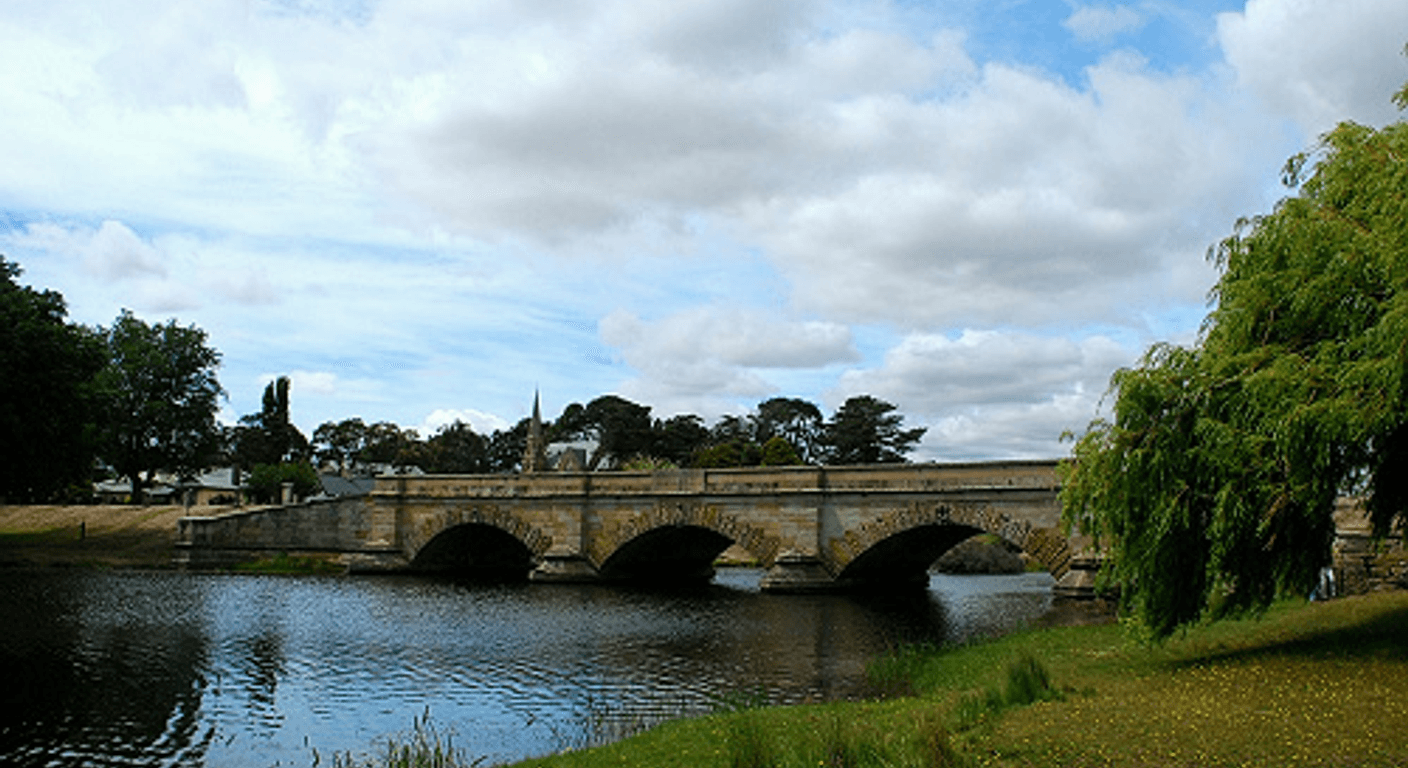
The bridge is the reason most people stop, and it earns the detour. Completed in 1836, it was built using convict labour — specifically the skilled stonework of Daniel Herbert, a transported stonemason who carved 186 decorative panels into the sandstone. The carvings are eccentric and detailed: Celtic knotwork, faces, animals, symbols that Herbert apparently chose himself. As a piece of colonial craftsmanship, it's among the finest things in Tasmania. And it costs nothing to walk across.
Cross to the south bank and look back. The three arches reflect cleanly in the Macquarie River when the water is calm, and the surrounding willows and poplars — very European, very un-Australian — give the scene an oddly familiar quality that travellers of Italian or Southern European background often find unexpectedly moving. There's a small interpretive sign, but the bridge speaks for itself.
Ross township is famously described by its four corners: temptation (the Man O'Ross Hotel), recreation (the town hall), salvation (the Catholic church) and damnation (the old gaol). It's a dry colonial joke that has survived two centuries. The town's other significant site is the Ross Female Factory, where female convicts and their children were held — the remains are modest, a few low stone walls near the bridge, but the information boards are thoughtful and the history is confronting in the best way. Free to visit, open site.
Walking Ross: what to expect on foot
Church Street, Ross's main street, is flat, sealed and short — perhaps five minutes end to end at a comfortable pace. There are no steep kerbs or awkward crossings to navigate. The Tasmanian Wool Centre on Church Street doubles as a regional museum and is worth twenty minutes; it holds a surprisingly good collection of convict records and colonial wool industry artefacts. Entry fees apply — confirm current pricing at the door.
For coffee and something to eat, the bakery on Church Street has a loyal following among highway drivers and locals alike. It's a simple, unpretentious stop — good pies, decent coffee — and the tables outside suit a mild morning. Ross is not a lunch destination in the elaborate sense; save your appetite for Oatlands.
The town is quiet on weekdays, which suits solo travellers who'd rather not navigate weekend coach groups around the bridge. If you're travelling alone and want to linger longer at the Female Factory site or simply sit on the river bank for a while, a weekday gives you that space.
Oatlands: the mill, the lake and the longest Georgian streetscape in Australia
Oatlands makes a specific claim: it has the largest collection of colonial Georgian architecture in Australia, concentrated along its main street beside Lake Dulverton. Whether or not you want to test that against other contenders, the visual effect is real. Broad Street runs along the lake edge, lined with sandstone buildings in various states of use — some are galleries or cafés, others are simply homes. The whole thing is flat, fully accessible and about fifteen minutes of easy walking.
Callington Mill is the centrepiece. Built in 1837, it operated as a wind-driven flour mill for decades, fell into disrepair for most of the twentieth century and was painstakingly restored to working order — it now grinds grain on scheduled mill days. The tours run inside the mill and explain the restoration in detail; for anyone with a background in craft or engineering, it's genuinely absorbing. Tours are ticketed, around $15–$20 per adult — confirm current prices and tour times directly with the mill before you visit, as schedules vary seasonally.
Lake Dulverton beside the town is a shallow wetland reserve managed for waterbirds. A flat walking path circles part of the lake and it's a pleasant thirty-minute addition if the afternoon light is good. Swans, herons and various duck species are reliably present. No facilities on the lake path itself, so carry water.
Getting there: the honest transport picture
There is no regular public bus service to Ross or Oatlands. Redline Coaches operates between Hobart and Launceston and does pass through the Midlands Highway corridor, but stops and timetables don't align well with a comfortable day trip — confirm directly with Redline at redlinecoaches.com.au if you want to explore this. For most travellers, a hire car is the straightforward answer.
Driving from Hobart takes around an hour to Ross on the Midlands Highway — it's an easy, well-signed road with no difficult terrain. From Launceston, Ross is about ninety minutes south. Petrol is available in Campbell Town, ten kilometres north of Ross, which is also a reasonable coffee stop if you want to break the drive. Parking in both Ross and Oatlands is free and easy — no parking meters, no stress.
Small-group day tours from Hobart occasionally include one or both villages as part of a Midlands Highway itinerary. These suit solo travellers particularly well — you get the local context from a guide, don't have to manage driving and navigation alone, and often visit properties not easily accessible independently. Operators change seasonally, so check current offerings through Discover Tasmania at discovertasmania.com.au.
Practical comfort: what to know before you go
Tasmania's Midlands can be cold even in summer — mornings in particular. A packable layer is sensible year-round, and in winter (June to August) you'll want proper warmth. The upside of the colder months is that both villages are even quieter, the light is low and golden by mid-afternoon, and the sandstone takes on a deeper colour. It's a trade-off worth knowing about.
Public toilets are available in both Ross (near the bridge car park) and Oatlands (near the mill). Both are maintained and accessible. There are no major hills, steps or uneven surfaces on the main walking routes — the occasional heritage footpath in Ross has some unevenness, so sensible flat shoes are the call rather than anything with a narrow heel.
Mobile coverage is adequate on the Midlands Highway and in both towns, though it can drop in some pockets. Download offline maps before you leave Hobart. If you're travelling solo, letting someone know your rough itinerary is simply good practice on any Tasmanian country drive — not because the road is risky, but because the highway can be quiet and it's sensible to have a check-in plan.
Staying overnight: when a day trip becomes something more
Ross rewards an overnight stay in a way few day-trip villages do. The town empties of day visitors by late afternoon, and what's left is remarkably still — the sound of the river, the light on the stone, a genuinely quiet dinner. The Man O'Ross Hotel on Church Street has accommodation above the pub; there are also several self-contained colonial cottages available through booking platforms, some with working fireplaces. Indicative prices vary considerably by season — confirm directly with properties.
Staying overnight also lets you walk the bridge at dusk and again at dawn, which are its two best moments. It's a different experience from the midday tourist visit — more personal, more reflective. For a solo traveller who appreciates having time to actually absorb a place rather than tick it off, that extra twelve hours changes the nature of the trip entirely.
If you're driving the full Heritage Highway from Hobart to Launceston over two days, Ross is the logical overnight stop. Combine it with Campbell Town (the red-brick bridge is worth a look) and you have a genuinely layered colonial history drive that doesn't feel hurried.
Quick planning guide
| Ideal pace | Slow and unhurried |
|---|---|
| Best months | Comfortable year-round; winter (June–August) is quieter and colder, with better afternoon light |
| Suggested stay | Full day (8–9 hours) from Hobart, or overnight in Ross for a deeper visit |
| Mobility level | Easy — flat, sealed main streets with no steps or steep kerbs |
| Cost level | Budget-friendly — free village walks and bridge, modest fees for the Wool Centre and mill tour |
| Comfort level | Casual and low-effort, though cold mornings are common even in summer |
| Best for | Independent and solo travellers interested in convict history, colonial architecture and craftsmanship |
| Main planning consideration | No regular public transport — a hire car or small-group tour from Hobart is essential |
Key takeaways
- Ross Bridge, completed in 1836, features 186 individually carved sandstone panels — the work of a single transported stonemason named Daniel Herbert.
- Both Ross and Oatlands main streets are flat, sealed and short, making this one of Tasmania's most accessible heritage day trips for travellers with any mobility consideration.
- Oatlands' Callington Mill is one of very few restored working wind-driven flour mills in Australia; tours run on scheduled days, so confirm times before visiting.
- There is no practical public transport to either village — a hire car or small-group tour from Hobart is the realistic access option.
- The Ross Female Factory site, where female convicts were held in the 1820s, is free to visit and often overlooked by visitors focused on the bridge.
- A combined Ross and Oatlands day trip from Hobart is comfortably done in eight to nine hours, with time for a proper lunch and the mill tour.
Recommended partners and links
Indicative prices only — always confirm with the operator before booking.
Frequently asked questions
Is Ross Bridge free to visit?
Yes. Ross Bridge is an open public site — you can walk across it, view the convict carvings up close and access the south bank of the Macquarie River at no cost, at any time during daylight hours.
How much does a Callington Mill tour cost in Oatlands?
Mill tours at Callington Mill in Oatlands are indicatively priced around $15–$20 per adult, but prices and tour schedules vary seasonally. Confirm current pricing and available tour times directly with the mill at callingtonmill.com.au before your visit.
Can I visit Ross and Oatlands without a car?
It's difficult. There is no regular public bus service timed for a day trip to either village. Redline Coaches passes along the Midlands Highway between Hobart and Launceston — confirm current stops and timetables at redlinecoaches.com.au — but for most travellers, a hire car or an organised small-group tour from Hobart is the practical solution.
Are these villages suitable for travellers with limited mobility?
Both Ross and Oatlands main streets are flat and on sealed surfaces, making them well suited to travellers who find hills or uneven terrain difficult. The Ross Female Factory site and the bridge approach are also flat. Inside Callington Mill, stairs are involved in the full tour — contact the mill directly to ask about accessibility options before booking.
What is the best time of year to visit Ross and Oatlands?
October through April offers the most comfortable daytime temperatures and the longest light. That said, the Midlands can be cold even in summer mornings, so a warm layer is always sensible. Winter visits (June–August) are quieter and atmospherically striking, but you'll want proper cold-weather clothing and should confirm mill tour availability, as schedules can reduce in the off-season.