Sicily rewards a two-week visit best taken April to June or September to October, when temperatures are warm rather than punishing. The island's defining draw is its layered history — the Valley of the Temples, Taormina's Greek theatre against Mount Etna, and Monreale's Byzantine mosaics. Mobility demands are moderate, with uneven ancient terrain and volcanic slopes. Getting there means a 20–24 hour flight with a stopover, and demanding roads make small-group escorted touring the relaxed way to see it.
Why Sicily, and why now
Sicily sits at the crossroads of every civilisation that ever mattered in the Mediterranean — Greek, Roman, Arab, Norman, Spanish. That layering is not a marketing line; it's visible in a single afternoon in Palermo, where a Norman cathedral stands on the footprint of a mosque that replaced a Byzantine church. The island is the size of Switzerland and packs more UNESCO World Heritage sites than most countries. For travellers who've done Rome and Tuscany, Sicily is the less-trodden chapter that rewards properly.
The timing question matters more here than almost anywhere else in Europe. July and August in Sicily can reach 38°C or above in inland areas, which turns a visit to the Valley of the Temples — an exposed, shadeless archaeological site — into something closer to an endurance event than a pleasure. April through June, and again in September and October, offer warmth without punishment, clearer light for photography, and a quieter island. The almond blossoms in February are genuinely beautiful if you don't mind cooler days.
For Australian travellers, the flight is the first honest conversation to have. From Melbourne or Sydney, you're typically looking at 20 to 24 hours of travel including a stopover in Dubai, Singapore, Doha or Abu Dhabi, connecting to Palermo (Falcone-Borsellino Airport) or Catania (Fontanarossa Airport). That's a serious journey. Build in a recovery night at your first hotel before any touring begins — it's not indulgence, it's sense.
Why small-group touring makes sense for Sicily
Sicily is not a self-drive island for the faint-hearted. Roads between major sites are often narrow, signage inconsistent, and driving culture — particularly in Palermo — operates on a logic that takes some time to appreciate. The distance between Agrigento in the south, Taormina on the east coast and Palermo in the northwest is considerable; doing it independently means long days behind the wheel, parking headaches at popular sites, and arriving tired. A good small-group tour absorbs all of that.
The other advantage is access. Quality tour operators work with local guides who hold licensed access to sites, know which entrances to use at which hour, and can navigate the ticketing systems that have become increasingly complex at popular heritage sites across Italy. At the Valley of the Temples, for example, a knowledgeable local guide transforms what might otherwise be a walk past large old stones into something genuinely moving. That context is difficult to replicate with a guidebook and an audio tour.
Small-group specifically — generally defined as 12 to 20 travellers — means a more personal experience, greater flexibility at mealtimes, and a pace that doesn't feel like a relay race. For solo travellers, it also provides built-in companionship without the social pressure of a large coach tour. Many operators catering to the over-50 market have designed their Sicily itineraries with two- and three-night stays in each base, which is the right call: Sicily deserves to be absorbed, not ticked off.
The Valley of the Temples: what to expect on the ground
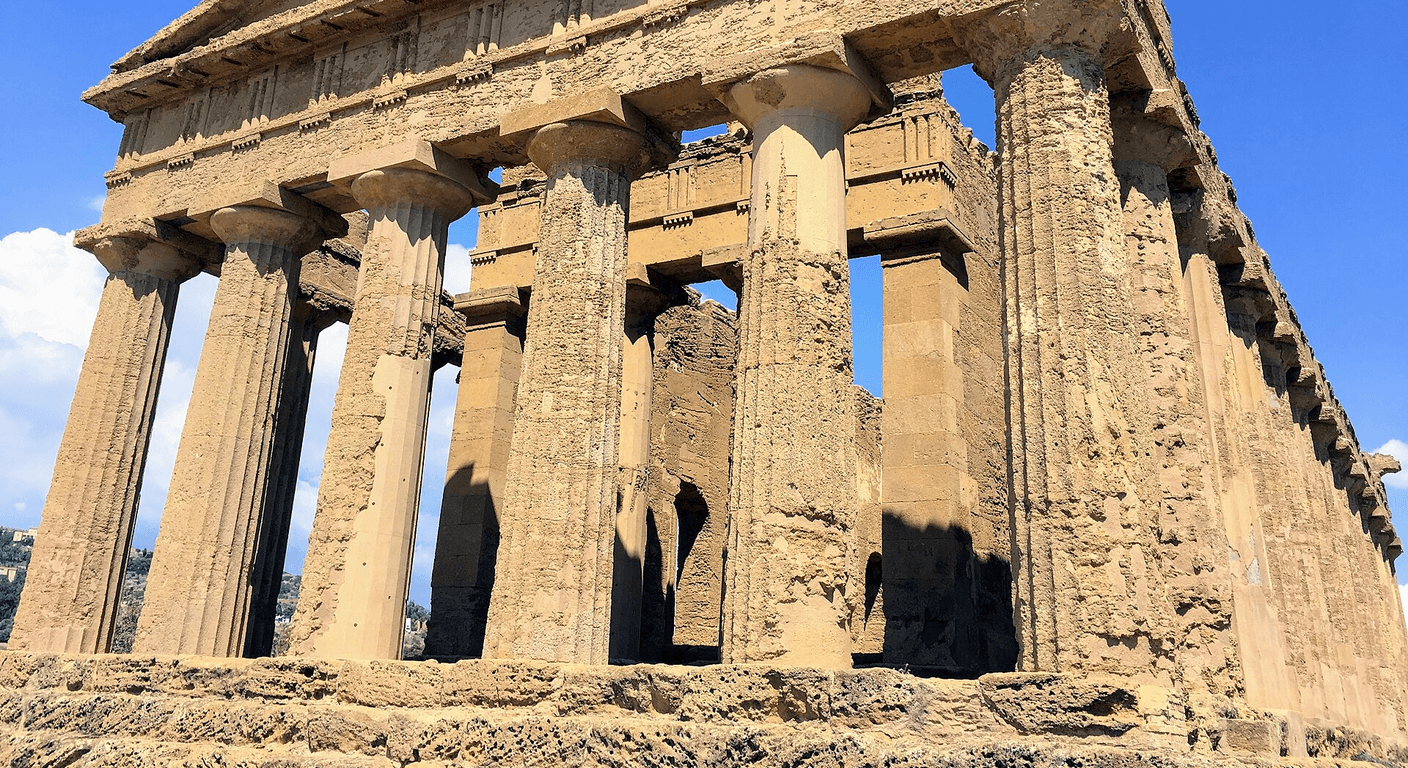
The Valle dei Templi outside Agrigento is one of the best-preserved collections of ancient Greek temples outside Greece itself — arguably better preserved than most of what remains in Athens. The Temple of Concordia, dating to around 440 BCE, is close to intact. Walking the ridge-top archaeological park in the right light, with the Mediterranean visible in the distance, is the kind of experience that stays with you. Confirm current opening hours and ticketing at the official Valle dei Templi website (parcovalledeitempli.it) before visiting.
The practical reality: the site involves uneven paths, some sloped terrain, and limited shade. Wear comfortable walking shoes — not sandals — and visit in the morning before the heat builds. The site is substantial; allow two to three hours. Mobility aids such as walking poles are sensible; the main paths are generally accessible but the terrain is ancient and imperfect. Your tour guide will advise on the day.
Agrigento itself is a working Sicilian city, not a tourist stage-set, and that's part of its character. The views down to the temples from the town are worth the visit alone. A number of tour itineraries base travellers here for two nights, which allows a more leisurely morning at the temples and an afternoon exploring the town's medieval quarter.
Taormina, the Greek theatre, and Etna behind it
Taormina is the island's most photogenic town, perched on a cliff above the Ionian Sea with the Teatro Antico — a Greek theatre later modified by the Romans — as its centrepiece. The theatre is still used for performances and the views from its upper tiers, with Etna's cone rising behind the stage, are the kind of composition that makes photographers stop mid-sentence. Book tickets through the official Parco Archeologico Naxos Taormina site and confirm hours, which vary seasonally.
The town itself rewards a slow morning. The Corso Umberto, the main pedestrian street, is lined with ceramics shops, pastry bars and cafes that open early. Taormina has catered to wealthy European visitors since the 19th century and the infrastructure — good hotels, reliable restaurants, easy walking for those who don't mind some hills — reflects that history. The cable car from Mazzarò beach to the town centre is a practical option for those who prefer to avoid the climb.
Etna deserves its own honest paragraph. Europe's most active volcano is visible from much of eastern Sicily and a visit to its slopes is one of the island's defining experiences. Most tour operators include an Etna excursion, typically reaching the base stations at around 1,900 metres by 4WD minibus. From there, a cable car (Funivia dell'Etna) ascends to around 2,500 metres, and optional guided walks go higher still. The altitude is real: some travellers feel breathless. The terrain at the upper stations is volcanic rock — uneven and sometimes icy even in warmer months. Sensible footwear and a warm layer are non-negotiable. If walking on the crater rim is not for you, the views from the cable car station alone are worth the ascent. Confirm current operational status at funiviaetna.com, as volcanic activity can affect access.
Palermo, Monreale and the art of the long lunch
Palermo is a city that operates on its own frequency. The Ballarò and Vucciria markets are among the oldest in Europe, and wandering them — arancini in hand, navigating stalls of swordfish, blood oranges and street food that owes as much to Arab tradition as Italian — is a genuinely immersive experience. It can also be a sensory overload if you arrive without context; a local guide makes the difference. The markets are busiest in the morning and wind down by early afternoon.
Twelve kilometres above Palermo, the Duomo di Monreale contains what many art historians consider the finest Byzantine mosaic cycle outside Istanbul. The golden interior — covering more than 6,000 square metres of surface — depicts biblical scenes with a detail and luminosity that stops most visitors cold. It's not widely known outside specialist travel circles, which means it's rarely overwhelmed by crowds in the way that, say, the Sistine Chapel is. Confirm opening hours at the official Duomo di Monreale site before visiting.
The long lunch is not a cliché in Sicily — it's a cultural institution. A proper Sicilian midday meal might begin with caponata (a sweet-sour aubergine dish with a complexity that varies by family recipe and neighbourhood), move through fresh pasta with sea urchin or swordfish, and arrive at cannoli filled that morning. The island's Arab-influenced sweet tradition — marzipan, cassata, granita — is a chapter on its own. A good tour operator will factor genuine meal experiences into the itinerary rather than herding travellers through tourist restaurants. Ask specifically about this when comparing operators.
What does a Sicily small-group tour cost, and what should you ask?
Tour pricing varies considerably by operator standard, inclusions and duration. As a rough, indicative guide — and prices change, so always confirm directly — a mid-range small-group Sicily tour of 10 to 12 days might start from around AUD 3,500 to 5,500 per person land-only, while premium or luxury-styled tours with higher-grade accommodation and more inclusions can run from AUD 7,000 to 10,000 or above per person. International flights are almost always additional. These figures are indicative only; treat them as a starting reference and verify current pricing with operators.
When comparing tours, the questions worth asking are specific: How many passengers maximum? What is the accommodation standard — boutique hotels or large chain properties? Are meals included, and how many? Does the tour use licensed local guides at heritage sites, or is the tour manager also the guide? What is the refund or amendment policy if a participant has a health issue? Some operators now offer single-supplement waivers on certain departures, which is worth asking about if travelling solo.
Travel insurance is non-negotiable for this destination and this demographic. Italy has reciprocal healthcare arrangements with some countries but Australia is not among them; a medical event in Sicily without adequate insurance is a serious financial exposure. Ensure your policy covers pre-existing conditions, emergency medical evacuation and trip cancellation. The Australian Government's Smartraveller site (smartraveller.gov.au) is the authoritative source for current entry requirements, safety advice and health information for Italy — check it before booking and again before departure.
Practical matters: getting there, staying comfortable, getting around
Most Australian travellers fly into either Palermo or Catania, with Catania often preferred for itineraries that begin in the east with Taormina and Etna before moving west. Connection cities vary by airline; Emirates, Qatar Airways, Singapore Airlines and Etihad all serve Italian cities with reasonable connections, though a direct Palermo or Catania connection from a Gulf hub may require an additional short domestic leg via Rome or Milan. Confirm routing carefully when booking, and factor in that a 20-plus hour journey followed immediately by touring is a recipe for exhaustion.
Accommodation on a quality tour will typically be in three- to four-star properties in town centres or close to major sites. Sicily's boutique hotel scene has grown considerably in the past decade — converted masserie (farmhouses), palazzo hotels in historic centres — and the better operators have moved away from anonymous highway properties. If booking independently, prioritise location over star rating: being able to walk to a morning market or an evening passeggiata without needing a taxi matters more than a pool.
Dress codes are enforced at churches and cathedrals across Sicily — shoulders and knees covered. Monreale and the Palermo Cathedral will turn visitors away who aren't appropriately dressed. A light scarf or wrap in your daypack solves this instantly. For Etna, a windproof layer and closed walking shoes are essential regardless of the temperature at sea level. Sicily's tap water is generally safe in cities but bottled water is widely used locally; your tour will advise. The island is generally safe for tourists, though standard urban awareness — bag security in markets, not leaving valuables visible in vehicles — applies in Palermo as in any major city.
Quick planning guide
| Ideal pace | Slow-paced, with two- to three-night stays in each base |
|---|---|
| Best months | April to June and September to October |
| Suggested stay | 10–14 days |
| Mobility level | Moderate — uneven ancient paths, sloped terrain and volcanic ground at altitude |
| Cost level | Mid-range to premium, roughly AUD 3,500–10,000+ per person land-only |
| Comfort level | Good — three- to four-star hotels and boutique properties in town centres |
| Best for | Over-50 travellers wanting history, food culture and volcano scenery without self-driving |
| Main planning consideration | Long flight (20–24 hours) and demanding roads make small-group escorted touring the sensible choice |
Key takeaways
- Sicily's major sites — Agrigento, Taormina, Palermo and Etna — are hours apart on demanding roads, making a small-group escorted tour the practical and relaxed choice for over-50 travellers.
- April to June and September to October are the optimal months; July and August heat regularly exceeds 35°C at exposed archaeological sites.
- Flights from Australian cities to Palermo or Catania typically take 20–24 hours with a stopover; build in a recovery night before touring begins.
- Etna visits involve real altitude (cable car to around 2,500 metres) and volcanic rock terrain — warm layers and proper footwear are essential, and the cable car view alone justifies the trip for those not wanting to walk higher.
- Travel insurance covering pre-existing conditions and emergency medical evacuation is essential; Italy has no reciprocal healthcare arrangement with Australia.
- Monreale's Byzantine mosaic interior — 6,000-plus square metres of gold — is among the most significant works of medieval art in Europe and is rarely crowded.
Recommended partners and links
Indicative prices only — always confirm with the operator before booking.
Frequently asked questions
Is Sicily suitable for travellers over 70 with moderate mobility?
Yes, with the right tour. Many of Sicily's key sites involve uneven cobblestones, stepped terrain and some walking on sloped ground, so a tour operator that is transparent about physical demands and offers alternatives is important. The Valley of the Temples requires comfortable walking shoes and a willingness to walk on uneven paths for two to three hours. Taormina has hills but also a cable car. Etna's upper stations involve volcanic rock; the cable car is available for those who prefer not to walk further. Discuss your specific needs directly with the operator before booking.
Do Australians need a visa to visit Sicily (Italy)?
Italy is part of the Schengen Area. As of mid-2025, Australians could visit Italy visa-free for up to 90 days within a 180-day period, but the EU's ETIAS (European Travel Information and Authorisation System) was pending implementation. Entry requirements can change; always check the current advice at smartraveller.gov.au and the official Italian consulate website before booking.
What is the best way to visit Mount Etna from Taormina?
Most small-group tours include a guided Etna excursion as part of the itinerary, typically travelling by 4WD minibus to the southern base stations at around 1,900 metres, then taking the Funivia dell'Etna cable car to approximately 2,500 metres. Guided walks to higher elevations are optional. Independent travellers can reach the Rifugio Sapienza base station by car or organised transfer from Catania or Taormina. Confirm current cable car operational status at funiviaetna.com, as volcanic activity can affect access. Always bring a warm layer and closed footwear regardless of sea-level temperatures.
How much does a small-group Sicily tour cost for Australians?
As an indicative guide only — prices vary by operator, standard and inclusions — mid-range small-group tours of 10 to 12 days start from roughly AUD 3,500 to 5,500 per person land-only. Premium tours with boutique accommodation and more inclusions can range from around AUD 7,000 to 10,000 or above per person. International airfares are almost always additional. These figures are indicative; confirm current pricing directly with operators, as costs change.
When is Sicily too hot for comfortable sightseeing?
July and August are the months to approach with caution. Temperatures regularly exceed 35°C, and exposed sites like the Valley of the Temples have very little shade. Inland areas can be hotter still. If travelling in summer, plan outdoor sightseeing for early morning and use midday hours for shaded lunches, museums or air-conditioned spaces. April to June and September to October offer warm, manageable conditions that suit the pace most over-50 travellers prefer.