Singapore is one of the most accessible cities in Asia for Australian travellers over 50 — safe, English-speaking, and surprisingly generous with free experiences. From the luminous Supertree Grove to the layered heritage streets of Little India and Chinatown, the city rewards slow, curious walkers who know when to rest. This guide maps the genuinely free and nearly free highlights, with honest notes on pacing, heat, and what to skip if your knees or energy have better uses.
Why Singapore Works So Well for Over-50 Australians
There's a reason Singapore keeps appearing on travel shortlists for Australians in their fifties, sixties and beyond. It's not just proximity — direct flights from Sydney, Melbourne and Brisbane run roughly eight hours, with no stopover required on most carriers. It's that the city has quietly built one of the most navigable urban environments in Asia: step-free MRT stations, clean public toilets, excellent hospitals, and a culture where asking for help is never awkward.
For travellers with Indian Australian heritage in particular, Singapore carries a particular resonance. The city's Tamil, Hindi and Bengali communities have shaped Little India and parts of Kampong Glam for well over a century. Walking those streets isn't tourism — it's recognition. The smells, the temple bells, the stacked jasmine garlands: they land differently when they're familiar.
The honest caveat is the heat. Singapore sits roughly one degree north of the equator, and the humidity is relentless year-round. Mornings before 9 am and evenings after 5 pm are your windows. Between noon and 4 pm, the city's free attractions are best appreciated from an air-conditioned hawker centre or a shaded café. That's not a compromise — it's the rhythm the locals live by, and it suits a well-paced itinerary beautifully.
Gardens by the Bay: What's Actually Free, and What Isn't
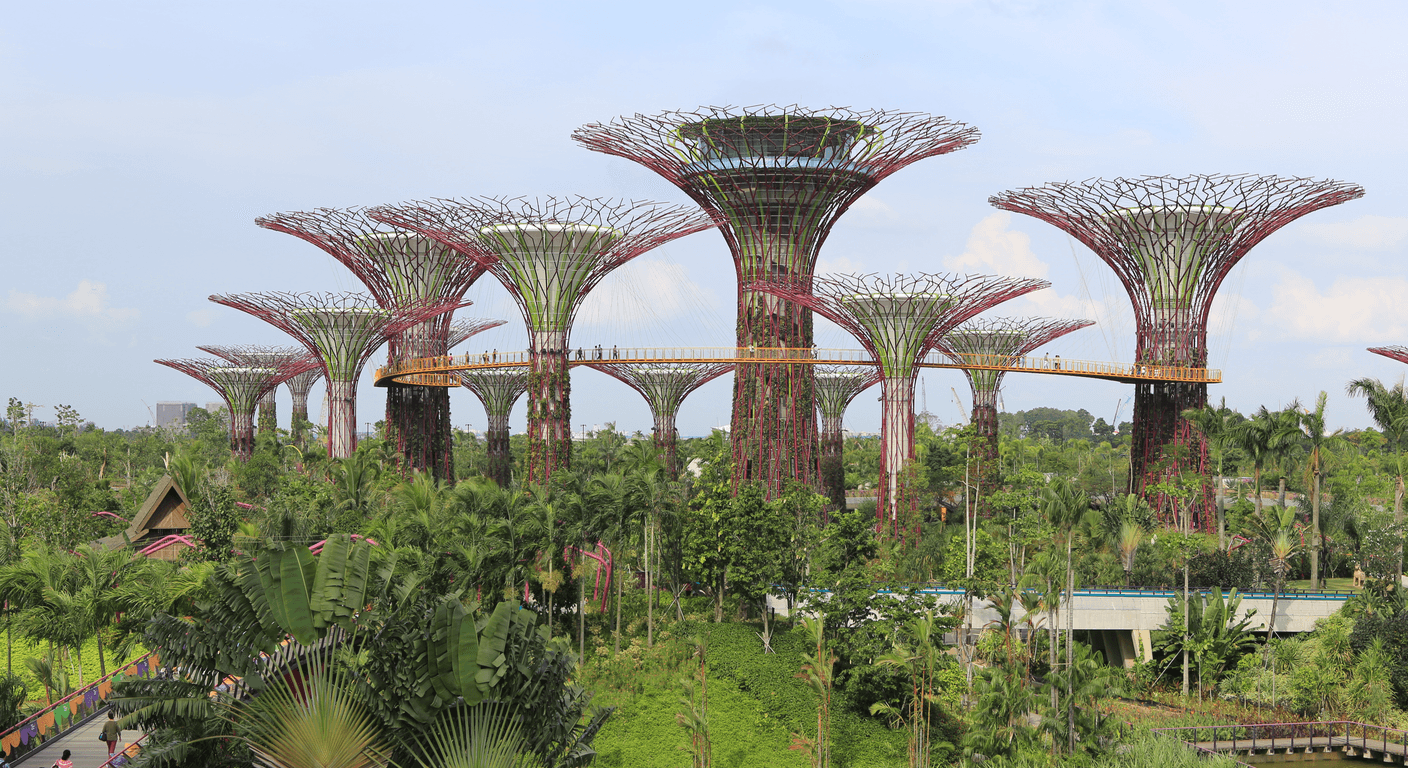
Gardens by the Bay is the city's signature set piece, and the good news is that the most spectacular part of it costs nothing. The outdoor Bay South Garden — including Supertree Grove, the Dragonfly Lake path, and the Golden Garden — is free to enter at any hour. The 18 towering Supertrees, some reaching 50 metres, are extraordinary in daylight and genuinely theatrical after dark. No ticket required.
The OCBC Skyway, the elevated walkway that connects two of the taller Supertrees, does carry a fee — roughly AUD $10–15 per person (indicative; confirm current pricing at gardensbythebay.com.sg before you go). It's a pleasant walk with good views, but those with any hesitation about heights or enclosed walkways can skip it without missing the garden's essence. The ground-level paths around the Supertrees offer equally good angles for photographs, and seating is plentiful throughout.
The real drawcard for free visitors is the Garden Rhapsody light and sound show, which runs nightly — typically twice each evening, around 7.45 pm and 8.45 pm, though schedules change seasonally so check the website. Arrive 20 minutes early to claim a bench near the outdoor OCBC Stage; the surrounding lawn also fills with families on picnic mats. The show runs for roughly 15 minutes. It's genuinely beautiful, and the fact that it's free still catches visitors off guard. Note that the indoor conservatories — Flower Dome and Cloud Forest — are ticketed separately, starting from around AUD $40–50 for adults. Worth considering, but not essential on a budget-conscious visit. Nearest MRT: Bayfront (Circle/Downtown lines), step-free access.
Marina Bay Waterfront: The Promenade, Merlion Park, and the Light Show
The Marina Bay waterfront promenade is one of the great free urban walks in Asia. The path runs from Merlion Park past the Esplanade — Theatres on the Bay — and continues around the bay toward Gardens by the Bay, a distance of roughly three kilometres in total. The surface is flat, well-maintained, and mostly shaded by canopies or trees in sections. Walking the full route in one go is ambitious in the heat; breaking it across an evening stroll and a morning section is a far more comfortable approach.
Merlion Park is, by any measure, one of the most photographed spots in Southeast Asia. The half-lion, half-fish statue is smaller than most visitors expect — and the park is open around the clock with free entry. Early morning, before 8 am, is the sweet spot: cooler air, fewer crowds, and light that flatters the surrounding skyline. Nearest MRT: Raffles Place (East-West/North-South lines), with a flat, shaded walkway to the waterfront.
The Marina Bay Sands light show — Spectra — is the other free evening fixture worth planning around. It runs at the Event Plaza in front of Marina Bay Sands hotel, typically on Friday and Saturday nights with a shorter weekday schedule (confirm at marinabaysands.com as timings shift). The show projects water jets, lasers and light across the bay for about 15 minutes. Combined with the Garden Rhapsody show at Gardens by the Bay on the same evening, it makes for a very satisfying — and almost entirely free — night out. The two venues are a short taxi or MRT ride apart; many visitors walk the waterfront promenade between them on cooler evenings.
Little India and Chinatown: Heritage Walks That Cost Nothing
Little India is one of the most sensory-rich neighbourhoods in Singapore, and it asks nothing of your wallet to explore. The main streets — Serangoon Road, Campbell Lane and Buffalo Road — are lined with textile merchants, flower sellers, gold jewellers and tiffin carriers that look much as they did decades ago. Sri Veeramakaliamman Temple on Serangoon Road is free to enter (remove footwear; dress modestly); the painted gopuram tower above the entrance is worth standing beneath for a full minute. Nearest MRT: Little India (North-East/Downtown lines), step-free access. The footpaths here are narrower than Marina Bay, and the crowds on weekends can be thick — a weekday morning visit is calmer and cooler.
Chinatown rewards a different kind of attention. The Chinatown Heritage Centre on Pagoda Street has a ticketed museum component, but the streets themselves — Pagoda, Trengganu, Smith and Sago — are free to wander and dense with detail. The Buddha Tooth Relic Temple and Museum on South Bridge Road is free to enter (again, modest dress required) and houses one of the most elaborately decorated interiors in the city. Allow an hour. There's seating inside, air conditioning in parts, and the rooftop garden is a quiet spot that most visitors miss. Nearest MRT: Chinatown (North-East/Downtown lines), step-free access.
A practical note on both neighbourhoods: the hawker centres attached to each — Tekka Centre in Little India, Maxwell Food Centre near Chinatown — are ideal midday rest stops. A full meal at either costs roughly AUD $6–12 per person (indicative), is air-conditioned or at least well-ventilated, and gives legs and energy levels a chance to recover before the afternoon. This is not a detour; it's essential planning.
Kampong Glam and Fort Canning: Two Walks Worth the Effort
Kampong Glam — the historic Malay-Muslim quarter centred on Arab Street and Haji Lane — is the kind of neighbourhood that photographs well but actually feels even better in person. The Sultan Mosque (Masjid Sultan) on North Bridge Road is free to visit outside of prayer times, and the gold dome is remarkable up close. The surrounding streets are a pleasing mix of heritage shophouses, fabric merchants, perfume sellers and independent cafés. Nearest MRT: Bugis (East-West/Downtown lines), step-free. The walk from Bugis MRT to the mosque takes about seven minutes on flat ground.
Fort Canning Park is a different proposition — the city's green hill, rising about 48 metres above the civic district. The park is free to enter and the grounds include a spice garden, a colonial-era cemetery, and remnants of the British military command bunker from World War II. The terrain involves some gentle slopes and stairways, so it's best rated as moderately active. Early morning is ideal — the tree canopy provides shade and the park is genuinely quiet before 9 am. There are benches throughout. Nearest MRT: Fort Canning (Downtown line), which opened in 2019 and places you almost at the park's entrance — a thoughtful piece of urban planning. The park connects by a pleasant walk downhill to Clarke Quay and the Singapore River, if energy allows.
The combination of Kampong Glam in the morning and Fort Canning in the late afternoon — with a long lunch break in between — makes for one of the better free days in Singapore. It's a day that covers three distinct chapters of the city's history without feeling like a checklist.
National Gallery Singapore and Free Museum Days
The National Gallery Singapore, housed in the restored City Hall and Supreme Court buildings on St Andrew's Road, holds the world's largest public collection of Southeast Asian art. The permanent galleries are accessible free on selected days and for certain visitor categories — check the current schedule at nationalgallery.sg before your trip, as free-access arrangements change. Even on standard ticketed days, the building itself is extraordinary: the domed atrium, the repurposed courtrooms, the colonnaded facades. Nearest MRT: City Hall (East-West/North-South lines), step-free.
The Asian Civilisations Museum on the Singapore River (acm.org.sg) similarly offers free permanent gallery access on Friday evenings (confirm current hours). For travellers with South Asian heritage, the South Asian gallery is particularly absorbing — a well-curated collection of objects that traces the region's trade, religion and migration across centuries. The museum sits right on the river at Empress Place, with outdoor seating that's pleasant in the early evening.
Singapore's public library network is also worth knowing about. The National Library on Victoria Street is free to enter, air-conditioned, and has comfortable seating on multiple levels — a genuinely useful refuge on a hot afternoon, with a good café on the ground floor. It won't appear on most tourist itineraries, and that's precisely why it's worth mentioning.
Practical Tips: Heat, Mobility, Payments, and Pacing Over 3 Days
The EZ-Link card is the single most practical purchase for getting around Singapore. Available from TransitLink counters at major MRT stations, it covers all MRT lines, buses, and even some taxis. Load it with around SGD 20–30 for a four-night stay (indicative; adjust to your travel pattern). The MRT network is extensive, punctual, and almost entirely step-free — lifts are standard at every station, though it's worth confirming at transitlink.com.sg if a specific station has any works planned. Cashless payment is accepted almost everywhere in Singapore; carrying a small amount of Singapore dollars for hawker centres and wet markets is still sensible, though many stallholders now accept PayNow and NETS.
Hydration is non-negotiable. Singapore's humidity can sit above 80 percent even on 'mild' days, and the body loses water faster than thirst signals suggest. Carry a 750ml bottle and refill it at the drinking fountains available at most MRT stations and parks. A small handheld fan is not a tourist affectation — locals use them. Light, loose, moisture-wicking fabrics are more practical than cotton, which soaks and stays damp. Comfortable, well-supported walking shoes with grip matter on the occasional wet pavement after an afternoon shower.
A suggested three-day free-and-low-cost itinerary: Day one — morning at Little India (Sri Veeramakaliamman Temple, Serangoon Road walk, Tekka Centre lunch), afternoon rest, evening at Gardens by the Bay for Garden Rhapsody. Day two — morning at Chinatown (Buddha Tooth Relic Temple, hawker breakfast at Maxwell), midday break, afternoon at National Gallery or Asian Civilisations Museum, evening waterfront walk from Merlion Park to Marina Bay Sands for Spectra. Day three — morning at Kampong Glam (Sultan Mosque, Arab Street), late morning at Fort Canning Park, afternoon rest, free evening to revisit a favourite neighbourhood or explore a local hawker centre. This pace allows for the midday heat to be spent indoors or at rest, which is not laziness — it's the reason you'll still feel good on day four.
Key takeaways
- Gardens by the Bay's outdoor Supertree Grove and the nightly Garden Rhapsody light show are completely free — no ticket, no booking required.
- Singapore's MRT is one of the most step-free metro systems in Asia, making it genuinely practical for travellers with mobility considerations.
- The best free hours in Singapore are before 9 am and after 5 pm — tropical heat between noon and 4 pm makes outdoor sightseeing uncomfortable and potentially risky.
- Little India, Chinatown and Kampong Glam are three distinct heritage neighbourhoods that can each be explored meaningfully in a half-day, entirely on foot and at no cost.
- An EZ-Link card (available at TransitLink MRT counters) is the most practical and affordable way to navigate the city — load it on arrival and top up as needed.
- The National Gallery Singapore and Asian Civilisations Museum offer free permanent collection access on selected days — confirm current schedules before your visit.
Recommended partners and links
Indicative prices only — always confirm with the operator before booking.
Frequently asked questions
Is Singapore's Gardens by the Bay really free to enter?
The outdoor Bay South Garden — including Supertree Grove, the lake paths, and the Golden Garden — is free to enter at any time. The indoor conservatories (Flower Dome and Cloud Forest) are ticketed separately, starting from around AUD $40–50 per adult (indicative; confirm at gardensbythebay.com.sg). The nightly Garden Rhapsody light show is also free and runs twice each evening, though schedules change seasonally.
How accessible is Singapore for over-50 travellers with limited mobility?
Singapore is one of the most accessible cities in Asia for travellers with limited mobility. The MRT network has lifts at virtually every station, footpaths throughout the tourist areas are flat and well-maintained, and major attractions including Gardens by the Bay, Merlion Park and the Marina Bay waterfront are wheelchair and walking-frame accessible. The main challenge is heat and humidity, not terrain. Confirm lift availability at specific stations at transitlink.com.sg if you have specific requirements.
What is the best time of year for Australian over-50 travellers to visit Singapore?
February to April is generally the most comfortable period — slightly drier, with a marginally lower chance of heavy afternoon downpours. Singapore is warm and humid year-round (typically 25–32°C), so there is no 'cool' season. Avoid June to August if possible, as school holiday crowds from across the region increase at major attractions. The city is well set up for any month, but early-year visits tend to be the most comfortable.
How do I pay for things in Singapore — is cash still necessary?
Singapore is highly cashless. Credit and debit cards (Visa, Mastercard) are accepted in hotels, restaurants, shopping centres and most tourist attractions. An EZ-Link card, purchased at TransitLink counters in major MRT stations, covers all public transport. Carrying a small amount of Singapore dollars (SGD 30–50) is useful for hawker centres and wet markets, though many stalls now accept digital payments. Australian banks typically charge foreign transaction fees — check your card's terms or consider a travel money card before departing.
Do Australian travellers need a visa to visit Singapore?
Australian passport holders do not require a visa for short stays in Singapore — entry is typically granted for up to 30 days on arrival, subject to immigration officer discretion. However, entry requirements can change, so confirm current conditions with the Immigration and Checkpoints Authority of Singapore (ica.gov.sg) or the Singapore High Commission in Australia before booking. Ensure your passport is valid for at least six months beyond your intended stay.