Tasmania's Tahune Airwalk sits about 85 kilometres and a 75–90 minute drive southwest of Hobart. Its flat, fully railed steel walkway rises 50 metres into the forest canopy above the Huon and Picton rivers — the defining highlight. Best visited September to April, it suits a half to full day, paired with Huon Valley stops. Mobility is easy, with no steps, though the walkway's gentle sway can surprise some; ground-level trails offer a steadier alternative.
What exactly is the Tahune Airwalk?
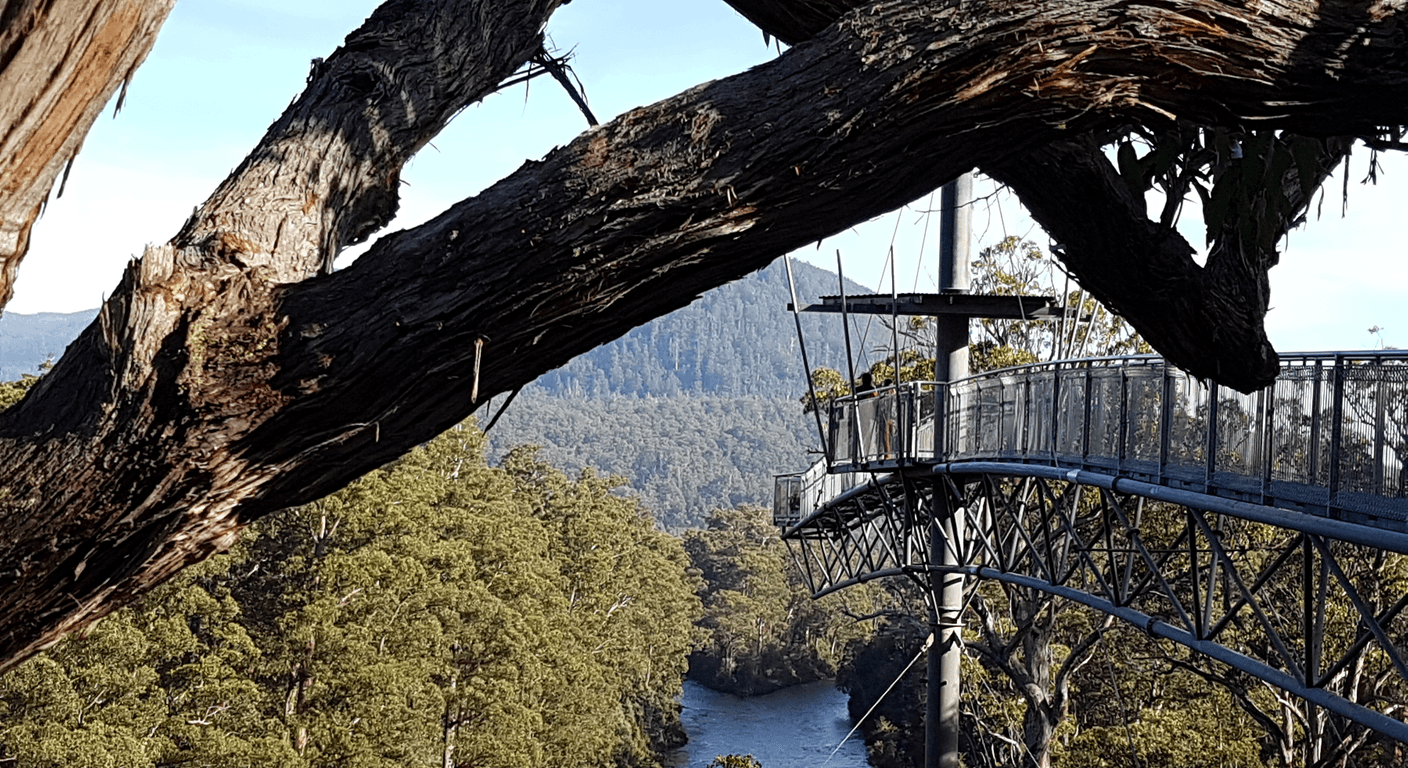
The Tahune Airwalk is a cantilevered steel walkway system that extends through the forest canopy above the junction of the Huon and Picton rivers, about 85 kilometres southwest of Hobart. At its highest point the walkway reaches around 50 metres above the forest floor — roughly the height of a 15-storey building — giving an uninterrupted view across a landscape of swamp gum, Huon pine and leatherwood that stretches toward the Tasmanian Wilderness World Heritage Area.
The walkway itself is wide enough for two people to pass comfortably, fully railed on both sides, and entirely flat. There are no steps on the elevated section. What surprises many visitors is the sway — a gentle, engineered movement that's perfectly safe but can unsettle those who weren't expecting it. For anyone uneasy with heights, the ground-level forest trails along the riverbank offer a genuinely rewarding alternative. You're still in old-growth country; you're just closer to the tree roots than the crowns.
Getting there from Hobart — what's the drive actually like?
From Hobart, the route runs south through Huonville on the Huon Highway, then southwest along the Arve Road through the Arve Valley. The total drive is around 85 kilometres and takes approximately 75 to 90 minutes, depending on how often you slow down — and you will slow down. The Huon Valley section alone, with its apple orchards, river flats and roadside cider stops, earns unhurried attention.
The Arve Road is sealed for most of its length but narrows toward the site. It's well-suited to standard passenger vehicles and most campervans, though it's worth checking road conditions with the operator or the Tasmanian Government's road report service before setting out, particularly after heavy rain. Departing Hobart before 9am gives you the site largely to yourself for the first hour, and means you're back in the Huon Valley in time for a long lunch.
What's the experience like on the walkway itself?
Once you step onto the steel grating and feel the structure move slightly underfoot, there's a recalibration moment. It passes quickly. The walkway curves outward from the entry platform in a broad arc, and within a few minutes you're level with the upper canopy — close enough to observe the texture of bark and the way the river light filters through the eucalypt crowns. The Huon River below is a dark, tannin-stained green, its surface broken by the occasional fallen log.
The cantilever extends furthest over the Picton River confluence, and it's here that the sense of being genuinely suspended above wilderness is strongest. On a clear day the view extends across unbroken forest toward Federation Peak and the Arthur Range. On a misty morning — and mornings in the Arve Valley are often misty — the effect is something else entirely: a quiet, almost meditative immersion in cloud and canopy.
The walkway takes around 20 to 30 minutes to traverse at a comfortable pace, with time to pause at the platforms. Most visitors do a second pass. There are no time limits and no crowds pushing you through.
Ground-level walks — a worthwhile alternative or addition?
The ground-level forest trails at Tahune deserve more credit than they typically receive. The Huon Pine Walk follows the riverbank through a stand of Huon pine — one of the world's longest-lived tree species, with individual specimens reaching over a thousand years old. The trees here are not especially tall, but their girth, their rough dark bark and the knowledge of their age make them genuinely affecting.
There's also the Swinging Bridge, a suspension footbridge across the Huon River that adds a mild adventure of its own. For those who prefer to stay at ground level entirely, or who want to give their legs and nerves a rest after the elevated walkway, the riverside circuit is flat, well-surfaced and takes around 40 minutes at an easy pace. It's a sensible plan for couples with different comfort levels — one on the airwalk, the other on the river trail, meeting back at the café.
Practical matters: timing, facilities and what to bring
The on-site café serves coffee, light meals and local Tasmanian produce — it's a genuine café, not a vending machine and a bench. Toilets are available at the visitor centre. The entry area is paved and accessible. The walkway itself, being flat and railed, is manageable for most mobility levels, though the steel grating underfoot and the movement of the structure mean that walking frames or rollators would be awkward; a walking stick is fine.
Dress in layers regardless of the season. The Arve Valley sits at elevation and the forest canopy holds moisture; even a warm Hobart day can feel considerably cooler here. Comfortable walking shoes with grip are worth the small effort. A light rain jacket is sensible from April through September.
Entry is priced at around $35–40 per adult — confirm current pricing directly with Tahune Adventures before visiting, as rates are subject to change. Opening hours vary seasonally; the operator's website is the reliable source. Booking ahead is not always necessary but is worth considering in peak summer months.
Pairing Tahune with the Huon Valley — making a full day of it
The Huon Valley is one of Tasmania's most satisfying drives, and combining the Airwalk with a leisurely return through the valley turns a half-day excursion into something more substantial. Huonville, the main town, has a decent main street with cafés and the Apple Shed at Grove — a working apple museum and cidery that tells the story of the valley's orchard history without being coy about it.
Further north, the town of Cygnet has built a quiet reputation for its food and arts community, with a Saturday market worth timing your return for. The drive back along the Huon Highway in the late afternoon, with the river appearing and disappearing through the trees, is the kind of thing that makes a good day feel longer than it was — in the best possible sense.
For those based in Hobart for several days, this makes an excellent second or third day out. Pair it with a morning at the Museum of Old and New Art (MONA) or a Bruny Island trip on alternate days, and you have a considered southern Tasmania itinerary that doesn't feel rushed.
Is the Tahune Airwalk suitable for travellers with a fear of heights or mobility considerations?
Honest answer: it depends on the individual. The walkway is engineered with safety as its obvious priority — the rails are solid and at a sensible height, the surface is non-slip steel grating, and there are rest platforms at intervals. Most people who describe themselves as mildly uneasy with heights find they manage it comfortably once they're on the structure. A small number decide, having taken the first few steps, that they'd rather not continue. That's a legitimate choice and the ground-level experience remains worthwhile.
For travellers with significant balance concerns or those using mobility aids beyond a walking stick, it's worth contacting the operator directly before visiting to discuss accessibility. The entry area and visitor centre are accessible; the walkway itself is the variable. The ground-level trails are the more reliably accessible option and, for Huon pine enthusiasts in particular, arguably the more interesting one.
Quick planning guide
| Ideal pace | Relaxed — 20-30 minutes on the walkway, longer with ground trails and valley stops |
|---|---|
| Best months | September to April for milder temperatures |
| Suggested stay | Half day to full day, extended with a Huon Valley drive |
| Mobility level | Easy — flat, railed, no steps, though grating and sway may not suit walking frames or rollators |
| Cost level | Budget-friendly, around $35–40 per adult |
| Comfort level | Comfortable — on-site café, toilets, paved entry area |
| Best for | Nature lovers, couples with different comfort levels around heights, Hobart-based travellers wanting a considered day trip |
| Main planning consideration | Confirm current pricing and seasonal hours with the operator, and check Arve Road conditions after heavy rain |
Key takeaways
- The Tahune Airwalk reaches 50 metres above the Huon and Picton rivers on flat, fully railed steel walkways — no steps on the elevated section.
- Entry runs around $35–40 per adult; confirm current pricing and seasonal hours with the operator before visiting.
- Ground-level forest trails, including the Huon Pine Walk, offer a genuinely rewarding alternative for those who prefer to stay earthbound.
- The drive from Hobart takes roughly 75–90 minutes via the Huon Valley; the valley itself is worth the unhurried return.
- Best visited September to April for milder temperatures; morning arrivals offer the site at its quietest.
- The Huon Valley's cider producers, Saturday markets and riverside towns make this an easy full-day itinerary from Hobart.
Recommended partners and links
Indicative prices only — always confirm with the operator before booking.
Frequently asked questions
How long does a visit to the Tahune Airwalk take?
Most visitors spend two to three hours at the site, covering the elevated walkway, the ground-level Huon Pine Walk and the Swinging Bridge, with time for coffee at the café. Allow a half-day when combined with the drive from Hobart.
Is the Tahune Airwalk suitable for seniors or older travellers?
The elevated walkway is flat and fully railed, making it physically manageable for most older travellers. The main consideration is comfort with heights and the gentle sway of the structure. Ground-level trails are accessible and flat for those who prefer to avoid the elevated section.
How much does the Tahune Airwalk cost?
Entry is indicatively priced at around $35–40 per adult. Prices are subject to change; confirm the current rate directly with Tahune Adventures at tahune.com.au before your visit.
Can you get to Tahune Airwalk without a car?
Tassielink Transit operates coach services from Hobart to the Huon Valley region; confirm current schedules and whether a Tahune stop is available directly with Tassielink. Most visitors drive, and the route is straightforward on sealed roads.
What is the best time of year to visit the Tahune Airwalk?
September to April offers the most comfortable conditions — milder temperatures and longer daylight hours. The forest is atmospheric in all seasons, but the Arve Road can be cold and wet in winter. Check road conditions before departing between May and August.