Tirana offers colourful Soviet-era apartment blocks, the moving Bunk'Art museums, and a café culture centred on the Blloku district — a refreshing change from Europe's well-trodden circuits. No single best season is noted, though a relaxed few days plus a day trip to Krujë suits most visitors. Mobility is moderate, as footpaths and traffic require care, and there are no direct flights from Australia, with journeys taking 24 to 28 hours via a stopover.
Why Tirana — and why now?
Most Australians couldn't place Albania on a map without hesitation, which is precisely what makes Tirana interesting. The country spent nearly five decades under one of the most extreme communist regimes in the world — more isolated than North Korea at its peak, according to historians — and then opened almost overnight in 1991. The city that emerged is still working out who it wants to be, and watching that process unfold is, for the right kind of traveller, quietly fascinating.
For women travelling in a group of friends, Tirana has a particular appeal. The café culture is serious and sociable, the streets around the Blloku district (once reserved exclusively for the communist elite) are lively without being rowdy, and locals tend to be genuinely curious about visitors rather than indifferent to them. A well-travelled woman from regional Victoria who has done her share of Italian hill towns and Spanish plazas will find Tirana familiar enough to feel safe and different enough to feel worthwhile.
The timing matters too. Tirana hasn't yet reached the saturation point of Dubrovnik or Prague. Queues at museums are short, restaurant bookings are rarely necessary, and the photographers haven't entirely taken over the good corners yet. That won't last indefinitely.
Getting there from Australia — what the journey actually involves
There are no direct flights from Australia to Tirana's Nënë Tereza International Airport. From Sydney, Melbourne or Brisbane, plan on a journey of roughly 24 to 28 hours including a stopover — commonly Istanbul (Turkish Airlines), Rome (with onward connections), Vienna (Austrian Airlines) or London. Istanbul is a popular choice because the layover can be kept relatively short and the Tirana leg is under two hours. Confirm current routes and schedules with your preferred airline or a travel agent, as connections change.
A recovery night in your first Tirana hotel is not optional — it's good travel strategy. Jet lag combined with the sensory adjustment of an unfamiliar city is a real consideration, and Albania's traffic patterns will make more sense after a decent sleep. Book accommodation for the arrival night separately if needed, and don't schedule anything ambitious on day one. A walk, a coffee, an early dinner — that's enough.
Travel insurance is essential and worth discussing carefully with your insurer before booking. Pre-existing conditions must be declared, and cover for medical evacuation from Albania — while improving in quality — is a legitimate consideration. The Australian Government's Smartraveller website (smartraveller.gov.au) carries current safety and entry advice for Albania; check it close to your departure date as conditions can change.
What does Tirana actually look like?
The first thing many visitors notice is the colour. In the early 2000s, the then-mayor Edi Rama — an artist before he became a politician, and later Prime Minister — commissioned the painting of Tirana's drab communist-era apartment blocks in bold geometric patterns: orange diamonds, yellow stripes, turquoise chevrons. The blocks are still there, still grey concrete underneath, but the effect is genuinely striking and speaks to something about Albanian resilience that no guidebook quite captures in words.
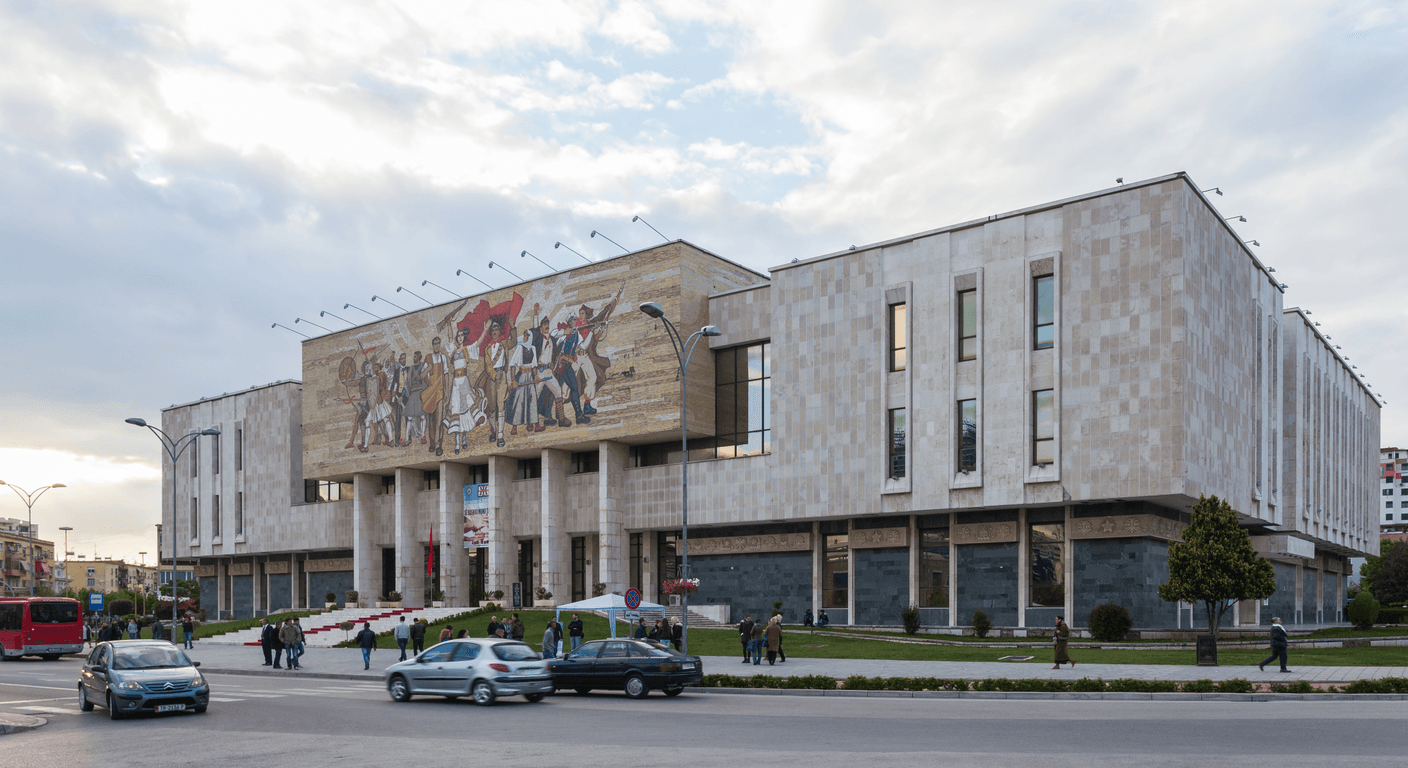
Skanderbeg Square anchors the city centre. It's large, recently pedestrianised, and framed by the Et'hem Bey Mosque, the National History Museum (with its famous socialist-realist mosaic façade), and the Clock Tower. The statue of Gjergj Kastrioti — Skanderbeg, the 15th-century national hero — stands at the centre. The square is busiest in the late afternoon when families come out to walk, and that's the best time to sit at one of the surrounding cafés and simply watch.
The Blloku district, a short walk south, is where the city's café and restaurant scene concentrates. Streets here are more pleasant to walk than many parts of central Tirana — better paving, more shade — and the mix of outdoor tables, independent boutiques and the occasional communist-era villa (some now converted to restaurants) makes it the natural base for an afternoon. Coffee in Albania is typically strong, espresso-style, and costs around 100–150 lekë — roughly AUD 1.50 to 2.00 at indicative exchange rates. Confirm current rates before you travel.
The history you'll want to understand before you arrive
Enver Hoxha ruled Albania from 1944 until his death in 1985, and his regime left marks that are impossible to miss once you know what you're looking at. The 700,000-odd concrete bunkers scattered across the country — one for roughly every four Albanians — are the most surreal legacy, but Tirana itself carries subtler ones: the scale of the government buildings, the layout of the Blloku, the absence of religious architecture in some areas (Hoxha declared Albania the world's first atheist state in 1967).
The two Bunk'Art museums are the best places to sit with this history. Bunk'Art 1 occupies a vast nuclear bunker built for the regime's leadership beneath Mount Dajti; Bunk'Art 2 is a smaller bunker near Skanderbeg Square focused on the history of the Interior Ministry and its surveillance apparatus. Both are professionally curated, with English-language materials, and they're genuinely moving without being exploitative. Allow at least two hours for each — more if you tend to read every panel, which is worth doing here.
A local guide adds real value in Tirana in a way that isn't always true in more-visited cities. The official museums are good, but the city's history has layers — Ottoman, Italian occupation during World War II, communist, post-communist chaos and then gradual reconstruction — that a knowledgeable local can connect in ways that a self-guided visit can't. Half-day walking tours with English-speaking guides are available through several operators; indicative costs run from roughly AUD 40 to 80 per person. Confirm current availability and pricing directly with operators.
Mobility and getting around — the honest version
Tirana is walkable in the sense that its main sights are reasonably close together. It is not walkable in the sense that the pavements are uniformly smooth and predictable. Broken tiles, unexpected steps, parked scooters occupying footpaths, and cars that treat pedestrian crossings as suggestions rather than instructions are all real features of the city. None of this is insurmountable, but it does require attention — and it means that a day of significant walking will feel more tiring than the same distance in, say, Vienna or Barcelona.
The good news is that taxis and rideshare apps (Bolt operates in Tirana and is widely used) are inexpensive and readily available. For anyone with knee or hip concerns, or simply on days when the heat is up, using Bolt for crosstown journeys is a perfectly sensible choice and costs very little. The app works in English and payment can be made by card.
A day trip to Krujë — the hilltop castle town about 30 kilometres north of Tirana — is popular and manageable. Organised tours handle the transport, which is easier than navigating local buses independently. The bazaar in Krujë sells antiques, textiles and copper work, and the castle museum focuses on Skanderbeg's resistance against the Ottoman Empire. The road is winding and the site involves some uphill walking on uneven stone, but the views across the valley are worth the effort for those who are steady on their feet.
Where to eat, drink and linger
Albanian food deserves more attention than it gets. The cuisine draws on Ottoman, Greek and Italian influences — slow-cooked lamb, byrek (flaky pastry filled with spinach or cheese), grilled fish from the Adriatic coast, and a particular affection for yoghurt that appears at most meals. The Blloku district has the widest range of restaurants, from simple tavërna-style places to more polished dining rooms. A full meal with wine at a mid-range restaurant runs to around AUD 20–35 per person at indicative exchange rates — confirm current prices locally.
Coffee is the social currency of Tirana. Albanians drink it slowly and often, and the café culture invites exactly the kind of long, talking afternoon that suits a group of friends who haven't seen each other properly in months. The city's cafés are generally non-smoking indoors (though outdoor sections vary), and the quality of espresso is consistently high. Raki — the local grape or mulberry spirit — appears at the end of meals the way grappa does in Italy. It is offered generously and is best accepted in small quantities.
The National History Museum on Skanderbeg Square has a café inside and is worth visiting for the building as much as the collection. The mosaic on its exterior facade — a socialist-realist panorama of Albanian history — is one of the more arresting pieces of public art in the Balkans, even if the ideology it was built to celebrate has rather fallen from favour.
Practical planning — what to sort before you leave Australia
Australian passport holders have not required a visa for Albania for short stays in recent years, but entry requirements can change and the authoritative source is always Smartraveller (smartraveller.gov.au) rather than any travel article. Check the current advice close to your travel date and again a week before departure. Register your travel with Smartraveller so the Australian Government knows you're there.
The Albanian currency is the lek (ALL). Credit cards are accepted in hotels and larger restaurants in Tirana, but smaller cafés, markets and taxis often prefer cash. ATMs are available in the city centre and generally reliable, but carrying some local currency is sensible. The euro is widely accepted informally, but you'll get better value paying in lek. Confirm current exchange rates through your bank before travel.
Accommodation in Tirana ranges from international-brand hotels on or near Skanderbeg Square to boutique guesthouses in the Blloku district. Mid-range hotel rooms run to around AUD 80–140 per night at indicative rates — confirm current pricing when booking. For a group of friends, a serviced apartment in the Blloku area offers more space for socialising and often better value than individual hotel rooms. Book through established platforms and read recent reviews carefully, as quality can vary more than in Western European cities.
Quick planning guide
| Ideal pace | Relaxed, with a recovery night built in on arrival |
|---|---|
| Best months | No single best season specified — currently uncrowded year-round with short museum queues |
| Suggested stay | A few days in the city, plus a day trip to Krujë |
| Mobility level | Moderate — uneven pavements and unpredictable traffic, though taxis and rideshare apps ease getting around |
| Cost level | Budget-friendly — meals, coffee and hotels are inexpensive by Western European standards |
| Comfort level | Comfortable for steady walkers; extra care needed on footpaths and crossings |
| Best for | Curious travellers drawn to recent history and café culture, including groups of women friends |
| Main planning consideration | No direct flights from Australia — allow 24–28 hours with a stopover, and check Smartraveller before departure |
Key takeaways
- Tirana is one of Europe's most affordable capitals — a full restaurant meal with wine costs roughly what a café lunch does in an Australian city.
- The Bunk'Art museums are among the most compelling Cold War history sites in Europe and deserve at least half a day each.
- Pavements and traffic are less predictable than in Western Europe — comfortable shoes, a rideshare app and a relaxed pace solve most of it.
- There are no direct flights from Australia; allow 24–28 hours travel time and plan a recovery night on arrival.
- A local guide is worth the cost in Tirana — the city's layered history is harder to read without someone who lived through parts of it.
- Always confirm current visa rules and entry requirements on smartraveller.gov.au before booking.
Recommended partners and links
Indicative prices only — always confirm with the operator before booking.
Frequently asked questions
Do Australians need a visa to visit Albania?
Australian passport holders have not required a visa for short stays in Albania in recent years, but entry requirements can change. Always check the current advice on smartraveller.gov.au before booking and again close to your departure date — that is the only authoritative source for Australians travelling abroad.
Is Tirana safe for older women travelling in a group?
Tirana is generally considered safe for tourists, including women travelling in groups. Petty theft exists as in any city, so standard precautions apply — keep bags close, use ATMs in banks rather than on quiet streets, and use Bolt or reputable taxis rather than unmarked vehicles. The Blloku district and the area around Skanderbeg Square are well-frequented and feel comfortable at most hours. Check current Smartraveller advice for any updated safety information.
How difficult is it to get around Tirana with mobility considerations?
Tirana's pavements are uneven in many areas, with broken tiles, unexpected kerbs and scooters parked on footpaths. The city is walkable for those who are steady on their feet and wearing supportive shoes, but it requires more attention than well-maintained European cities. The rideshare app Bolt operates throughout Tirana, is inexpensive, and works in English — it's a practical option for anyone who wants to limit walking distance on any given day.
What is the best time of year to visit Tirana?
April to May and September to October are the most comfortable months for visitors over 50. Temperatures are mild — typically 18–26°C — crowds are manageable, and daylight hours are generous. July and August are hot (often above 35°C), more crowded, and better avoided unless heat is not a concern. Winter is mild by European standards but can be grey and rainy.
How much does a trip to Tirana cost compared with other European destinations?
Tirana is among the most affordable European capitals for Australian travellers. Indicative costs at current exchange rates suggest a good espresso for around AUD 1.50–2.00, a full restaurant meal with wine for AUD 20–35 per person, and mid-range hotel rooms from roughly AUD 80–140 per night. These figures are indicative only — confirm current prices and exchange rates before and during travel, as conditions change.