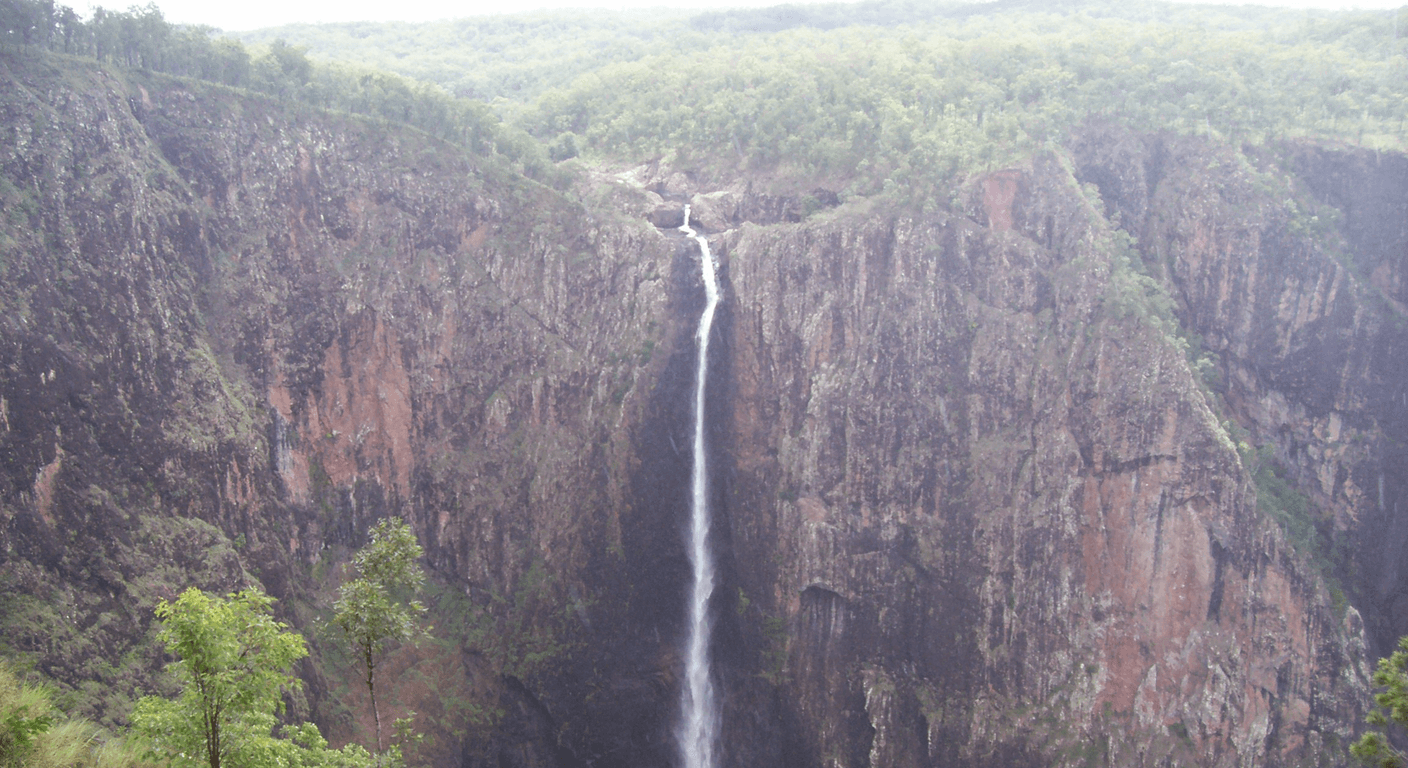
Wallaman Falls, Australia's highest single-drop waterfall at 268 metres, plunges into a rainforest gorge in Girringun National Park near Ingham, Far North Queensland. April to June brings the best combination of strong post-wet-season flow and clear skies. The main lookout is an easy, flat 200-metre walk from the car park, suiting most travellers over 50. Reaching it means a 51-kilometre winding sealed drive from Ingham with no public transport option, best planned as a full day trip or paired with an overnight stay in town.
Why Wallaman Falls Earns the Journey
Numbers rarely tell the full story of a natural place, but 268 metres is worth pausing on. Wallaman Falls, tucked inside Girringun National Park in the Wet Tropics World Heritage Area west of Ingham, drops further in a single unbroken plunge than any other permanent waterfall on the continent. The Stoney Creek tributary of the Herbert River simply runs off the edge of the Seaview Range and falls — not in stages, not in a series of cascades, but in one long, roaring column — into a gorge dense with fan palms and ancient ferns.
What makes this especially appealing for a group of friends travelling together is the ratio of effort to reward. The main lookout platform is a flat, sealed walk of roughly 200 metres from the car park. You step out, you look down, and the scale of it takes a moment to register properly. There's no need to earn the view with a punishing descent. For travellers who value good company and a genuine experience over proving fitness, that's not a compromise — it's the point.
When to Go: Timing the Flow
Wallaman Falls runs year-round — that's what 'permanent' means — but the volume varies dramatically with the seasons. Far North Queensland's wet season typically runs November through March, and the falls reach their most powerful flow in the weeks that follow. April through June is widely regarded as the sweet spot: the torrent is still full and forceful, temperatures have eased from the humid extremes of summer, and the rainforest is an almost implausible shade of green. Skies tend to be clearer, too, which matters when you're trying to photograph a waterfall from above.
July and August are drier and cooler — genuinely pleasant — though flow will have reduced noticeably by then. Avoid the heart of the wet season unless you've confirmed the road is open; the mountain access road can become impassable after heavy rain, and the gorge itself can be hidden entirely in cloud. A quick check of Queensland road conditions at qldtraffic.qld.gov.au before leaving Ingham is always worth the thirty seconds it takes.
The Drive: Beautiful, But Earn Your Seat Behind the Wheel
The 51-kilometre drive from Ingham to the falls takes around 50 minutes under normal conditions, and it earns the word 'winding' honestly. The road climbs through cane fields and then into the rainforest of the Seaview Range, with tight bends, occasional single-lane sections, and gradients that reward a driver who's comfortable taking mountain roads steadily rather than quickly. It's sealed all the way, and most conventional vehicles handle it without drama — but it's not a road for someone who finds winding mountain driving stressful.
For a group, it's worth deciding early who's driving. The passenger seats offer excellent views into the canopy, and spotting a cassowary crossing the road (it happens) is far easier when you're not concentrating on the next hairpin. There are no fuel stops, no shops, and no services between Ingham and the falls. Fill the tank before you leave town — this isn't a catastrophising warning, just the kind of straightforward planning that makes a day out comfortable rather than anxious.
Parking at the falls is free and reasonably spacious. A covered picnic area sits near the lookout, so bringing a proper lunch is a sensible choice. There are basic toilet facilities at the site — confirm current amenity availability with Queensland Parks before travelling, particularly if visiting early in the dry season.
The Lookout and the Gorge Track: What's Realistic
The main lookout delivers the full spectacle: the falls, the gorge, the forest canopy below, and on a clear day a sense of the vast Herbert River valley beyond. It's genuinely one of Queensland's great views, and it requires no more than comfortable flat shoes and a willingness to walk a few minutes from the car. A second lookout nearby provides a slightly different angle — also flat and easy.
The gorge-floor track is a different matter entirely. It descends steeply — around 300 metres of elevation — to the base of the falls along a rough, rocky trail that takes experienced walkers roughly two hours return. The ascent back up is demanding even for fit younger walkers. For most travellers over 50, and especially for a group enjoying a day out rather than a bushwalk expedition, skipping the gorge floor is simply the sensible call. The view from the top is not a consolation prize. It's the experience the place is famous for.
If anyone in the group is using a walking stick or has knee concerns, the main lookout path is manageable; the gorge track is not appropriate. Queensland Parks rates the gorge walk as Grade 5 — the most difficult classification — so there's no ambiguity there.
Ingham: More Than a Fuel Stop
Ingham is the kind of regional Queensland town that rewards a slow look. It's the commercial centre of the Hinchinbrook region, and it carries a strong Italian-Australian heritage — the legacy of Calabrian and Sicilian families who came to work the cane fields in the early twentieth century and stayed to shape the culture. That history shows up most pleasantly in the town's cafés and bakeries, where a decent espresso and a proper Italian pastry are not hard to find. Ask locally for current favourites; the best places tend to be family-run and don't need a TripAdvisor ranking to stay busy.
The TYTO Wetlands, on the edge of town, are a genuine surprise for a regional centre of Ingham's size. A network of flat boardwalks winds through paperbark wetlands and open grasslands that attract over 230 recorded bird species. Brolgas, spoonbills, kingfishers and the occasional jabiru make an appearance depending on the season. The boardwalks are accessible and largely flat — a relaxed hour or two of birdwatching that pairs beautifully with a morning at the falls. The TYTO Eco-Tourism Hub also houses the local visitor information centre and a small museum covering the region's Italian heritage.
If the group decides to stay overnight rather than driving back to Townsville or Cairns in the same day — a genuinely good idea — Ingham has accommodation options ranging from the TYTO Hotel (confirm current rates directly) to motel-style stays along the main street. An overnight stop also means you can time your departure for the falls in the cooler morning light, which is when the spray catches best and the gorge is quietest.
Getting to Ingham: Practical Routes from Major Cities
Ingham sits on the Bruce Highway between Townsville (roughly 110 km south) and Cardwell (around 65 km north), making it a natural stop on a Far North Queensland road trip. From Townsville, the drive is around 90 minutes — straightforward highway driving with services along the way. From Cairns, allow around two and a half hours south on the Bruce Highway. Both cities have domestic airports with regular services from Brisbane, Sydney and Melbourne.
For grey nomads travelling the east coast by caravan or motorhome, Ingham is a logical overnight base. There are caravan parks in the town; confirm current availability and facilities directly. Note that the mountain road to Wallaman Falls, while sealed, has some sections that are not suitable for large rigs or caravans — check with local visitor information before attempting it with anything larger than a standard campervan.
Those not driving can reach Ingham by Queensland Rail's Tilt Train or Spirit of Queensland services between Brisbane and Cairns, which stop at Ingham. From there, the falls require a vehicle — there's no public transport to the national park. Car hire is limited in town; Townsville or Cairns are the practical bases for picking up a rental before heading north or south along the highway.
Making the Most of Your Day: A Practical Shape for the Trip
A well-paced day from an Ingham base might look like this: an early morning walk at TYTO Wetlands while the light is low and the birds are active, then a mid-morning drive up to the falls to beat the midday heat and any day-tripper coaches arriving from Townsville. Pack a proper lunch for the picnic area at the falls — there's nothing to buy on the mountain. Return to Ingham by early afternoon, leaving time for a slow coffee and a wander through the town centre before the drive back to your base.
Groups travelling from Townsville or Cairns as a day trip can certainly do Wallaman Falls and a TYTO walk in a single day, but it's a long one. Factor in the mountain drive, time at the falls, the return drive, and any town stops — you're looking at six to eight hours of movement. Starting early and choosing a comfortable vehicle with good air conditioning makes a real difference in Far North Queensland, even in the cooler months.
Travel insurance is worth mentioning plainly: if anyone in the group has pre-existing conditions, confirm that your policy covers this kind of regional activity. The nearest major hospital is in Townsville. This isn't a reason not to go — it's the kind of detail that experienced travellers sort before departure, not after.
Quick planning guide
| Ideal pace | Slow and relaxed, view-focused rather than strenuous |
|---|---|
| Best months | April to June, for strong flow and clearer skies |
| Suggested stay | Full day trip from Ingham, or one overnight in Ingham |
| Mobility level | Easy at the main lookout (flat 200m walk); gorge-floor track is Grade 5 and not recommended |
| Cost level | Free entry, budget-friendly aside from fuel and any overnight stay |
| Comfort level | Comfortable, though the mountain road is winding and needs a confident driver |
| Best for | Groups over 50 who prefer scenic reward without steep walking |
| Main planning consideration | Fill up with fuel in Ingham first and check road conditions before departure, as there are no services en route |
Key takeaways
- Wallaman Falls drops 268 metres in a single unbroken plunge — the highest permanent single-drop waterfall in Australia, and the main lookout is just a flat 200-metre walk from the car park.
- April to June is the optimal window: post-wet-season flow is strong, temperatures are manageable, and skies tend to be clear.
- The mountain road from Ingham is sealed but winding — a confident driver is needed, and fuel must be topped up in Ingham before departure as there are no services on the route.
- The gorge-floor track is Grade 5 and involves 300 metres of steep descent; the lookout delivers the full experience without it.
- Ingham's TYTO Wetlands boardwalks are flat, accessible, and home to over 230 bird species — a natural companion to the falls on the same day.
- Entry to Girringun National Park and the Wallaman Falls precinct is free; confirm road conditions with Queensland Parks or Queensland Traffic before travelling.
Recommended partners and links
Indicative prices only — always confirm with the operator before booking.
Frequently asked questions
Is Wallaman Falls accessible for older travellers or those with limited mobility?
The main lookout at Wallaman Falls is accessible to most travellers, including those with limited mobility. It's a flat, sealed path of around 200 metres from the car park to the viewing platform. The gorge-floor track, however, is rated Grade 5 by Queensland Parks — steep, rough, and not suitable for most travellers over 50 or anyone with knee or balance concerns. The lookout provides the full visual experience of the falls.
What is the best time of year to visit Wallaman Falls?
April to June is generally considered the best time to visit Wallaman Falls. Flow is strong from the preceding wet season, temperatures have eased, and skies are typically clear. The falls run permanently throughout the year, but volume reduces significantly by late dry season (August to October). Visiting during the wet season (November to March) risks road closures and cloud cover obscuring the falls.
How far is Wallaman Falls from Ingham, and is the drive difficult?
Wallaman Falls is approximately 51 kilometres from Ingham, a drive of around 50 minutes. The road is fully sealed but involves winding mountain bends, some single-lane sections, and significant gradients. It's manageable in a standard vehicle for a confident driver but is not suitable for caravans or large rigs. There are no fuel stops or services on the route, so fill the tank in Ingham before departing.
Is there an entry fee for Wallaman Falls or Girringun National Park?
Entry to Girringun National Park and the Wallaman Falls precinct is free. There is no vehicle entry fee or park pass required. Basic facilities including parking, a picnic area, and toilets are available at the site — confirm current amenity status with Queensland Parks before visiting, particularly early in the dry season.
What else is worth seeing near Ingham on the same day as Wallaman Falls?
The TYTO Wetlands on the edge of Ingham town are well worth combining with a visit to Wallaman Falls. Flat boardwalks wind through paperbark and wetland habitat supporting over 230 bird species, including brolgas and kingfishers. The TYTO Hub also houses visitor information and a local heritage museum. Ingham's Italian-Australian café culture — a legacy of early Calabrian and Sicilian settlers — makes the town a pleasant stop for coffee and lunch.