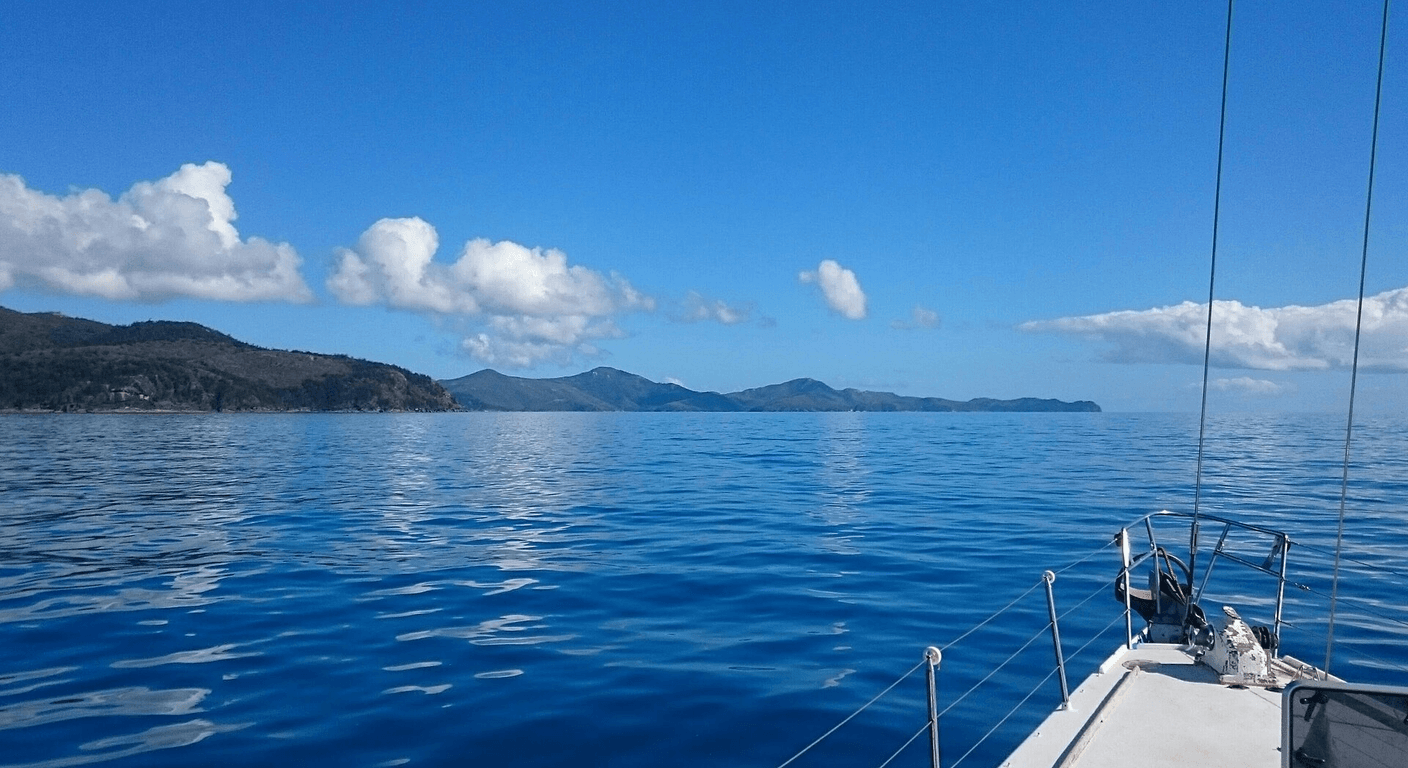
Whitsunday crewed yacht charters suit over-50 travellers seeking a private, small-group sailing holiday without any sailing experience. May to September brings the calmest weather, and charters typically run several days, visiting Whitehaven Beach's silica-white sand and Hill Inlet's turquoise swirl. Mobility is moderate: boarding via marina pontoons or tenders requires reasonable balance, though catamarans reduce rolling motion. Departures are from Airlie Beach or Hamilton Island marinas, with a professional skipper and host handling all sailing duties.
What exactly is a crewed charter — and how does it differ from bareboat?
A bareboat charter hands you the keys and assumes you know what to do with them. A crewed charter is the opposite arrangement entirely. You board a yacht — most commonly a sailing catamaran between 45 and 65 feet — that comes with a professional skipper to handle all navigation, anchoring and seamanship, and a host (sometimes called a deck hand or chef-host) who manages meals, provisioning and the day-to-day comfort of guests. Your job is to enjoy the Whitsundays. That's the whole brief.
This distinction matters enormously for over-50 travellers who've never sailed, or who sailed decades ago and have no interest in refreshing their chart-reading skills in open water. The crewed model is genuinely relaxing rather than theoretically relaxing — nobody is quietly stressed about the anchor dragging at 2am, because that's the skipper's concern, not yours.
Small-ship cruises departing Airlie Beach (operators like Fantasea or Cruise Whitsundays) offer a similar hands-off experience but typically carry 30 to 120 passengers on powered vessels with structured itineraries. A crewed sailing charter, by contrast, carries four to twelve guests on a vessel that feels genuinely intimate. You're not sharing a buffet with strangers; you're sailing with friends, or meeting a small number of like-minded travellers if you book individual cabins on a shared charter.
What do the boats look like, and what's the cabin situation?
Most crewed charters in the Whitsundays operate catamarans rather than monohulls, and that's a practical advantage for older travellers. Catamarans are significantly more stable underway — the two-hull design reduces the rolling motion that makes some people miserable on traditional yachts. They also offer a wide, flat cockpit and saloon area that's genuinely comfortable for spending long anchored afternoons without feeling cramped.
Typical configurations on a 50-55 foot crewed catamaran include two to four guest cabins, each with a double or queen berth and a private or semi-private ensuite. Couples booking a private charter have the vessel to themselves (plus crew, who have their own forward cabin). Those booking a shared charter — the more economical option — may share with one or two other couples. It's worth asking operators directly how many guests maximum they carry, and whether the vessel has been configured with comfort in mind rather than maximum revenue.
Headroom in cabins varies by vessel. Some newer charter catamarans offer generous standing headroom; older boats may require ducking in the companionway. Beds in the hulls are typically accessed via a short ladder or steep steps from the saloon — not a problem for most people, but worth factoring in if you have significant knee or hip limitations. Ask the operator to describe the specific boat, not just the class.
Getting aboard: the honest story on boarding and mobility
Boarding a charter yacht in the Whitsundays is not like stepping onto a cruise ship via a covered gangway. Depending on where the vessel is berthed — Airlie Beach marina, Hamilton Island marina, or picked up from a mooring — you'll typically step from a marina pontoon down onto a swim platform, or transfer from a tender (a small inflatable dinghy) that ferries guests from shore or anchorage. Both require a reasonable degree of balance and the ability to step down and across a moving surface.
Once aboard and underway, the deck is not flat. Catamarans are more stable than monohulls, but there's still movement at anchor and in a breeze, and moving around the vessel — particularly forward on the trampoline netting between the hulls — requires confident footing. The cockpit and saloon are the most accessible areas and where most guests spend the majority of their time. If you use a walking aid on land, discuss this frankly with operators before booking; most will be honest about whether their vessel suits your situation.
There are no industry-wide accessibility standards for charter yachts equivalent to those for hotels or cruise ships. Operators generally don't carry hoists, grab rails to medical standards, or mobility aids. The Whitsundays charter experience suits travellers who are mobile and reasonably steady on their feet, even if they move more slowly or carefully than they did at 45. It's not suited to those with significant balance impairment, severe hip or knee restrictions, or anyone who would struggle to self-evacuate in an emergency. Ask operators directly — the good ones will tell you straight.
What does a typical day actually look like?
The rhythm of a crewed Whitsundays charter is one of its great appeals. There's no fixed schedule. A typical day might begin with coffee in the cockpit at anchor, breakfast prepared by the host, then a morning sail of one to three hours to the next anchorage — often with the islands of the Whitsunday Group or the outer reef fringing the horizon. Short sails are the norm, not the exception. This is not an offshore passage; most anchorages are within ten to twenty nautical miles of each other.
Whitehaven Beach — the seven-kilometre silica beach in Whitsunday Island National Park — is the centrepiece of most itineraries and justifiably so. Access is via tender to the beach, which involves a short wet landing or a dry step onto a beach pontoon depending on conditions and the operator's tender. The beach itself is flat and easy to walk; Hill Inlet lookout above the northern end involves a moderate uphill walk of around twenty minutes on a formed path. It's worth the effort on a clear morning when the tidal patterns in the inlet create that much-photographed swirl of white and turquoise.
Snorkelling is typically offered at reef sites around Hook Island and the outer Bommie reefs. Entry is usually via the swim platform at the stern, with a ladder back up. Operators often provide flotation aids and guidance. For non-swimmers or those who prefer to stay dry, a glass-bottomed kayak or simply watching from the cockpit is perfectly valid — nobody will pressure you in. Afternoons at anchor in a protected bay, perhaps with a book and a glass of local white, are considered entirely legitimate use of the charter.
What does it cost, and is it worth comparing to other options?
Crewed charter pricing in the Whitsundays is not modest, and it's worth being clear-eyed about that. For a shared crewed catamaran charter — where you book one or two cabins on a vessel with other guests — indicative costs run from around $700 to $1,200 per person per day, all-inclusive of meals, snorkelling equipment, national park fees and fuel. These are indicative figures only; actual pricing varies significantly by operator, vessel quality, season and inclusions. Confirm current rates directly with operators before making any assumptions.
A private crewed charter — the whole boat to yourselves — commands a higher base rate, typically from around $3,500 to $6,000 or more per day for the vessel, again indicative and operator-dependent. Split across four to six guests (two or three couples), the per-person daily cost becomes more comparable to the shared option. For a group of friends who've been talking about doing something properly together, this is worth the conversation.
By comparison, a three-night small-ship cruise from Airlie Beach with an operator like Fantasea runs at a substantially lower price point — roughly $500–$800 per person for the package, indicative — but the experience is fundamentally different: larger groups, structured timetables, less flexibility. A crewed charter offers something closer to a private floating holiday home. Whether that premium is worth it depends entirely on what you're after. For couples who value quiet, genuine engagement with the islands and the company of a small group, the charter model tends to justify itself.
Seasickness, weather and the realities of sailing in the Whitsundays
The Whitsundays sit inside the Great Barrier Reef Marine Park, which provides significant protection from ocean swell — one reason the region is considered among Australia's most benign sailing grounds. That said, 'benign' is relative. The Coral Sea can produce short, choppy wind-driven chop in the passages between islands, particularly in the afternoon when the trade winds build. Catamarans handle this better than monohulls, but if you're prone to motion sickness, bring medication and discuss it with your doctor before departure. Stugeron (cinnarizine) and Scopoderm patches are commonly used; ask your GP what's appropriate for you given any existing medications.
May to September is the recommended window for most over-50 travellers. Winds are more consistent and from the south-east — ideal for sailing — temperatures are comfortable rather than oppressive, and the humidity of the wet season (November to April) is absent. Cyclone season runs roughly November to April; reputable operators will not sail in dangerous conditions, and most will offer rescheduling or refund provisions for weather cancellations, but confirm the specifics in your charter agreement.
Weather-dependent itineraries are an inherent reality of sailing, not a failure of planning. Anchorages may change, Whitehaven may be visited on day two instead of day one, and occasionally an exposed snorkel site is skipped in favour of a sheltered alternative. A good skipper reads conditions and adjusts. The flexibility of a private or small-group charter — as opposed to a fixed-itinerary cruise — is actually an advantage here, because the skipper can make real-time decisions that serve the guests rather than a printed schedule.
Practical planning: when to book, what to pack, and what to ask
Book three to six months ahead for the May–September peak season, particularly if you have specific dates or want a private charter. Popular operators fill quickly in June, July and August, which coincide with Victorian and New South Wales school holidays — a period that can also mean more families on the water. If flexibility allows, late May, early September or the shoulder of October can offer quieter anchorages and occasionally lower rates. Confirm directly with operators.
Packing for a charter is genuinely minimal, which is one of its pleasures. Soft-sided bags or duffels are strongly preferred over hard suitcases — there's limited storage space in cabins and rigid luggage is awkward on boats. Bring reef-safe sunscreen (required in the Marine Park), a broad-brimmed hat, light long-sleeved layers for evening and wind, non-slip shoes with white or non-marking soles, and any prescription medications in sufficient supply for the trip plus a few days' buffer. Leave the formal wear at home.
Before booking, ask your operator these specific questions: What is the exact vessel and its cabin configuration? How do guests board — marina pontoon, tender, or swim platform? What is the maximum number of guests? Are there grab handles in the cabin and bathroom? What is the onboard first-aid capability and the skipper's medical training level? How far is the nearest medical facility from typical anchorages, and what is the emergency evacuation plan? A reputable operator will answer all of these without hesitation. If they're vague or dismissive, that tells you something. Comprehensive travel insurance with medical evacuation cover is non-negotiable — ensure your policy covers pre-existing conditions and is valid for activities including sailing.
Quick planning guide
| Ideal pace | Slow-paced, flexible days at anchor with no fixed schedule |
|---|---|
| Best months | May to September, when winds are consistent and conditions are calmest |
| Suggested stay | Multi-day charter of several days, hopping between anchorages |
| Mobility level | Moderate — reasonable balance needed for boarding via pontoon or tender and moving around a moving deck |
| Cost level | Premium — roughly $700–$1,200pp/day shared, higher for a private charter |
| Comfort level | High — private or semi-private cabins, catered meals and a small-group, intimate setting |
| Best for | Couples wanting genuine island immersion without sailing skills or large-ship crowds |
| Main planning consideration | Confirm vessel configuration, boarding arrangements and onboard medical capability directly with the operator, and secure comprehensive travel insurance with evacuation cover |
Key takeaways
- A crewed charter puts a professional skipper and host between you and the complexity — guests sail the Whitsundays without touching the helm.
- May to September offers the calmest, most comfortable sailing conditions in the Whitsundays for over-50 travellers.
- Indicative costs run from around $700–$1,200 per person per day for a shared crewed catamaran, all-inclusive — confirm current pricing directly with operators.
- Catamarans are significantly more stable than monohulls, but boarding via swim platforms and tenders still requires reasonable agility and balance.
- Book three to six months ahead for peak season; ask operators directly about vessel accessibility, boarding arrangements and onboard medical capability before committing.
- Comprehensive travel insurance with medical evacuation and pre-existing condition cover is essential for any Whitsundays sailing charter.
Recommended partners and links
Indicative prices only — always confirm with the operator before booking.
Frequently asked questions
Do I need any sailing experience to join a crewed charter in the Whitsundays?
No sailing experience is required for a crewed charter. The skipper handles all navigation, anchoring and seamanship; the host manages meals and day-to-day comfort. Guests are passengers who can help with sails if they wish, or simply enjoy the experience from the cockpit.
What are the best months for a Whitsundays crewed charter for over-50 travellers?
May to September is the recommended window. Winds are consistent from the south-east, temperatures sit between roughly 22 and 28°C, humidity is low, and the region is outside cyclone season. June and July are the most popular months and book out earliest.
Is a crewed charter suitable for someone with limited mobility?
It depends on the degree of limitation. Boarding typically involves stepping down onto a swim platform or transferring from a tender, and moving around the vessel requires steady footing on an occasionally moving surface. Crewed charters are not suited to those with significant balance impairment or who need mobility aids. Discuss your specific situation directly with any operator before booking.
How does a crewed charter compare to a small-ship cruise from Airlie Beach?
Small-ship cruises carry 30 to 120 passengers on powered vessels with structured itineraries and are generally less expensive. A crewed sailing charter carries four to twelve guests on an intimate vessel with a flexible itinerary tailored to conditions and guest preferences. The charter experience is more private and immersive; the cruise is more social and budget-accessible.
What should I ask a Whitsundays charter operator about medical facilities?
Ask about the skipper's first-aid training level, what medical equipment is carried onboard, how far typical anchorages are from the nearest medical facility, and what the emergency evacuation procedure is. Also confirm whether the operator's cancellation policy covers weather-related changes. Reputable operators answer these questions readily.
- Tourism Whitsundays — official regional tourism body
- Great Barrier Reef Marine Park Authority — Whitsundays
- Parks and Wildlife Service Queensland — Whitsunday Island National Park
- Sailing La Vagabonde — Whitsundays sailing content (YouTube)
- Hamilton Island — marina and charter base information
- Smartraveller — travel insurance and health advice for Australian travellers