Angkor Wat rewards a slower approach: three considered temple mornings, a licensed local guide and a private tuk-tuk, spread across a five- to seven-night Siem Reap stay, let travellers take in Angkor Wat, the Bayon, Ta Prohm and Banteay Srei without the exhaustion of a single marathon day. Mobility is moderate — original stairways are near-vertical, but flat galleries and ground-level viewing keep it manageable. There are no direct flights from Australia; access is via a Singapore or Bangkok connection, often broken with a one-night stopover.
Why Three Days Beats One Marathon
The standard travel-industry pitch — see Angkor in a single day — works fine if you're thirty and fuelled by ambition. For everyone else, it's a recipe for heat exhaustion, sore knees, and the blurring sensation that all temples look the same by 2pm. They don't. They just look that way when you're overtired.
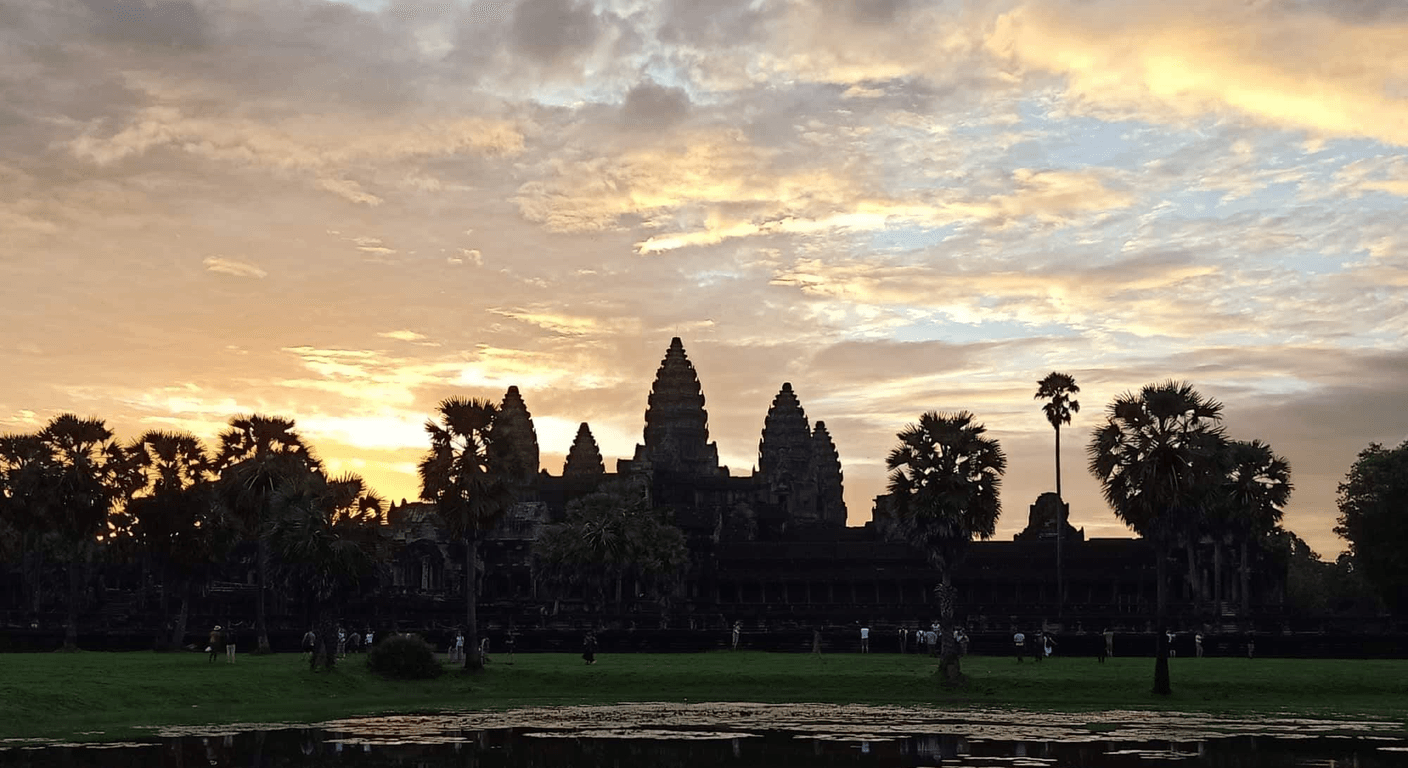
Spread your temple visits across three mornings and the complex reveals itself properly. Day one belongs to the main Angkor Wat circuit and the reflection pool at dawn if you choose — more on that shortly. Day two is for the walled city of Angkor Thom, the Bayon's tower of faces, and the jungle-swallowed Ta Prohm. Day three can be gentler: smaller temples like Banteay Srei, an hour's drive north, where the pink sandstone carvings are extraordinarily fine and the crowds are thinner.
This pace also gives your body time to adjust. Siem Reap sits at roughly 13 degrees latitude; even in the dry season, temperatures reach the low-to-mid thirties by mid-morning. A tuk-tuk ride back to the hotel, a long lunch, and an hour by the pool isn't indulgence — it's simply how the day works best.
The Honest Truth About Sunrise — and Temple Steps
Sunrise at Angkor Wat is on every photographer's list, and there are mornings when the reflection in the lotus pond is genuinely worth the 4:30am start. But those mornings have also become extremely crowded — hundreds of people, phone screens glowing in the dark, jostling for the same angle. If that sounds like your idea of a good time, go. If it sounds exhausting, know that the temple at 7am, once the sunrise crowd has thinned, is almost as beautiful and considerably more peaceful.
The steepness of Angkor's original stairways deserves an honest mention. Angkor Wat's central tower stairways are roughly 70 degrees — nearly vertical by modern standards, with worn stone steps and limited handrails. Many travellers over 50 choose to appreciate the towers from the lower galleries rather than climb them, and there's no loss in doing so. The bas-relief galleries alone — nearly 800 metres of carved narrative — take a good hour to walk and are entirely flat. Ta Prohm is similarly manageable, with root-draped ruins that are more atmospheric than physically demanding.
A licensed local guide is genuinely useful here, and not merely as a map. A good guide reads the crowd, knows which temple is quietest at what hour, and will quietly steer you away from a stairway that isn't worth the risk. Engaging one through your hotel or a reputable operator rather than accepting an approach at the gate is strongly recommended.
Getting Around: Tuk-Tuks, Drivers, and Why You Don't Need a Tour Group
A private tuk-tuk — the open-sided three-wheeler that is Siem Reap's default transport — costs an indicative USD 15 to 25 for a full day of temple touring, though confirm current rates with your hotel or driver. For a couple, that's genuinely modest. The breeze from a moving tuk-tuk is one of the most effective heat-management tools available, and having a dedicated driver who waits for you at each site removes any logistical anxiety about getting back.
Many hotels can arrange a driver-and-guide combination, or the two separately. A licensed guide typically costs around USD 25 to 40 for a half-day — again, indicative only, confirm before booking. The Cambodian Guides Association of Angkor trains and certifies guides, and the quality is generally high. They carry the context that makes the difference between looking at stone and actually understanding what you're seeing: the Churning of the Ocean of Milk depicted across an entire gallery wall, the meaning of the naga balustrades, the reason Ta Prohm was left partially unrestored.
Large group bus tours do operate, and for some solo travellers the social dimension is welcome. But for couples — particularly those who prefer to linger at a carving, sit quietly in a courtyard, or duck out early when the heat rises — a private arrangement is simply more comfortable. You set the pace. That matters.
Managing the Heat: A Practical Midday Strategy
The temples face east, which means the light is best — and the crowds thinnest — between 6:30am and 9am. By 10am the sun is overhead and the stone radiates heat. Most experienced visitors do their serious temple time in the early morning, return to the hotel by 11:30am, and spend two to three hours in the air-conditioned cool or by the pool before a late afternoon return for the golden hour. This rhythm suits older travellers particularly well, and it's not a compromise — it's the sensible way to structure the day.
Hydration is non-negotiable. Water bottles are sold everywhere at the temples, but carrying a good reusable bottle and refilling at your hotel before departure saves money and plastic. Light, loose linen or cotton in neutral colours is the practical dress code; temples require covered shoulders and knees, so a light scarf or sarong in a bag handles that easily. Comfortable, closed-toe shoes with grip are strongly preferred over sandals on uneven stone.
If you're managing a health condition — arthritis, a heart condition, diabetes — the heat is a real variable to factor into your travel insurance and your daily planning. Cambodia's medical facilities outside Phnom Penh are limited; Siem Reap has a small number of international-standard clinics, but serious emergencies require medical evacuation to Bangkok. Comprehensive travel insurance that covers pre-existing conditions and medical evacuation is not optional. Compare policies carefully and declare everything.
Siem Reap Beyond the Temples
Siem Reap is a more pleasant town than its reputation as a temple-adjacent stopover suggests. The Pub Street area can be skipped without regret, but the streets around the Old Market (Psar Chas) offer genuinely good Cambodian food at modest prices — fish amok, Khmer curry, and lok lak (stir-fried beef with a lime-pepper dipping sauce) are all worth seeking out. The Mekong Rustic restaurant near the river and the Mahob restaurant at Park Hyatt are two well-regarded options at opposite ends of the price scale; confirm current hours and bookings directly.
The Angkor National Museum, a short tuk-tuk ride from the temple complex, provides the architectural and religious context that makes the ruins more legible — if you can visit before your first temple day, it's worthwhile. The museum is air-conditioned, fully accessible on flat floors, and takes about two hours at a comfortable pace. Check current admission prices and hours at angkornationalmuseum.com.
For Indian Australian travellers, the vegetarian and South Indian food options in Siem Reap are more limited than in Bangkok or Singapore, but improving. Several restaurants cater to Indian tour groups and offer reliable vegetarian menus — your hotel concierge will know which ones are currently operating. A small note: the local cuisine uses fish sauce extensively, so it's worth asking clearly about vegetarian preparation.
Getting There: Flights, Stopovers, and the First Night
There are no direct flights from Australia to Siem Reap. The most common routing is via Singapore (Singapore Airlines, Scoot) or Bangkok (Thai Airways, Bangkok Airways), with total travel time from Sydney or Melbourne typically nine to twelve hours including the stopover and onward connection. The Singapore option connects to Siem Reap via SilkAir or Scoot; the Bangkok option often connects via Bangkok Airways. Confirm current routes, as airline schedules change — some itineraries now route through Phnom Penh with an onward domestic connection.
A one-night stopover in Singapore or Bangkok is a reasonable strategy if long-haul travel is taxing. It breaks the journey, allows a proper night's sleep, and means you arrive in Siem Reap in reasonable shape rather than bleary and stiff. Singapore's Changi Airport has excellent transit hotels for shorter layovers; Bangkok's Suvarnabhumi has similar options. The additional cost is modest against the benefit.
Jet lag from Southeast Asia is less severe than long-haul to Europe or North America — the time difference from Melbourne or Sydney is three to four hours — but the heat and humidity on arrival can amplify fatigue. Plan a quiet first afternoon: check in, hydrate, eat something light, and sleep at local time. Don't schedule a temple visit on arrival day.
Practicalities: Visas, Insurance, Money, and Staying Safe
Australian passport holders can apply for a Cambodian e-visa online before departure — the official portal is evisa.gov.kh. The fee is indicative around USD 30; confirm the current amount and processing time before applying, as these can change. Visa on arrival is also available at Techo International Airport, but completing the e-visa in advance removes one queue from an already long travel day. Always check the current entry requirements on smartraveller.gov.au, which is the Australian Government's official travel advisory site.
Cambodia is largely a cash economy, particularly for tuk-tuks, market purchases, and smaller restaurants. US dollars are widely accepted alongside the Cambodian riel; Australian dollars are not. Drawing USD from an ATM in Siem Reap (a fee typically applies, confirm with your bank) or exchanging at the airport is straightforward. Keep small denominations — exact change is appreciated and avoids confusion.
The Australian Government's smartraveller.gov.au site rates Cambodia as 'exercise a high degree of caution' — read the current advisory before travelling. The main practical concerns for tourists are traffic accidents (always use a seatbelt in any vehicle that has one), petty theft in crowded areas, and the limitations of local medical care noted above. Register your travel plans on the Smartraveller website so the Australian Government can reach you in an emergency. Siem Reap is generally considered safe and welcoming for tourists, including solo women travellers, but the usual common-sense precautions apply after dark.
Quick planning guide
| Ideal pace | Slow and considered — three temple mornings rather than one exhausting day |
|---|---|
| Best months | Dry season mornings recommended, though heat still builds by mid-morning |
| Suggested stay | 5-7 nights in Siem Reap, including a flight stopover |
| Mobility level | Moderate — steep original stairways exist but are easily skipped for flat galleries and ground-level viewing |
| Cost level | Budget-friendly for tuk-tuks and guides; dining and hotels range from modest to premium |
| Comfort level | Comfortable, well-serviced town with hotels that support a proper midday rest |
| Best for | Couples over 50 wanting a relaxed, guided cultural experience over a rushed group tour |
| Main planning consideration | Managing midday heat and temple stairways, plus comprehensive travel insurance covering medical evacuation |
Key takeaways
- Three half-day temple visits across five to seven nights delivers a far richer experience than a single exhausting full-day circuit.
- Angkor's original stone stairways are near-vertical and worn — most key temples offer rewarding ground-level access that skips the climb entirely.
- A private tuk-tuk and licensed local guide costs an indicative USD 40 to 65 for a day and transforms the comfort and depth of the visit.
- The ideal Angkor routine is early morning temples, midday hotel rest, and an optional late-afternoon return for golden-hour light.
- Australians fly to Siem Reap via Singapore or Bangkok with no direct options — a one-night stopover to break the journey is worth considering.
- Travel insurance covering pre-existing conditions and medical evacuation is essential; medical facilities in Siem Reap are limited, with serious cases evacuated to Bangkok.
Recommended partners and links
Indicative prices only — always confirm with the operator before booking.
Frequently asked questions
Is Angkor Wat suitable for travellers over 50 with knee or mobility concerns?
Yes, with realistic planning. The main Angkor Wat bas-relief galleries are entirely flat and accessible. The steep original tower stairways can be skipped without missing the temple's most significant features. A private local guide will know which areas are accessible and can plan a route that avoids unnecessary climbs. Uneven stone underfoot is the main challenge — wear closed-toe shoes with good grip and take your time.
How many days do you need at Angkor Wat?
A three-day temple pass is the right choice for most travellers over 50. It allows one day each for the main Angkor Wat circuit, the Angkor Thom complex including the Bayon and Ta Prohm, and a quieter third day at smaller temples like Banteay Srei. Spreading visits across five to seven nights in Siem Reap allows for midday rest and prevents the fatigue that turns great ruins into a blur.
Do Australians need a visa for Cambodia?
Yes. Australian passport holders need a visa for Cambodia. The most convenient option is an e-visa applied for online before departure at evisa.gov.kh. Visa on arrival is also available at Techo International Airport. The fee is indicative around USD 30 — confirm the current amount and processing time before booking. Always check the latest entry requirements at smartraveller.gov.au.
How do you fly from Australia to Siem Reap?
There are no direct flights from Australia to Siem Reap. The main routings are via Singapore (Singapore Airlines or Scoot connecting to Siem Reap) or via Bangkok (Thai Airways or Bangkok Airways). Total travel time from Sydney or Melbourne is typically nine to twelve hours including the stopover. Check current routes and schedules when booking, as airline connections change. A one-night stopover in Singapore or Bangkok is a practical option for breaking the journey.
What is the best time of year to visit Angkor Wat?
November to February is the most comfortable period, with lower humidity and temperatures generally in the high twenties to low thirties Celsius. March and April are very hot. The wet season from May to October brings heavy afternoon rains but also lush green surroundings and fewer visitors. For travellers over 50 managing heat sensitivity, the November to February dry season is the clear recommendation.