Nice makes an ideal single base for a French Riviera stay, best visited in shoulder season — late April to early June or September to October — for comfortable temperatures and lighter crowds. A one-to-two week stay suits the pace, with the flat Promenade des Anglais and a coastal train reaching a dozen towns without a hire car. Mobility is moderate overall: Nice itself is easy, but hill villages like Èze demand real climbing. Flights from Australia run 22 to 26 hours via Singapore, Dubai or Doha, so a recovery night before sightseeing is recommended.
Why Nice works better than you might expect
The French Riviera has a reputation for glamour that can feel exhausting before you've even packed. Monaco's prices, Cannes' film-festival crowds, Saint-Tropez's inaccessibility by train — all of it suggests a destination that rewards the young and the wealthy. Nice sidesteps most of that. It's a real city, France's fifth largest, with a functioning metro area, a university, neighbourhood markets and residents who are not particularly interested in performing luxury for visitors.
For a traveller based in Melbourne or Sydney, the practical case for Nice as a single base is straightforward. The Promenade des Anglais runs flat along the waterfront for nearly six kilometres — genuinely easy walking for most mobility levels. The old town, Vieux-Nice, is compact and largely pedestrianised, its narrow lanes opening onto the Cours Saleya market each morning. And from Nice-Ville station, a single regional rail line threads east and west along the coast, making a dozen towns accessible without a hire car, a tour bus, or a particularly early alarm.
There's a sensible rhythm to building a Riviera stay around Nice. You settle in, you learn the neighbourhood, you discover the boulangerie that gets the fougasse right. Then, when energy and curiosity align, you catch a train. The hotel room is always there when you return. That kind of stability matters more than most travel guides acknowledge — particularly after a 22-plus-hour flight from Australia.
Getting there from Australia: what the journey actually involves
Nice Côte d'Azur Airport is the second-busiest in France. Most Australians will connect through Singapore (Changi), Dubai or Doha, with total travel time from Melbourne or Sydney typically sitting between 22 and 26 hours depending on the connection. Some itineraries involve an overnight in a hub city, which — far from being a nuisance — can serve as a useful halfway reset, especially for travellers managing joint stiffness or sleep disruption.
Jet lag on the Europe run is genuine. France is eight or nine hours behind Australian eastern time in shoulder season (the offset shifts with daylight saving on both ends), which means your body clock will want breakfast at dinner and sleep at lunch for the first few days. A recovery night or two in Nice before any day trips is not indulgence — it's common sense. Book accommodation for arrival night before you plan any sightseeing.
Travel insurance is non-negotiable, and for travellers over 50 with pre-existing conditions, it requires specific attention. Policies vary enormously in what they cover, and a hospital stay in France — while excellent in quality — is not cheap without adequate cover. Compare policies carefully and declare everything. The Australian Government's Smartraveller website (smartraveller.gov.au) carries current entry requirements, visa information for French territory as part of the Schengen Area, and safety advice. Confirm all of this before booking, as rules can change.
The coastal train: your most useful piece of infrastructure
The TER (Train Express Régional) line that runs from Nice along the coast toward the Italian border is one of Europe's more quietly spectacular commuter routes. It hugs cliffs, dips into tunnels, emerges above harbours. And for day-tripping purposes, it's simply the most efficient way to move between towns. Trains are frequent, fares are modest, and most stations along the route are manageable for travellers who don't want to navigate a hire car on narrow Riviera roads.
Eastward from Nice, the key stops are Villefranche-sur-Mer (about seven minutes), Beaulieu-sur-Mer (twelve minutes), Èze-sur-Mer (note: this is the coastal village at sea level, not the hill village of Èze above), Monaco-Monte-Carlo (roughly 25 minutes), and Menton (around 35 minutes). Westward, Antibes is approximately 25 minutes, with Juan-les-Pins adjacent. Cannes is around 30 to 35 minutes. Fares are indicative — confirm current pricing on the SNCF Connect website before travel, as they fluctuate and rail pass eligibility varies for non-European visitors.
A practical note on stations: Nice-Ville is the main terminus and well-serviced, with lifts to platforms. Smaller stations along the line vary in accessibility. If step-free access is a priority, check individual station conditions on the SNCF website or contact them directly. Trains themselves generally have low-floor boarding on this coastal service, but it's worth confirming for any specific journey.
Day trips sorted by effort: what to expect at each stop
Villefranche-sur-Mer demands very little. The walk from the station to the harbour takes about ten minutes, mostly downhill, and the town is compact enough to cover comfortably in a morning. The harbour is pretty, the citadel walls are solid, and the Chapelle Saint-Pierre — decorated by Jean Cocteau in 1957 — is worth the small entry fee. Return to Nice for lunch, or stay for a long seafood lunch at one of the harbourside restaurants. Beaulieu-sur-Mer is similarly flat and gentle, with a fine Belle Époque promenade and the Villa Kérylos, a faithful reconstruction of an ancient Greek residence that's more interesting than it sounds.
Monaco is a day trip that rewards realistic expectations. Yes, the casino is there. Yes, the yachts are impressive. The Oceanographic Museum, perched on a cliff above the sea, is genuinely excellent — substantial marine science exhibits, an aquarium, and views that justify the entry fee. The Palais Princier and the old town around it are walkable. What Monaco is not: relaxing, cheap, or particularly welcoming to anyone not already wealthy. Treat it as a curiosity rather than a destination and you'll enjoy it more. Menton, at the Italian border, is the gentler alternative — a town of lemon groves, a beautiful old cemetery on a hillside (the Cimetière du Vieux Château, if you can manage the steps), and a pace that suits a slow afternoon.
Antibes to the west is a different kind of day. The old town is walled and walkable, the Marché Provençal is one of the better markets on the coast, and the Musée Picasso — housed in the Château Grimaldi where Picasso worked in 1946 — holds a significant collection of his Mediterranean-period work. The harbour at Port Vauban is vast and worth a slow walk. Antibes suits a full day rather than a half-day; take a later train back.
Èze and the hill villages: honest advice on the climb
Èze is the village that appears on every French Riviera mood board — stone lanes, cacti, a ruined castle, views across the sea to Corsica on a clear day. It is genuinely beautiful. It is also perched at 427 metres above sea level, and the medieval village is almost entirely composed of steep, uneven stone steps. There are no lifts, no flat alternatives, and no way to see the best of it without committing to a real climb.
Getting there from Nice involves a bus (the No. 83 from Nice to Èze Village, or a taxi), not the train — the coastal rail stop 'Eze-sur-Mer' is the beach settlement at the bottom of the cliff, connected to the hill village by a very steep footpath called the Nietzsche Path that takes around 45 minutes up and is not recommended for anyone with knee or hip concerns. The bus drops you closer to the village entrance. Even so, allocate honest energy for the day. Go in the morning before the heat builds, wear proper shoes, and take your time.
Other hill villages — Saint-Paul-de-Vence, Gourdon, Peillon — involve similar physical commitment and typically require a hire car or organised tour to reach. If hill villages are a priority and climbing is a concern, consider booking a small-group tour from Nice that handles the logistics, so energy can go into the experience rather than the navigation. Several local operators run half-day excursions; check options through the Nice tourism office.
Nice itself: what to do on the days you don't go anywhere
The Cours Saleya flower and produce market runs Tuesday through Sunday mornings in Vieux-Nice and is one of the better market experiences in France — not because it's unusual, but because it's still a working market used by local restaurants and residents, not purely a tourist performance. Arrive before ten. The socca — a chickpea-flour pancake cooked in a wood-fired oven — is the correct breakfast. There are several vendors; the queues indicate quality.
The Musée Matisse sits in a seventeenth-century Genoese villa in the Cimiez neighbourhood, about a twenty-minute bus ride from the centre. Matisse lived in Nice for much of his later life and is buried nearby. The collection spans his entire career and the building itself is lovely. The Musée d'Art Moderne et d'Art Contemporain (MAMAC) is in the city centre and free on the first Sunday of each month. The Musée des Beaux-Arts, less visited, holds a solid collection of nineteenth and early twentieth-century European work in a Belle Époque mansion.
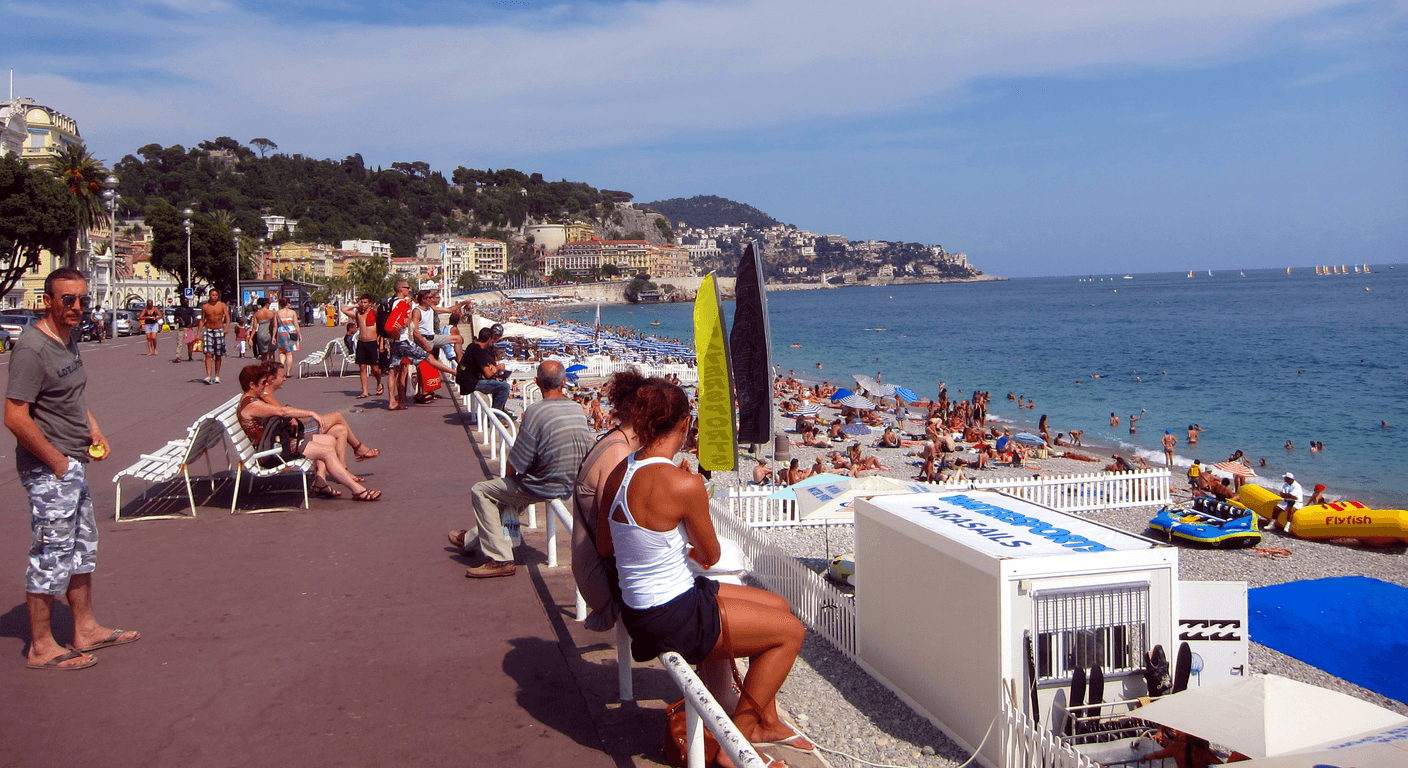
The Promenade des Anglais deserves a morning walk, preferably early before the cycling lanes fill. It's flat, wide, and the sea is always there to the left. The pebble beaches alongside it are accessible and popular, though reef shoes are genuinely advisable — the stones are large and uneven at the waterline. Sun lounger hire is available at most private beach concessions along the promenade, at prices that will feel steep by Australian standards. A rough indicative figure is around €20–€30 for a lounger and parasol for the day, but confirm this on arrival as prices vary by beach and season.
When to go, what it costs, and a few things to sort before you leave
Shoulder season is the clear recommendation. Late April through to early June gives you comfortable temperatures — typically 18 to 24 degrees — without the full weight of July and August, when the Riviera is at capacity, prices peak, and the coastal trains carry the kind of crowds that make day trips less pleasant. September and October are arguably the best months of all: the sea is warm from summer, the light is golden, and the tourist infrastructure is still fully operational. July and August are manageable but require more planning, earlier bookings, and a higher tolerance for queues.
Costs on the French Riviera are genuinely high. A mid-range hotel in Nice in shoulder season might run around AUD $200 to $350 per night for a double room — indicative only, verify directly with properties. Dining out for two at a decent restaurant without being extravagant will likely cost €60 to €100 with wine, more in Monaco. The coastal trains are relatively inexpensive, and Nice's city buses are affordable. The overall budget for a couple over two weeks, including flights, accommodation, dining and activities, will be substantial — plan accordingly and treat any online estimates as rough guides only.
Before booking anything, visit smartraveller.gov.au for current France travel advice, Schengen Area entry requirements for Australian passport holders, and any health or safety notices. France is a Schengen member, which means Australian citizens currently receive a visa-free allowance for short stays — but the European Travel Information and Authorisation System (ETIAS), when it comes into effect, will require pre-registration. Confirm the current status well before departure. Carry a copy of your travel insurance policy, your Medicare card, and any prescription medication documentation. A European Health Insurance Card does not apply to Australians — your private travel insurance is your only coverage.
Quick planning guide
| Ideal pace | Slow — settle into Nice, then day-trip by train |
|---|---|
| Best months | Late April to early June, or September to October |
| Suggested stay | One to two weeks |
| Mobility level | Moderate — flat and easy in Nice, but steep steps in hill villages like Èze |
| Cost level | Premium — high accommodation and dining costs, especially in Monaco |
| Comfort level | Comfortable, stable base with reliable transport links |
| Best for | Over-50 travellers wanting variety without changing hotels |
| Main planning consideration | Book a recovery night on arrival and assess personal mobility before attempting hill villages like Èze |
Key takeaways
- Nice's flat city centre and coastal rail line make it one of Europe's most practical single bases for over-50 travellers.
- The TER coastal train reaches Monaco in around 25 minutes, Antibes in around 25 minutes, and Menton in around 35 minutes — no hire car required.
- Shoulder season (late April to early June, or September to October) delivers the best balance of weather, crowd levels and value.
- Èze village involves steep, uneven stone steps with no lift access — assess honestly before committing the day.
- Pebble beaches are the norm along this coastline; reef shoes are a practical addition to any packing list.
- Check current Schengen entry requirements and ETIAS status on smartraveller.gov.au before booking — rules change.
Recommended partners and links
Indicative prices only — always confirm with the operator before booking.
Frequently asked questions
How long should Australians stay in Nice to make the trip worthwhile?
A minimum of 10 nights is sensible for Australian travellers given the 22-to-26-hour journey. Two weeks allows time to recover from jet lag, explore Nice itself, and take five or six day trips without feeling rushed. Shorter stays exist but leave little room for the slow pace that makes the Riviera rewarding.
Is Nice suitable for travellers with mobility limitations?
Nice's city centre and the Promenade des Anglais are largely flat and accessible. The old town has some uneven cobblestones. Coastal rail destinations like Villefranche-sur-Mer, Beaulieu-sur-Mer, Antibes and Menton are generally manageable. Hill villages including Èze involve steep, uneven stone steps with no lift access and are not suitable for travellers with significant mobility limitations.
Do Australians need a visa to visit France?
Australian passport holders currently enter France and the Schengen Area without a visa for short stays. However, the European Travel Information and Authorisation System (ETIAS) — a pre-registration requirement — is expected to apply to Australian travellers when it comes into effect. Confirm current requirements on smartraveller.gov.au well before booking.
What is the best way to travel between Nice and Monaco, Antibes and Menton?
The regional TER train from Nice-Ville station is the most practical option. Monaco is roughly 25 minutes, Menton around 35 minutes, and Antibes around 25 minutes in the opposite direction. Trains are frequent and fares are modest. Check current timetables and fares on the SNCF Connect website (sncf-connect.com) before travel.
Are the beaches in Nice sandy?
No. Nice's beaches, and most beaches along the French Riviera, are pebble beaches. The stones can be large and uncomfortable underfoot, particularly at the waterline. Reef shoes or water shoes make a significant practical difference. Sun loungers are available for hire at private beach concessions along the Promenade des Anglais at indicative daily rates — confirm current pricing on arrival.