Andalusia — Seville, Granada and Córdoba — best suits over-50s in spring (April–May) or autumn (September–October); summer heat above 40 degrees is a health risk. The highlight is the region's Moorish monuments — Seville's cathedral and Alcázar, Granada's Alhambra, Córdoba's Mezquita — all walkable from hotels. Mobility is moderate: flat centres but steep, uneven paths at the Alhambra and Albaicín. Fast AVE trains link the three cities, making a multi-day trip easy without a car.
Why Andalusia works so well for travellers over 50
There is a particular kind of travel that becomes possible once you stop measuring a trip by how many sites you ticked off. Andalusia rewards exactly that shift. The three cities at the heart of this region — Seville, Granada and Córdoba — are compact enough to navigate on foot from a central hotel, rich enough to hold your attention for days without effort, and culturally wired around a rhythm that happens to align almost perfectly with the needs of an older traveller: a long morning of activity, a genuine midday rest, and a slow, sociable evening.
For a solo female traveller, the region also has practical advantages that matter. Spain's city centres are well-lit, busy well into the night, and the paseo culture — the evening stroll where everyone from grandmothers to teenagers is out on the street — means you are never conspicuously alone. Sitting at a bar counter for tapas is entirely normal for one person, and Spanish bar staff tend to be matter-of-fact rather than attentive in a way that feels intrusive. The cities are also used to independent international visitors and English is widely spoken in tourist areas, though a few words of Spanish — buenas tardes, una mesa para uno, la cuenta — go a long way toward warmth.
The Italian Australian ear will also find Andalusian Spanish more familiar than Castilian: the soft cadence, the vowel-heavy endings, the unhurried delivery. It is not Italian, but it is not entirely foreign either. That small comfort of partial comprehension makes solo navigation feel less effortful than it might in, say, northern Europe.
When to go — and why summer is a genuine health risk, not just uncomfortable
This needs to be said plainly: Andalusia in July and August regularly records temperatures above 40 degrees Celsius, and in recent years Seville has been among the hottest cities in all of Europe during summer. For travellers over 60, that level of heat is not a matter of personal preference — it is a serious risk of heat exhaustion and heat stroke, conditions that can escalate quickly and that are made worse by the fact that many of the region's great monuments involve long queues in exposed courtyards, cobbled streets with no shade, and limited seating. Do not plan this trip for summer.
The ideal windows are late March to early June and mid-September to early November. In these months, daytime temperatures sit roughly between 18 and 28 degrees — warm enough to enjoy the outdoor life that defines Andalusia, cool enough to walk comfortably for a few hours at a stretch. April and October are the sweet spots. Spring brings the orange blossom scent that fills Seville's streets and the famous Semana Santa (Holy Week) and Feria de Abril festivals, though those weeks bring significant crowds and accommodation prices rise sharply — worth knowing before you book.
Autumn is the quieter, arguably more comfortable choice for solo travellers who prefer a lower-key atmosphere. Crowds thin after mid-September, accommodation prices ease, and the light in October has a quality that makes the ochre and terracotta of these cities particularly warm. Pack a light layer for evenings in October and November — temperatures can drop to around 12–15 degrees after dark.
Seville: the cathedral, the barrio and the art of the evening paseo
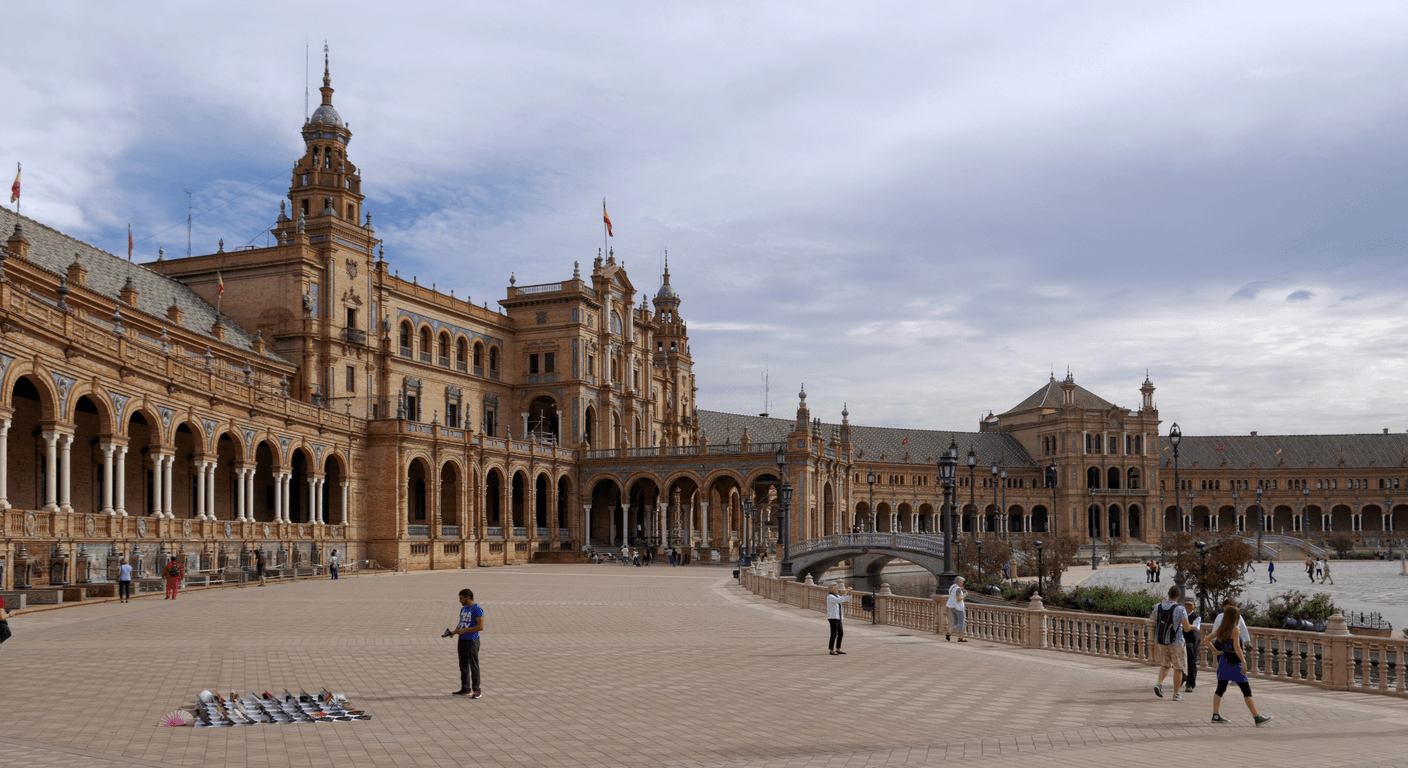
Seville is the largest of the three cities and the one that rewards a slower pace most generously. The historic centre is largely flat — important for anyone managing knees or a bad hip — and the main monuments cluster within reasonable walking distance of each other in the Santa Cruz and El Arenal barrios. The Catedral de Sevilla, the largest Gothic cathedral in the world, is the obvious anchor. Allow a full morning and book tickets in advance through the cathedral's official website (catedraldesevilla.es) to skip the queue at the door. The interior is vast and cool, the Giralda tower offers a ramp rather than stairs to the top — a genuine accessibility consideration — and the views over the city from the top repay the climb.
The Real Alcázar, a royal palace complex immediately adjacent to the cathedral, is arguably the more beautiful of the two. The Mudéjar architecture — intricate tilework, carved plasterwork, shaded garden courtyards with fountains — has a quality of stillness that suits a slow morning. Again, pre-book through the official Alcázar website (alcazarsevilla.org) and go early; the gardens in particular become busy by midday. Both the cathedral and Alcázar have some uneven stone surfaces and limited seating inside, so comfortable, flat-soled shoes are not optional.
The evening paseo is one of those cultural practices that sounds like a tourist description until you actually do it. From around 7pm, the streets of the Barrio Santa Cruz and along the riverfront Paseo de Cristóbal Colón fill with locals of all ages — not performing for visitors, simply living. Find a table at a bar with outdoor seating, order a glass of fino sherry or a tinto de verano (red wine with lemon soda, lighter than it sounds), and watch. The Spanish do not eat dinner until 9pm or later, which initially feels disorienting for Australians used to a 6.30 sitting. The practical adjustment is to treat the tapas hour — roughly 7 to 9pm — as a substantial grazing meal rather than a prelude to something else.
Granada and the Alhambra: what you need to know before you book anything else
The Alhambra is one of the most visited monuments in Europe, and the ticketing system reflects that reality in ways that catch travellers off guard. Timed-entry slots for the Nasrid Palaces — the jewel of the complex — are released in advance and sell out weeks, sometimes months, ahead during the spring and autumn peak seasons. The single most important logistical step for any trip to Granada is to secure Alhambra tickets before you book flights or accommodation. Go directly to the official Patronato de la Alhambra website (alhambra-patronato.es) and do not use third-party resellers, who charge unnecessary premiums and occasionally sell invalid tickets.
The Alhambra complex sits on a hill above the city, which means there is an uphill approach however you arrive. The city bus (Line 111 from Plaza Nueva) takes you to the main entrance and is the most practical option for anyone who finds hills difficult. Once inside, the site is extensive and involves significant walking on uneven stone paths. Comfortable shoes with good grip are essential. The Generalife gardens — the summer palace gardens above the main complex — are among the most peaceful parts of the visit and worth the extra time; they are also slightly less crowded than the palaces themselves.
Granada's city centre, in the Albaicín neighbourhood below the Alhambra hill, is a UNESCO World Heritage area of Moorish-era laneways that is genuinely beautiful and genuinely steep. It is worth exploring at your own pace with no particular agenda — a tea house (tetería) for mint tea in the afternoon, a bench in the Plaza de San Nicolás for the famous view back across to the Alhambra at dusk. Be aware that the cobblestones in the Albaicín are uneven and some laneways are quite steep; anyone with balance concerns or mobility aids should pick their route carefully and stick to the wider streets.
Córdoba and the Mezquita: a half-day or a full day?
Córdoba sits between Seville and Granada on the rail line, which makes it a natural stop rather than a detour. The Mezquita-Catedral de Córdoba — the great mosque-cathedral that is the city's defining monument — is unlike anything else in Europe: a forest of red-and-white striped arches built by the Umayyad caliphate in the eighth century, into which a Renaissance cathedral was inserted in the sixteenth. The juxtaposition is either jarring or fascinating depending on your architectural sensibilities, but the sheer scale and the quality of the light inside make it worth the visit regardless. Book through the official Mezquita website (mezquita-catedraldecordoba.es) and go early morning when the light through the windows is at its best and the crowds are thinnest.
The Judería, the old Jewish quarter surrounding the Mezquita, is compact, flat and easily navigable. The Alcázar de los Reyes Cristianos, a short walk away, has extensive gardens that are pleasant in spring. Córdoba's restaurant scene is quieter and less touristy than Seville's, and the local speciality — rabo de toro, slow-braised oxtail — is worth seeking out for lunch. A half-day is enough to see the Mezquita and walk the Judería; a full day allows for the Alcázar, lunch at leisure, and an afternoon rest before the evening train.
As a practical note: Córdoba in summer is, if anything, hotter than Seville. The city sits inland in a bowl of hills and has historically recorded some of the highest temperatures in Spain. The spring and autumn advice applies here with equal force.
Getting between the cities: the AVE train and how to use it
Spain's AVE high-speed rail network is the backbone of any Andalusian itinerary and it is genuinely good — punctual, comfortable, air-conditioned and far less stressful than driving on unfamiliar roads in a foreign country. The Seville–Córdoba leg takes around 45 minutes; Seville–Granada takes roughly three hours (with some services requiring a change); Córdoba–Granada takes around two hours. All three are served by Renfe, the Spanish national rail operator, and tickets are booked at renfe.com.
Book Renfe tickets as soon as your dates are confirmed. Early booking typically yields the cheapest fares — indicative prices for a single leg in second class (which is perfectly comfortable) run roughly AUD 20–70 depending on route and timing, but confirm current fares directly with Renfe as pricing changes. The Tarjeta Dorada (senior rail card) is available in Spain for travellers over 60 and offers discounts on many Renfe services; it is worth investigating at a Spanish train station on arrival, though the savings depend on your itinerary.
Luggage logistics matter for solo travellers. Andalusian city centres have a mix of accommodation from large hotels with lifts to small boutique guesthouses in historic buildings — the latter often have no lift and narrow stairways. When booking, check explicitly for lift access if you have any mobility concerns or are travelling with a larger bag. A medium-sized rolling carry-on is the practical maximum for navigating cobblestone streets and train station platforms without difficulty.
Tapas culture, meal times and eating alone with confidence
Eating alone in Spain is socially unremarkable in a way that is genuinely refreshing. Bar counters are designed for solo diners — you stand or perch on a stool, point at what looks good in the glass display case, and the transaction is efficient and friendly without being performative. Tapas in Andalusia often follow a regional tradition where a small free tapa comes with each drink ordered; in Granada this tradition is particularly strong and a glass of wine or beer might arrive with a plate of jamón, a small bowl of stew, or a slice of tortilla at no extra charge. Order at the counter, eat, move on — there is no expectation of a formal sit-down experience unless you want one.
The meal time adjustment is real and worth planning around rather than fighting. Lunch is the main meal of the day and runs from roughly 2 to 4pm — this is when the best-value menú del día (fixed-price lunch menu, typically two courses plus bread and a drink) is available, often for roughly AUD 15–20 at a neighbourhood restaurant. Dinner does not start until 9pm and the kitchen may not be in full swing until 9.30. For travellers who find late eating difficult, the practical solution is to eat a substantial menú del día lunch, rest through the hottest afternoon hours, and treat the evening tapas hour as a lighter social meal rather than a full dinner.
A few words of Spanish make a meaningful difference at the table. Una ración is a full serving, a media ración is a half-serve good for one person, and una tapa is the smallest portion. La cuenta, por favor gets the bill without awkwardness. Tipping is not mandatory in Spain but rounding up or leaving a euro or two at a sit-down restaurant is customary. In a bar, nothing is expected. Water is not automatically brought to the table — ask for agua, either con gas (sparkling) or sin gas (still).
Quick planning guide
| Ideal pace | Slow-paced, with a genuine midday rest built into each day |
|---|---|
| Best months | Late March–early June and mid-September–early November; avoid July–August entirely |
| Suggested stay | A relaxed multi-day trip split across Seville, Granada and Córdoba, linked by train |
| Mobility level | Moderate — flat, walkable city centres, but steep hills and uneven cobblestones at the Alhambra and Albaicín |
| Cost level | Mid-range — menús del día around AUD 15–20, AVE train legs roughly AUD 20–70, accommodation prices rise sharply in peak spring festival weeks |
| Comfort level | High for solo travellers — well-lit cities, solo-friendly bar culture, English widely spoken in tourist areas |
| Best for | Solo travellers over 50 who want substance over spectacle and are comfortable adjusting to a later meal rhythm |
| Main planning consideration | Book Alhambra tickets through the official Patronato website before booking flights or accommodation |
Key takeaways
- Andalusia's spring (April–May) and autumn (September–October) are the only sensible windows for travellers over 60 — summer heat above 40 degrees is a genuine health risk, not a minor inconvenience.
- Alhambra tickets for the Nasrid Palaces sell out weeks in advance; booking through the official Patronato website before you book anything else is the single most important logistical step.
- Spain's AVE high-speed trains connect Seville, Córdoba and Granada efficiently — book through Renfe's official site as early as possible for the best indicative fares.
- Spanish meal times run late by Australian standards — a generous menú del día lunch and a light tapas evening is the most practical and enjoyable adaptation for older travellers.
- Solo dining at a bar counter is completely normal in Andalusia; Granada's tradition of a free tapa with each drink makes grazing both social and easy on the wallet.
- The Giralda tower in Seville uses a ramp rather than stairs to the top, and the Alhambra's Line 111 city bus avoids the uphill walk to the entrance — small details that make a real difference to the day.
Recommended partners and links
Indicative prices only — always confirm with the operator before booking.
Frequently asked questions
Is Andalusia safe for solo female travellers over 60?
Spain's major Andalusian cities — Seville, Granada and Córdoba — are considered safe for solo female travellers. City centres are busy well into the evening due to the paseo culture, streets are generally well-lit, and solo dining at bars and restaurants is entirely unremarkable. Standard precautions apply: be mindful of pickpockets in crowded tourist areas such as around the Seville Cathedral and the Alhambra entrance, use a cross-body bag, and keep copies of your passport separate from the original. Check current travel advice at smartraveller.gov.au before departure.
How far in advance do you need to book Alhambra tickets?
During spring and autumn — the peak seasons recommended for older travellers — Alhambra timed-entry tickets for the Nasrid Palaces can sell out four to eight weeks in advance, sometimes longer. Book as soon as your travel dates are confirmed, directly through the official Patronato de la Alhambra website at alhambra-patronato.es. Do not rely on buying tickets on arrival — same-day availability is extremely limited and cannot be counted on.
What is the best order to visit Seville, Granada and Córdoba?
A practical and commonly used sequence is to fly into Seville (well served by international connections via Madrid or London), spend three to four nights there, take the short AVE train to Córdoba for one to two nights, then continue to Granada for three to four nights before flying home from Granada or returning to Seville by train. This follows the natural rail line and avoids backtracking. Adjust based on where you find the cheapest flights — Málaga is another entry point with good onward rail connections to both Granada and Seville.
How much does a trip to Andalusia cost for an Australian traveller?
Costs vary widely depending on accommodation standard and travel timing. As a rough, indicative guide only: mid-range hotel accommodation in a central location runs around AUD 150–250 per night; a menú del día lunch is roughly AUD 15–25; a glass of wine or beer with tapas at a bar is roughly AUD 3–6. Train legs between cities are indicatively AUD 20–70 per segment booked in advance. The Alhambra general entry is indicatively AUD 25–35. Always confirm current prices directly with providers, as costs change and exchange rates fluctuate. Comprehensive travel insurance including medical evacuation cover is strongly recommended for all international travel.
Is Andalusia accessible for travellers with mobility concerns?
Accessibility varies considerably across the region. Seville's historic centre is largely flat and manageable. Granada's Albaicín neighbourhood involves steep, uneven cobblestone laneways that are genuinely difficult with a walking frame or limited balance. The Alhambra complex has extensive walking on stone paths; the city bus (Line 111) avoids the uphill approach but the site itself requires sustained walking. Córdoba's Judería is relatively compact and flat. The Giralda tower in Seville uses a ramp rather than stairs. When booking accommodation, confirm lift access explicitly — many historic city-centre guesthouses have no lift and narrow internal stairs.
- Patronato de la Alhambra y Generalife — Official Tickets and Visitor Information
- Renfe — Spain National Rail (AVE high-speed services)
- Spain Tourism Official Site — Turismo de España
- Catedral de Sevilla — Official Website
- Real Alcázar de Sevilla — Official Website
- Mezquita-Catedral de Córdoba — Official Website
- Smartraveller — Australian Government Travel Advice for Spain