Kerala, in southern India, suits an unhurried visit best taken from November to February, when humidity eases and skies stay clear. The defining highlight is an overnight on a premium houseboat drifting the Alleppey backwaters, alongside Fort Kochi's colonial lanes and Munnar's cool tea estates. Mobility is generally easy, though houseboat boarding requires crossing a narrow gangplank. No direct flights exist from Australia; travellers connect via Singapore, Kuala Lumpur or Dubai, with a recommended stopover night.
Why Kerala Works So Well for Australian Travellers Over 50
India has a reputation — earned, largely — for sensory overload. The north delivers it in full: the heat, the traffic, the sheer press of humanity. Kerala is a different proposition. It's still unmistakably India, with the spice markets, the temple bells at dusk, the improbable colour of a sari against a green rice paddy. But the volume is lower. The pace is slower. The infrastructure, particularly around the backwater tourism circuit, is genuinely well set up for travellers who prefer a cold Kingfisher at sunset over a frantic auto-rickshaw negotiation.
For a couple based in Melbourne, the cultural pull of Kerala has a particular resonance. The Greeks and the Keralites share something — a deep attachment to hospitality, to food as a form of love, and to the sea as part of identity. The Malabar Coast has been trading with the Mediterranean world for two thousand years; the spices in a Greek kitchen likely passed through these very ports. That long history makes Kerala feel, somehow, like a place that's been expecting you.
Practically, Kerala suits the over-50 traveller because the key experiences — houseboat drifting, colonial walking tours, hill-station drives, Ayurvedic treatments — are all inherently low-intensity. You're not scrambling up ruins or standing in three-hour queues. The challenge is getting there comfortably, eating wisely, and not trying to do too much. All three are manageable with decent planning.
Getting There: Flight Routings and the Case for a Stopover
The main gateway for Kerala is Cochin International Airport (Kochi), with Trivandrum International Airport as an alternative for southern itineraries. From Melbourne, Sydney or Brisbane, the most common routings go via Singapore (Singapore Airlines, Scoot), Kuala Lumpur (Malaysia Airlines, AirAsia) or Dubai (Emirates). Total travel time, including the stopover, typically runs 14–18 hours depending on connection times. Direct flights to Kochi don't exist from Australia; you're always connecting.
The stopover is not an inconvenience — treat it as a feature. A night in Singapore or Kuala Lumpur, booked in advance at a comfortable airport hotel, does two things: it breaks the physical strain of the long haul, and it gives your body a partial adjustment before the Indian heat. Singapore's Changi airport hotel options are excellent and well-signed; KLIA2 in Kuala Lumpur is functional if less luxurious. Either way, arriving in Kochi having slept in a bed rather than a seat makes the first day infinitely more enjoyable.
Jet lag from India is real but manageable — the time difference from Melbourne is around 4.5 hours behind Australian Eastern Standard Time in winter, which means mornings in Kerala align reasonably well with your normal sleep rhythm. Most travellers find the return journey harder. Plan a quiet recovery day at home after landing back in Melbourne. On costs: indicative economy return fares from Melbourne to Kochi via Singapore or Kuala Lumpur run roughly AUD 1,200–2,200 depending on season and carrier — confirm current pricing directly with airlines.
The Alleppey Backwaters: An Overnight on the Canals
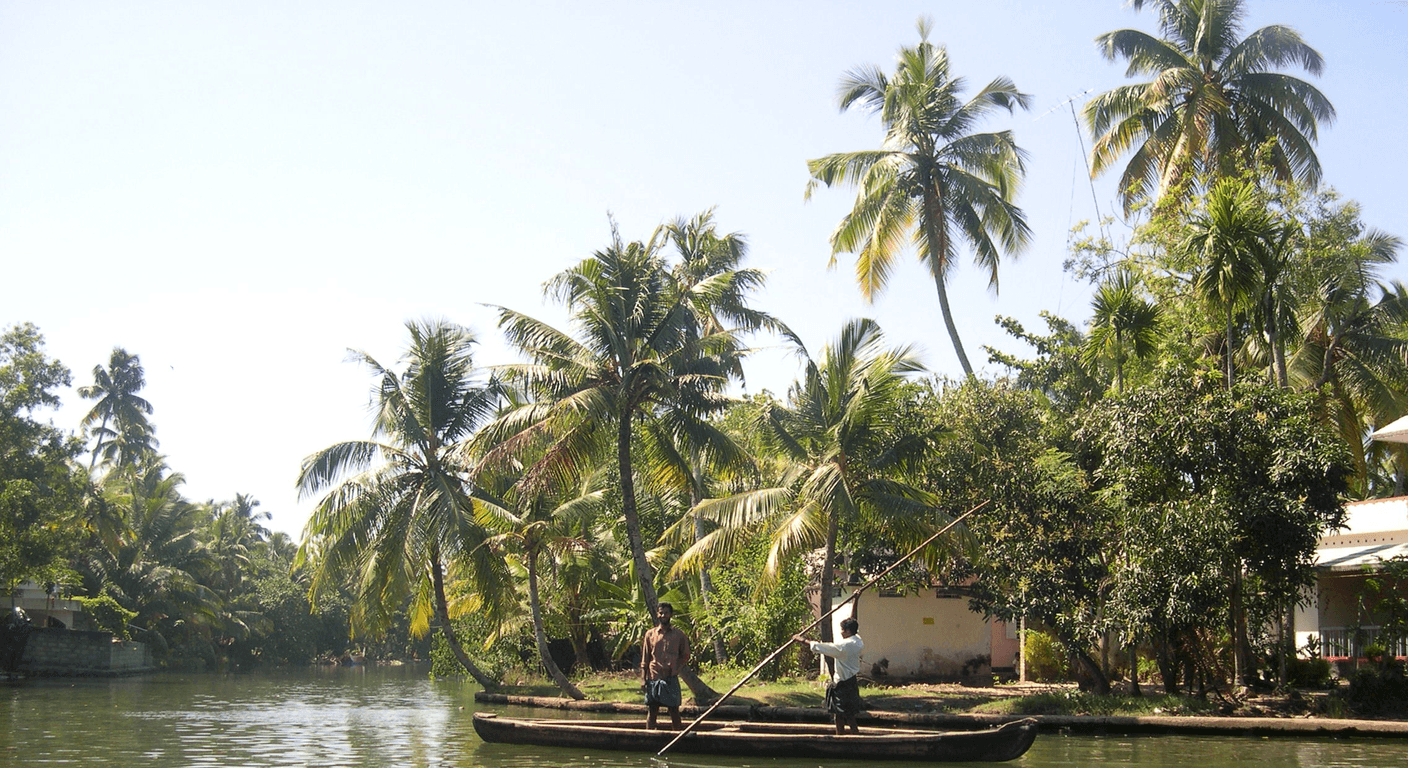
Alleppey — officially Alappuzha — is the houseboat capital of Kerala, and the overnight houseboat experience is the trip's centrepiece. The vessels, called kettuvallam, are converted rice barges: thatched roofs, open-sided living areas, a small bedroom with a proper bed, and a kitchen where a cook prepares meals from the morning's market. You move slowly through a lattice of canals, lagoons and lakes, past fishing villages, coconut groves, and the occasional small temple. Nobody is in a hurry. That is, genuinely, the point.
For a couple, a two-bedroom premium houseboat offers considerably more comfort than the budget options — private bathrooms, better beds, air-conditioning in the sleeping area, and a higher standard of food hygiene. This matters. Indicative costs for a quality overnight houseboat run roughly AUD 200–380 per boat per night, depending on the vessel and season; confirm current rates with operators via Kerala Tourism's accredited listings at keralatourism.org. The difference between a well-run boat and a poorly maintained one is significant, so booking through an accredited operator rather than the cheapest option on a general platform is worth the extra spend.
The backwaters are at their best in the early morning and late afternoon — the light is extraordinary, and the temperature is tolerable. Midday, you'll want shade and a long lunch. That's fine. The boat goes nowhere fast, and that's exactly what you paid for. One honest note on mobility: boarding and disembarking kettuvallam involves stepping across a narrow gangplank, which can be awkward if you have balance concerns. Ask your operator in advance about boarding arrangements.
Fort Kochi: Colonial Layers and Chinese Fishing Nets
Fort Kochi is where Kerala's trading history becomes visible. Portuguese, Dutch, British and Jewish communities all left their mark on this small peninsula, and walking its lanes — past Dutch-gabled warehouses, a 16th-century Portuguese church, the oldest European church in India, and the atmospheric Jew Town spice market — is one of the most rewarding heritage walks in Asia. The famous Chinese fishing nets, cantilevered over the harbour edge, are likely a legacy of Zheng He's 15th-century voyages; they're still operated by fishing families and still work.
The walking is largely flat and manageable, though the lanes are uneven in places and the occasional motorbike requires a quick sidestep. The area around Mattancherry and the Dutch Palace (officially the Mattancherry Palace, maintained by the Archaeological Survey of India) rewards a slow half-day rather than a hurried hour. The palace's Kerala murals — depicting scenes from the Ramayana in extraordinary detail — are among the finest examples of this art form, and they're in a relatively uncrowded setting.
Fort Kochi has matured considerably as a traveller destination. Heritage boutique hotels in restored colonial buildings offer genuine character and usually strong breakfasts. Evenings here are pleasant — the harbour breeze arrives reliably, the restaurants around Princess Street are good, and the famous Kerala Kathakali dance performances (check listings at keralatourism.org for current venues) offer a culturally rich evening that doesn't require late hours or significant walking.
Munnar: Tea Country and Cool Air
The drive from Kochi to Munnar takes around four hours and climbs steadily into the Western Ghats — from sea-level heat to a hill station sitting at roughly 1,600 metres. The temperature drop is immediate and welcome. Munnar's tea estates, managed largely by Tata Tea (the Kannan Devan brand), carpet the hills in geometric rows of green that shift colour as the cloud moves through. It looks like nothing else in India.
A private driver rather than a tour bus is strongly recommended for this journey. The mountain roads are winding and occasionally vertiginous, and having the flexibility to stop at a viewpoint, or to skip one if the clouds have closed in, is worth the extra cost. Indicative rates for a private driver for the Kochi–Munnar–Kochi circuit run roughly AUD 120–200 for the journey, depending on the vehicle and operator; confirm current rates locally or through your hotel.
Munnar itself is a small town that has expanded rapidly around its tourism trade — the town centre is congested and unremarkable. The value is in the estates and the surrounding national park. The Eravikulam National Park, home to the endangered Nilgiri tahr (a mountain goat of considerable charisma), is accessible by shuttle bus from the park entrance; the walking is easy and the views, on a clear morning, are worth the early start. Note that the park has restricted visitor numbers — check current access and booking requirements at keralatourism.org before your trip.
Ayurvedic Resorts: What to Expect and How to Choose
Ayurveda — the ancient Indian system of medicine based on herbal treatments, massage and dietary practice — is Kerala's other great drawcard, and the state has a genuine, deep tradition of it. The challenge for a first-time visitor is distinguishing an authentic therapeutic programme from a spa that has borrowed the vocabulary. A real Ayurvedic programme involves a consultation with a practising Ayurvedic physician, treatments tailored to your constitution and health situation, and a dietary component. It takes days to feel meaningful. A 'Ayurvedic massage' on a resort menu is something else entirely — pleasant, but not the same thing.
For a couple with a genuine interest in a therapeutic experience, Kerala Tourism maintains a list of certified Ayurvedic centres at keralatourism.org — these have been assessed against defined standards and are a sensible starting point. The Kumarakom and Kovalam areas have a concentration of quality resorts; the backwater resort properties around Kumarakom Lake are particularly well regarded for combining the Ayurvedic experience with genuine comfort. Indicative costs for a quality Ayurvedic resort run roughly AUD 250–500 per couple per night for accommodation and treatments combined; confirm current pricing directly with properties.
One practical consideration: Ayurvedic treatments often involve oils and herbs that interact with medications. If either of you is on regular medication — and statistically, most travellers in their seventies are — raise this with both your GP before departure and the Ayurvedic physician on arrival. This is not a reason to avoid the experience; it's a reason to approach it with the same care you'd apply to any medical treatment. Most reputable centres will ask about medications as part of their initial consultation.
Food Safety, Practical Sense and What to Pack
Kerala's cuisine is genuinely one of the great pleasures of the trip — coconut-based curries, fish molee, appam (lacy rice pancakes), prawn dishes cooked with kokum and green mango, and the extraordinary sadya, a traditional feast served on a banana leaf for festivals and Sundays. Eating well in Kerala is not difficult. Eating without consequence requires a bit of discipline.
The standard advice holds: stick to cooked food served hot, avoid raw salads and unpeeled fruit from street stalls, drink only bottled or filtered water (including for cleaning teeth), and be cautious with ice in lower-end establishments. This is not paranoia — it's the same logic that applies in any country with different gut bacteria to your own, and it becomes more relevant as the immune system ages. Good hotel restaurants and established eateries in Fort Kochi and Kumarakom generally maintain high standards; the risk rises at roadside stalls, however appetising they look.
Pack light cotton clothing (Kerala is warm and humid even in the dry season), a light layer for Munnar evenings, comfortable walking shoes with grip, a quality insect repellent (dengue is present in Kerala; use DEET-based repellent and cover up at dusk), and any prescription medications in sufficient quantity for the trip plus a few days' buffer. Confirm with your GP that your travel vaccinations are current — Hepatitis A, typhoid and tetanus are commonly recommended for India; your doctor will advise based on your specific health profile and itinerary. Comprehensive travel insurance covering pre-existing conditions is non-negotiable for this trip.
Quick planning guide
| Ideal pace | Slow and unhurried |
|---|---|
| Best months | November to February |
| Suggested stay | Enough days to cover the backwaters, Fort Kochi and Munnar without rushing |
| Mobility level | Easy overall, with a few exceptions — a narrow gangplank for houseboat boarding and uneven lanes in Fort Kochi |
| Cost level | Moderate to premium, especially for accredited houseboats and Ayurvedic resorts |
| Comfort level | High, with premium houseboats, heritage hotels and a well-set-up tourism circuit |
| Best for | Couples over 50 wanting a gentle, low-intensity first introduction to India |
| Main planning consideration | The long connecting flight (with a recommended stopover) and choosing accredited operators for houseboats and Ayurvedic treatments |
Key takeaways
- Kerala is India's most accessible entry point for first-time visitors over 50, offering comfort and cultural depth without the sensory overload of the north.
- The best time to visit from Australia is November to February, when humidity is lower and the skies are reliably clear.
- An overnight on a premium accredited houseboat on the Alleppey backwaters is the defining experience — book through Kerala Tourism's certified operator list.
- Always confirm current visa requirements and health advisories at smartraveller.gov.au before booking any India travel.
- A stopover night in Singapore or Kuala Lumpur breaks the long haul and arrives you in Kochi in considerably better shape.
- Comprehensive travel insurance covering pre-existing conditions is essential; do not travel to India without it.
Recommended partners and links
Indicative prices only — always confirm with the operator before booking.
Frequently asked questions
Do Australians need a visa to visit Kerala, India?
Yes. Australian passport holders require a visa to enter India. An e-visa is available for tourist purposes and can be applied for online at indianvisaonline.gov.in. Processing times and fees change; always confirm current requirements at smartraveller.gov.au and the Indian High Commission website before booking.
How long is the flight from Melbourne to Kochi (Kerala)?
There are no direct flights from Australia to Kochi. The most common routings connect through Singapore, Kuala Lumpur or Dubai, with total travel time (including stopover) typically running 14–18 hours. A planned overnight stopover in Singapore or Kuala Lumpur is strongly recommended to reduce physical strain.
Is Kerala safe and suitable for travellers in their 70s?
Kerala is generally considered one of India's safer and more traveller-friendly states. The key experiences — houseboats, heritage walking in Fort Kochi, hill-station drives — are low-intensity and well-suited to travellers in their 70s. Standard food-safety precautions apply, and comprehensive travel insurance covering pre-existing conditions is essential. Check current advisories at smartraveller.gov.au.
What is the best time of year to visit the Kerala backwaters?
November to February is the optimal window for Australian visitors. Temperatures are cooler, humidity is lower, and the monsoon has cleared. March and April heat up considerably; the monsoon (June to September) brings heavy rain to the backwaters, which some travellers find atmospheric but others find limiting.
How much does an overnight houseboat on the Alleppey backwaters cost?
Indicative costs for a quality, accredited overnight houseboat in Alleppey run roughly AUD 200–380 per boat per night for a couple, depending on the vessel standard and season. Budget options exist at lower price points but with notably reduced comfort and food-hygiene standards. Always confirm current pricing directly with operators or through keralatourism.org.