A coach tour linking the Grand Canyon, Zion, Bryce Canyon and Yellowstone suits over-50 Australians avoiding high-altitude self-driving. Spring through autumn suits best, and a 14-to-20-day itinerary allows proper pacing. The highlight is Yellowstone's geothermal boardwalks and wildlife alongside the Grand Canyon's rim views. Mobility is moderate, with most viewpoints needing no hiking, and access requires an ESTA plus a flight into Las Vegas or Salt Lake City before joining the coach.
Why coach touring makes sense for these particular parks
The American Southwest and the northern Rockies are not places that reward improvised independent travel, particularly for a group of friends who want to actually enjoy the scenery rather than negotiate rental cars, mountain highways and scarce petrol stations. The distances between the Grand Canyon, Zion Canyon, Bryce Canyon and Yellowstone are measured in full driving days, and the roads through places like Zion's narrow canyon corridor or the switchbacks above Bryce require focused driving in unfamiliar left-hand traffic. An escorted coach removes all of that.
Park accommodation is genuinely limited. Lodges inside Grand Canyon, Zion and Yellowstone book out months — sometimes over a year — in advance, and the alternatives outside park boundaries can mean long early-morning drives to reach the main viewpoints before the crowds. A reputable tour operator has those logistics sorted as part of the package: accommodation, park entry fees, and a guide who knows where to position the group at the right time of day.
For a group of women travelling together from regional Victoria, the social structure of a coach tour also matters. You share meals, swap notes on what you have seen, and have a guide to lean on when someone needs to sit out a walk or wants a quieter afternoon. That kind of built-in support is harder to replicate when you are self-driving and booking everything piecemeal.
What is the altitude situation, and why does it matter?
Altitude is the detail that catches many Australian travellers off guard, because nothing in Victoria — not Mount Hotham, not the High Country — quite prepares you for sustained time above 2,000 metres. The South Rim of the Grand Canyon sits at roughly 2,100 metres. Bryce Canyon's main viewpoints are between 2,400 and 2,700 metres. Yellowstone's interior plateaus average around 2,400 metres. These are not extreme altitudes, but they are enough to cause headaches, fatigue, shortness of breath and disrupted sleep in people who are not acclimatised.
The practical advice is straightforward: on your first day at any high-altitude park, do less than you think you need to. Walk slowly, drink water consistently throughout the day (not just when thirsty), avoid alcohol on arrival evenings, and go to sleep at a reasonable hour. Most people acclimatise within 24 to 48 hours. If you have a cardiovascular condition, respiratory condition, or are on diuretics, speak with your GP before the trip and let your tour guide know on day one.
A good escorted tour will build natural acclimatisation into the schedule — arriving at the Grand Canyon in the afternoon and spending a first morning at a gentle pace before committing to longer walks. If you are comparing itineraries, look for ones that do not rush you from sea-level Las Vegas to Bryce Canyon in a single day. That kind of pacing is a sign of an operator who has thought about the physical reality of the journey.
Grand Canyon: which viewpoints work for travellers who prefer not to hike?
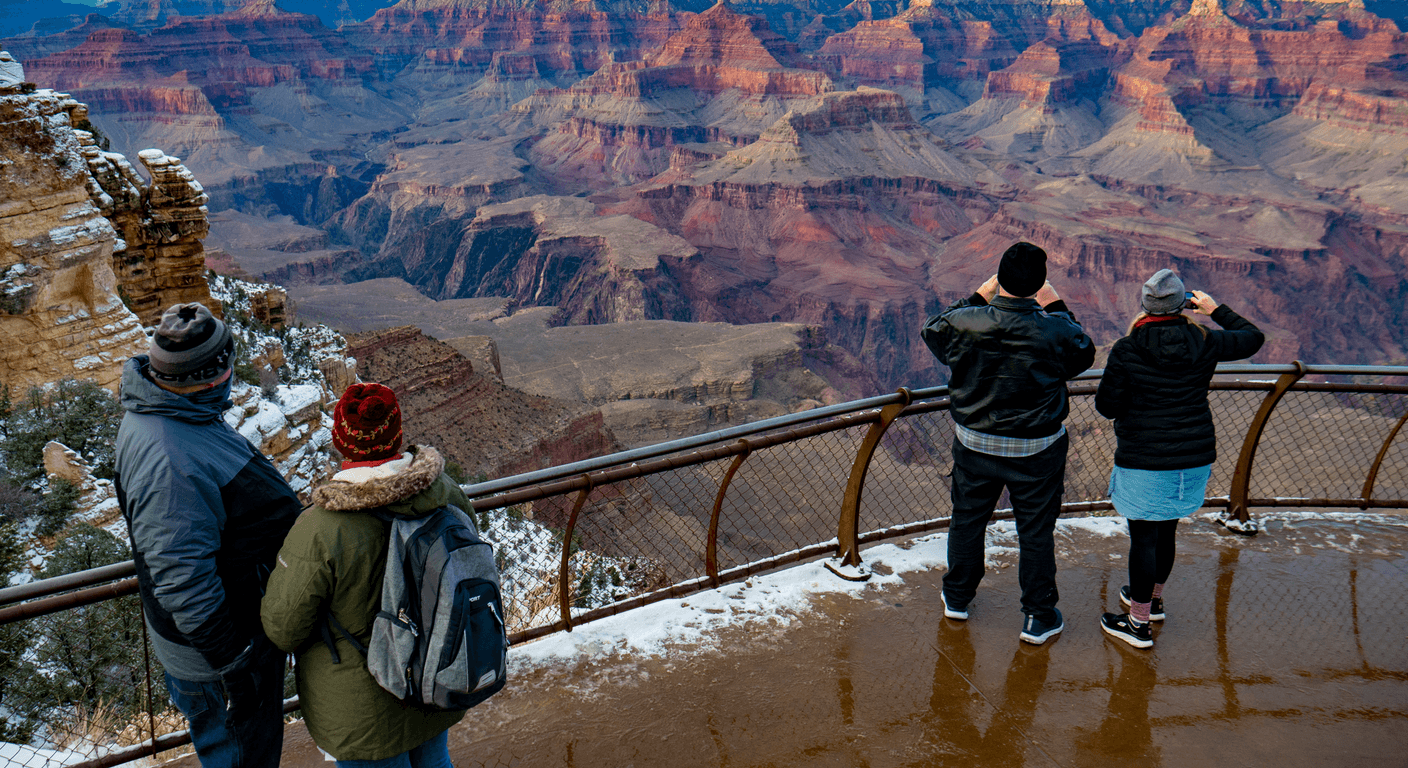
The Grand Canyon's South Rim is genuinely accessible for travellers who are not keen on long walks, and that is worth stating clearly because the Canyon's scale can make it feel like you need to hike into it to appreciate it. You do not. The Rim Trail is mostly paved or compacted gravel, runs for around 21 kilometres along the edge, and the free park shuttle buses stop at all the major viewpoints — Mather Point, Yavapai Point, Hopi Point and Mohave Point among them. You can cover the best of the South Rim on foot in short, flat sections between shuttle stops.
Descending into the Canyon on the Bright Angel or South Kaibab trails is a different matter. These are steep, exposed and unforgiving in warm weather, and the National Park Service explicitly advises against attempting to hike to the river and back in a single day. For most travellers on a coach tour, the descending trails are best treated as a short exploratory walk — go down for twenty minutes, take in the change of perspective, and come back up. The view from the rim is extraordinary on its own terms.
The Desert View Watchtower at the eastern end of the South Rim is often included in coach tour itineraries and offers a different angle on the canyon with less foot traffic. Accessibility inside the tower itself involves stairs, but the surrounding viewpoint is open and flat. Confirm with your operator what the walking requirements are on each day — a reputable company will answer that question directly.
Zion and Bryce Canyon: managing the crowds and the terrain
Zion Canyon in Utah has become extremely popular and the park now operates a mandatory shuttle system through the main canyon floor from spring through autumn — private vehicles are not permitted on Zion Canyon Scenic Drive during peak season. This actually works in a coach tour's favour, as the group transfers to the park shuttle and moves through at a comfortable pace. The canyon floor walk along the Virgin River is largely flat and shaded, making it one of the more accessible walks in the Southwest for travellers who want to be in the landscape rather than looking at it from above.
Bryce Canyon is different in character — it is less a canyon than a series of amphitheatres carved into a high plateau, filled with orange and red hoodoo formations. The Rim Trail connecting Sunrise Point, Sunset Point and Inspiration Point involves some uneven ground and is at altitude, so take it steadily. The views into the amphitheatres from the rim are the main event and require no descending at all. If you do want to walk among the hoodoos, the Queen's Garden trail is the least demanding of the descent options, though it is still a genuine hike with elevation change.
Both parks reward early mornings and late afternoons for the quality of light, and a coach tour with a knowledgeable guide will position the group accordingly. Midday at Bryce in summer is hot and harsh; the same viewpoints at 7am have a completely different quality.
Yellowstone: what to expect from the world's oldest national park
Yellowstone is enormous — larger than the states of Rhode Island and Delaware combined — and no coach tour covers all of it. What a well-designed itinerary will do is take you to the geothermal highlights: Old Faithful and the Upper Geyser Basin, the Grand Prismatic Spring, the Norris Geyser Basin, and the Yellowstone Grand Canyon with its waterfall overlooks. Boardwalks throughout the thermal areas are flat, well-maintained and wheelchair-accessible in most sections, making this one of the more accessible parts of the entire itinerary.
Wildlife is a genuine part of Yellowstone, not a marketing promise. Bison are encountered regularly on the park roads — often causing traffic to stop entirely — and elk, bears and wolves are present, though sightings of the latter two are never guaranteed. Your guide will know the best early-morning spots for wildlife watching, which typically means being out before 8am. For a group of friends, this kind of shared experience — standing quietly watching a bison herd cross a meadow — tends to be one of the parts of the trip people talk about most.
The drive between the Southwest parks (Grand Canyon, Zion, Bryce) and Yellowstone passes through Salt Lake City and covers several hundred kilometres through high desert and mountain terrain. Some itineraries include a night in Salt Lake City, which gives a useful rest day and the option to visit Temple Square or the Natural History Museum of Utah if the group is interested.
Practical matters: US entry, travel insurance and what to sort before you leave
Australian passport holders entering the United States for tourism need an approved ESTA (Electronic System for Travel Authorisation) before departure — this is not a visa but is a mandatory pre-travel requirement. Apply through the official US Customs and Border Protection website (esta.cbp.dhs.gov) and allow several days, though approval is usually faster. The Australian Government's smartraveller.gov.au page for the United States is the right place to check current entry requirements, any health declarations, and travel advisories. Register your trip on Smartraveller before you depart.
Travel insurance for a trip of this nature needs to cover medical evacuation, which in the United States is expensive. Helicopter evacuation from a remote national park can cost tens of thousands of dollars; your insurance policy needs to cover that explicitly. Read the product disclosure statement for altitude-related conditions if you have any pre-existing cardiovascular or respiratory issues, and declare everything honestly when you apply. Some policies have exclusions for travel above certain altitudes — check this specifically.
Medication management on a long-haul trip deserves attention. Carry enough prescription medication for the full trip plus a buffer of several days, keep it in original labelled packaging in your carry-on luggage, and bring a letter from your GP listing what you are carrying and why. Some medications require a doctor's letter for US customs. If you are travelling with a group of friends, it is worth having a quiet conversation before departure about who knows what, medically speaking, in case of an emergency.
Choosing the right tour: what to look for and what to ask
Not all escorted coach tours are equivalent in pace, group size or what they include. For travellers in their 60s and 70s, the relevant questions to ask an operator are: what is the maximum group size, what is the average daily walking distance, are there optional versus compulsory activities, and what happens if someone needs to stay behind on a particular day. A group cap of around 40 passengers is common; some operators run smaller groups at a higher price point, which can mean a more personal experience.
Inclusions vary significantly between operators. Some tour prices include most meals, all park entry fees, porterage and tips; others are room-and-coach-only with everything else additional. When comparing indicative costs — which for a quality 14-to-20-day national parks itinerary from Australia might run anywhere from roughly AUD 8,000 to AUD 15,000 or more per person including flights, though this varies widely and you should confirm directly with operators — make sure you are comparing like with like. A lower headline price that excludes meals, tips and internal flights can end up costing more than a higher-priced all-inclusive package.
Australian-based operators like APT have the advantage of understanding Australian travellers' expectations around service and pacing, and their customer support is in Australian time zones. International operators like Trafalgar and Insight Vacations have long-established national parks itineraries with experienced local guides. Reading recent traveller reviews on independent platforms — not just the operator's own site — gives a realistic sense of how the pacing actually feels on the ground.
Quick planning guide
| Ideal pace | Slow-paced, especially the first day at each high-altitude park |
|---|---|
| Best months | Spring through autumn, matching Zion's shuttle-only season |
| Suggested stay | 14 to 20 days for a full Southwest-to-Yellowstone circuit |
| Mobility level | Moderate — main viewpoints and boardwalks need no hiking, but altitude and some uneven ground require care |
| Cost level | Premium, roughly AUD 8,000–15,000+ per person including flights |
| Comfort level | High — accommodation, park entry and transport logistics are handled by the operator |
| Best for | Groups of friends in their 60s and 70s who prefer not to self-drive |
| Main planning consideration | Acclimatising to altitude above 2,000 metres and choosing a tour with sensible daily pacing |
Key takeaways
- Several parks on a classic Southwest-to-Yellowstone circuit sit above 2,000 metres — give yourself at least one slow day on arrival at each high-altitude park.
- The Grand Canyon's South Rim, Zion's canyon floor and Yellowstone's boardwalk thermal areas are accessible without significant hiking.
- Escorted coach tours handle the park shuttle logistics, accommodation bookings and driving so the group can focus on the experience.
- Australian travellers need an approved ESTA before boarding and should check current US entry requirements at smartraveller.gov.au.
- Travel insurance for US national parks travel must explicitly cover medical evacuation — check altitude exclusions in your policy's product disclosure statement.
- Indicative tour costs for a quality 14-to-20-day national parks itinerary from Australia vary widely; always confirm current pricing and inclusions directly with operators.
Recommended partners and links
Indicative prices only — always confirm with the operator before booking.
Frequently asked questions
Do you need to be fit to do an American national parks coach tour?
You do not need to be highly fit, but a reasonable level of mobility helps. Most viewpoints at the Grand Canyon, Bryce Canyon and Yellowstone are accessible via paved paths or boardwalks with minimal elevation change. Optional trail walks are available for those who want them. If you use a walking aid or have limited mobility, confirm with your chosen operator which activities are accessible before booking.
How does altitude affect you at the Grand Canyon and Yellowstone?
The South Rim of the Grand Canyon sits at roughly 2,100 metres, Bryce Canyon viewpoints at 2,400–2,700 metres, and Yellowstone's interior at around 2,400 metres. Common effects at these altitudes include headaches, fatigue and disrupted sleep, particularly in the first 24–48 hours. Drinking water consistently, avoiding alcohol on arrival evenings and pacing yourself on the first day at each park helps significantly. Speak with your GP before travel if you have cardiovascular or respiratory conditions.
Do Australian travellers need a visa to enter the United States for a national parks tour?
Australian passport holders do not need a visa for short-stay tourism to the United States, but they do need an approved ESTA (Electronic System for Travel Authorisation) before departure. Apply through the official US Customs and Border Protection website at esta.cbp.dhs.gov. Check current requirements and any updates at smartraveller.gov.au before you travel.
How far in advance should you book a national parks coach tour from Australia?
Popular summer departures (June–August in the northern hemisphere) on well-known itineraries can fill six to twelve months ahead, particularly for groups wanting to travel together. Booking 9–12 months in advance is a reasonable guide for 2026 departures. Contact operators directly to check availability for your preferred group size and travel dates.
Is Yellowstone accessible without a lot of walking?
Yes, much of Yellowstone's most distinctive scenery — the geyser basins, Grand Prismatic Spring and canyon overlooks — is reached via flat, paved or boardwalk paths. Old Faithful's viewing area, for example, requires very little walking. Wildlife watching is typically done from the coach or roadside pullouts. Yellowstone is one of the more accessible parks on a Southwest-to-Rockies itinerary.
- Smartraveller – United States of America travel advice (Australian Government)
- US National Park Service – Grand Canyon National Park
- US National Park Service – Zion National Park
- US National Park Service – Bryce Canyon National Park
- US National Park Service – Yellowstone National Park
- US Customs and Border Protection – ESTA application
- APT (Australian Pacific Touring) – USA escorted tours
- Trafalgar Tours – USA itineraries
- Insight Vacations – America's National Parks tours