Kununurra suits over-50 travellers who want authentic Kimberley wilderness without extreme conditions. Visit during the dry season, May to September, staying three to four days to fit in an Ord River cruise, a half-day trip to Lake Argyle and a morning walk through Mirima National Park. Access is via Perth or Darwin flights connecting into Kununurra Airport, with no reliable year-round direct route from east-coast cities. Mobility demands are easy overall — comfortable covered cruise vessels and short, well-marked walking tracks, with only a gentle incline at Mirima's lookouts.
Why Kununurra works so well for over-50 travellers
There's a particular kind of traveller for whom Kununurra is exactly right: someone who wants the real Kimberley — the red rock, the ancient country, the bird calls at dusk — without the 4WD convoys, the remote camping, or the sense that every experience requires a level of physical preparation usually associated with people half their age. Kununurra offers a comfortable base for all of that, and does so without any apology.
The town itself is small and genuinely functional. The supermarket is well-stocked, the medical centre is solid, the accommodation ranges from good motels to a handful of characterful lodges, and the distances between the main attractions are short enough to manage on a half-day excursion. For a solo traveller arriving from Melbourne or Adelaide, there's an immediate ease to the place — it's remote by geography but not by convenience.
What makes it particularly well-suited to the over-50 traveller is the quality of the tour operators who've built their businesses here. These aren't tick-and-go adventure companies. The Ord River cruise operators, in particular, understand that their passengers want to sit comfortably, watch the landscape unfold, hear a knowledgeable guide speak about Country, and have time to photograph the azure kingfishers without being rushed. That's a different kind of tour, and it's exactly what Kununurra does well.
Getting there: flights, connections and the question of direct routes
Kununurra Airport (KNX) is served by flights from Perth, and at various times by services from Darwin and Broome. Direct connections from east-coast cities such as Melbourne, Sydney or Adelaide are not always available year-round — they tend to operate seasonally and can change between carriers. The most reliable approach is to confirm current routes directly with Qantas, Virgin Australia and Rex, then check connecting options via Perth or Darwin. A Perth connection adds roughly an hour to two hours to the journey but is generally smooth.
From Melbourne, expect a total travel time of around five to six hours including a connection — manageable in a day if you choose a morning departure. The dry-season cabin air and the altitude change are rarely dramatic, but arriving with a clear evening to settle in, have a quiet meal and acclimatise is genuinely worthwhile. Kununurra is three time zones west of Melbourne (two hours behind AEST), so the adjustment is mild.
Travel insurance is worth mentioning plainly: the Kimberley is remote, and medical evacuation from any serious incident is expensive. For travellers managing pre-existing conditions, a policy that covers those conditions explicitly — not just emergency evacuation — is the sensible choice. The Australian Government's Smartraveller site (smartraveller.gov.au) has useful guidance on domestic travel insurance considerations, even for travel within Australia.
The Ord River cruise: the experience that defines the visit
If there's one thing Kununurra does that nothing else in Australia quite replicates, it's the Ord River cruise. The Ord is a slow, wide river that moves through a corridor of sandstone ranges and paperbark flats, and in the dry season it carries a density of birdlife that makes even non-birdwatchers reach for binoculars. Jabiru, brolga, sea eagle, kingfisher in multiple species — the river is generous with them.
Most cruises run in the morning or late afternoon, the latter often timed for the light on the red rock walls, which turns amber and then deep ochre as the sun drops. Vessels are typically flat-bottomed, covered pontoon-style boats with seating — not rigid inflatables or anything requiring agility to board. The boarding points are generally accessible; confirm with your chosen operator if you have specific mobility requirements, as arrangements can vary.
Indicative prices sit in the range of roughly $100 to $200 per person depending on cruise length and operator — confirm current pricing before booking, as these figures are a guide only. Several operators also offer combination cruises that include Lake Argyle, extending the journey and adding the extraordinary scale of the lake to the river's intimacy. For a solo traveller, joining a small-group cruise also provides easy, low-pressure company — the kind of conversation that starts over a sighting of a freshwater crocodile and ends with an exchange of recommendations for the next stop.
Lake Argyle: the scale that stays with you
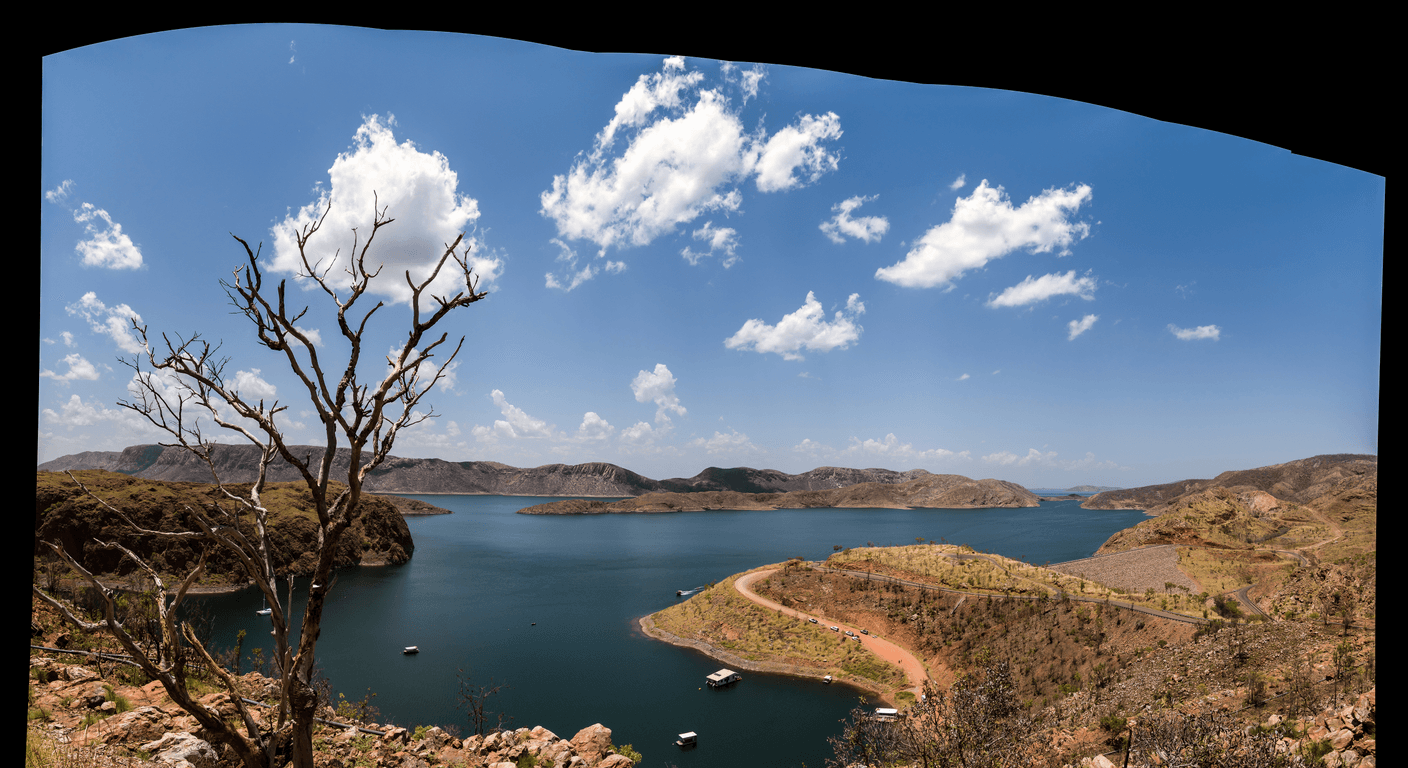
Lake Argyle is one of Australia's largest reservoirs by volume, created by the damming of the Ord River in the early 1970s. The numbers are almost abstract — it holds roughly eighteen times the volume of Sydney Harbour — but it's the visual reality that registers. Standing at the lookout above the lake, the water simply continues to the horizon in multiple directions, dotted with islands that were once hilltops. It's a landscape that rewards a long, quiet look.
The drive from Kununurra takes around forty-five minutes on a sealed road, making it a straightforward half-day excursion. The Lake Argyle Resort sits at the edge of the escarpment and operates cruises on the lake itself, including a popular sunset option. The infinity pool at the resort, overlooking the water, has become something of a signature image for the Kimberley — and it earns its reputation. Confirm current cruise and resort pricing directly with Lake Argyle Cruises and the resort.
For those who prefer not to drive themselves, several Kununurra-based tour operators include Lake Argyle as part of a guided day trip, which removes the navigation concern and adds local commentary. The road is generally in good condition during the dry season, but it's worth confirming conditions with the operator or the Main Roads WA website (mainroads.wa.gov.au) if you're self-driving.
Mirima National Park: ancient country at the edge of town
Mirima National Park is one of those places that would be a major drawcard if it were anywhere else in Australia. Here, it's five minutes from the Kununurra town centre. The park protects a series of weathered sandstone domes and gorges that geologists estimate at around 360 million years old — an age that gives even the most casual walk a certain weight.
The walking tracks are short and well-marked. The main loop takes around thirty to forty-five minutes at a comfortable pace, with some uneven ground and a gentle incline toward the best viewpoints. Sturdy shoes are recommended rather than required; the surface is rocky but the gradients are modest. In the early morning, the rock takes on a warm pink-orange colour and the birdlife is active — it's genuinely one of the better starts to a day in the Kimberley.
A standard WA national park entry fee applies — confirm the current rate with the Parks and Wildlife Service WA website before visiting. The park is managed with care for its cultural significance to the Miriuwung people, and the interpretive signage reflects that context thoughtfully. It's the kind of place where an hour spent slowly is worth considerably more than twenty minutes at a pace.
Practical comfort: accommodation, pacing and the dry-season reality
Kununurra's accommodation options have improved steadily over the past decade. The Hotel Kununurra is a reliable mid-range choice in the town centre; the Freshwater East Kimberley Apartments offer self-contained options that suit longer stays and independent travellers who prefer a kitchen and a quiet evening in. Several caravan parks also cater well to the grey nomad cohort arriving by road. Confirm current availability and pricing directly with properties.
The dry season (May to September) is non-negotiable for comfort. The wet season brings humidity, heat, and road closures that make most touring impractical. May and June offer cooler mornings — genuinely cool, down to the low teens overnight — while August and September are warmer but still manageable. July is peak season; booking accommodation and key tours a few months ahead is simply prudent.
Pace is worth thinking about deliberately. Two excursions a day is the practical maximum for most travellers, and one is often enough. The East Kimberley has a quality of stillness that rewards slowing down — an afternoon on a shaded veranda watching the light change over the ranges is not wasted time. For a solo traveller, particularly, the rhythm of a morning cruise, a long lunch, and an evening walk at Mirima is a very good day indeed.
Beyond the main attractions: Kununurra's quieter pleasures
The Kununurra Visitor Centre (visitkununurra.com) is a useful first stop on arrival — the staff are genuinely knowledgeable about current conditions, which operators are running well, and which roads are accessible. It's also where you'll find information about guided cultural tours with Miriuwung Gajerrong guides, which provide a depth of context that no amount of signage can replicate.
The Ord Valley is also serious agricultural country — the irrigation scheme produces sandalwood, chia, mangoes, melons and more, and farm-gate stalls operate seasonally. The Kununurra Farmers Market runs on select Saturdays during the dry season; confirm current dates with the visitor centre. It's a small but genuine market, and the chance to eat a mango grown in the Ord Valley while standing in the Ord Valley is a specific and uncomplicated pleasure.
For those with an interest in art, Kununurra has a strong connection to the Gija people and the distinctive Gija art tradition. Waringarri Aboriginal Arts (waringarriarts.com.au) is the region's most established Indigenous art centre and is worth a considered visit — both for the quality of the work and for the opportunity to purchase directly from an artist-owned centre, which is the most ethical and meaningful way to acquire Kimberley art.
Quick planning guide
| Ideal pace | Slow-paced — two excursions a day at most, often just one |
|---|---|
| Best months | May to September (dry season) |
| Suggested stay | 3-4 days |
| Mobility level | Easy, with short walks and some uneven ground |
| Cost level | Mid-range, with cruises roughly $100-$200 per person |
| Comfort level | High — quality tour operators and improving accommodation options |
| Best for | Solo and over-50 travellers wanting wild Kimberley scenery without remote-expedition demands |
| Main planning consideration | Confirm flight connections via Perth or Darwin and book ahead for the busy July peak season |
Key takeaways
- Kununurra's dry season runs May to September — outside those months, heat and road closures make most touring impractical.
- Ord River cruises operate from comfortable, covered vessels and typically cost around $100 to $200 per person — confirm current pricing with operators.
- Mirima National Park is five minutes from town and offers ancient sandstone formations on short, manageable walking tracks.
- Lake Argyle holds roughly eighteen times the volume of Sydney Harbour — the scale is best understood by seeing it, not reading about it.
- Direct flights to Kununurra operate from Perth and seasonally from Darwin; east-coast travellers should confirm current routes and connection options before booking.
- For solo travellers, small-group cruises offer easy, low-pressure company — and Kununurra's operators are well-practised at making single travellers feel entirely at home.
Recommended partners and links
Indicative prices only — always confirm with the operator before booking.
Frequently asked questions
When is the best time to visit Kununurra?
May to September is the dry season and the only practical window for comfortable touring. Temperatures are warm by day and cool at night, roads are open, and the Ord River is navigable. July is peak season. The wet season (October to April) brings extreme heat, humidity and frequent road closures.
Are Ord River cruises suitable for travellers with limited mobility?
Most Ord River cruises operate on flat-bottomed, covered pontoon-style vessels with seated viewing areas, which are generally accessible. Boarding arrangements vary by operator — contact your chosen operator directly to confirm boarding access and any mobility-specific requirements before booking.
Can you fly directly to Kununurra from Melbourne or Sydney?
Direct flights from east-coast cities to Kununurra are not consistently available year-round. The most reliable option is to fly via Perth or Darwin. Confirm current routes with Qantas, Virgin Australia and Rex before booking, as schedules change seasonally.
Is Kununurra a good destination for solo female travellers?
Kununurra is considered a safe and welcoming destination for solo female travellers. The town is small and community-oriented, tour operators run structured small-group excursions that provide easy social connection, and the accommodation options include well-managed hotels and self-contained apartments suited to independent travellers.
Do I need travel insurance for a domestic trip to Kununurra?
Travel insurance is strongly recommended for any visit to the Kimberley. The region is remote, and medical evacuation in the event of a serious incident carries significant cost. Travellers managing pre-existing health conditions should ensure their policy explicitly covers those conditions, not only emergency evacuation.