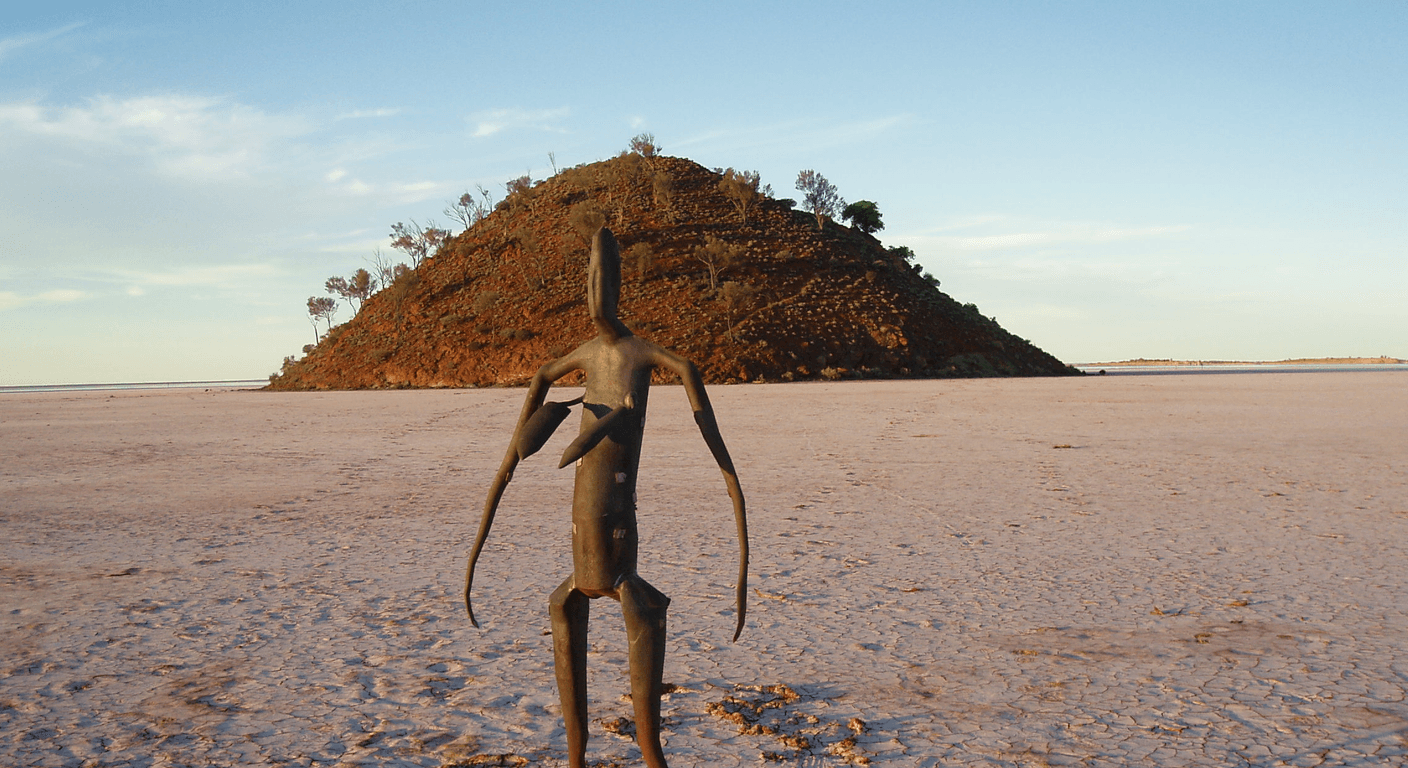
Lake Ballard, a dry salt lake in Western Australia's Goldfields, holds 51 Antony Gormley iron figures that have stood permanently since 2003. Visiting is free. Dawn is the defining moment, when low light and long shadows transform the white crust. The walk itself is easy on flat, firm salt, though there's no shade. Reaching it means flying to Kalgoorlie, then driving 180km to Menzies and a further 64km on unsealed road, best allowed three to five days as part of a wider Goldfields trip.
What exactly is Lake Ballard, and why do people make the journey?
Lake Ballard is a dry salt lake in the Western Australian Goldfields, sitting about 64 kilometres north-west of the small town of Menzies and roughly 180 kilometres north of Kalgoorlie. For most of its existence it was simply part of the landscape — ancient, flat, and dazzlingly white in the sun. Then in 2003, British sculptor Antony Gormley was commissioned by the Perth International Arts Festival to create an installation here. He made 51 figures, each one a reduced and abstracted cast of a Menzies local, and placed them across the lake bed. The community voted to keep them. They've been there ever since.
The figures aren't life-sized — they're pared back, almost skeletal in their geometry, which makes them stranger and more affecting than a realistic sculpture would be. Spread across several square kilometres of white crust, some close enough to inspect, others visible only as dark silhouettes on the horizon, they play with scale and distance in a way that's genuinely hard to describe. You walk among them and the lake does the rest. It's the kind of place that stays with you for reasons you don't fully understand until you're home.
Getting there from Victoria — the flights, the drive, and the honest logistics
From Melbourne, the most direct route is a flight to Kalgoorlie-Boulder Airport, either direct with Rex Airlines or via Perth with Qantas or Virgin Australia. Flying via Perth adds roughly two to three hours to the journey but gives more frequency and flexibility. Confirm current schedules and routes with airlines before booking — services do change. The flight from Melbourne to Kalgoorlie direct is around two and a half hours; via Perth, allow five to six hours door-to-gate.
From Kalgoorlie, the drive to Lake Ballard is around 180 kilometres north on the Great Northern Highway to Menzies, then a further 64 kilometres on an unsealed road to the lake. That unsealed section is the one to take seriously. It's generally passable in a conventional two-wheel-drive vehicle during the drier months, but corrugations, loose gravel and the occasional pothole are part of the deal. Check road conditions with Main Roads WA (mainroads.wa.gov.au) before you leave, and read your hire-car agreement carefully — many standard hire-car contracts prohibit unsealed roads, which could affect your insurance cover. If in doubt, a high-clearance vehicle or a 4WD hire is a sensible investment.
The alternative is to base yourself in Menzies for a night, which shortens the unsealed driving significantly and lets you leave for the lake at first light without a 180-kilometre pre-dawn push. Menzies is a small, honest outback town — accommodation is limited but the Menzies Hotel has been welcoming travellers for well over a century. Confirm current availability and rates directly.
When to go — and why dawn matters more here than almost anywhere else
The Goldfields in summer — December through February — regularly reach 40 degrees Celsius and beyond. The salt lake offers no shade whatsoever. Visiting in those months is possible in theory and inadvisable in practice, particularly for anyone who prefers not to end their day in a Kalgoorlie emergency department. April through October is the sensible window: daytime temperatures are manageable, the nights are cool, and the light is extraordinary.
Dawn at Lake Ballard deserves its reputation. When the sun is low and the sky shifts through amber and pink, Gormley's figures cast long shadows across the white crust and seem to acquire a weight and presence that the midday glare simply flattens. Photographers know this; the installation's most memorable images almost all come from those first forty minutes after sunrise. Plan to arrive before the sun clears the horizon. Set the alarm, make the drive in the dark if you need to, and give yourself that time. It's the difference between seeing the installation and actually experiencing it.
July and August bring cooler temperatures and occasional cold snaps overnight — pack a layer you won't need to think about. Wildflower season in September and October adds colour to the surrounding scrub, and the drive up through the Goldfields becomes unexpectedly beautiful.
Walking the lake — what to expect on the ground
The salt crust at Lake Ballard is firm and flat — there are no hills, no steps, no technical terrain. For most older travellers, including those with mild knee or hip concerns, the walking itself is straightforward. The figures are spread over a large area, so you'll cover several kilometres if you want to visit them all; a shorter loop visiting the nearest group is perfectly satisfying and takes about an hour at an easy pace.
What the lake does offer in abundance is exposure. There is no shade, no shelter, and in the warmer months the reflected light off the white salt can be intense even when the air temperature seems manageable. Sunscreen, a broad-brimmed hat, sunglasses and plenty of water are not optional extras — carry at least two litres per person, more in spring and autumn. There are no facilities at the lake itself: no toilets, no kiosk, no phone signal in most areas. Self-sufficiency is simply part of the experience.
The surface can be uneven in places where the salt crust has cracked or lifted slightly — sensible walking shoes with a firm sole are more appropriate than sandals or thongs. Walking poles are a practical comfort for anyone who finds uneven ground tiring over distance.
Where to stay — Kalgoorlie, Menzies, or somewhere in between
Kalgoorlie-Boulder is the natural base for this journey. It's a proper regional city with good accommodation across a range of price points, decent restaurants, a supermarket for stocking up on supplies, and enough to fill a day before or after the lake drive. The Palace Hotel on Hannan Street is a beautifully restored Federation-era pub worth seeing in its own right. The Exchange Hotel and Quest Kalgoorlie offer more contemporary options. Expect to pay roughly $150 to $250 per night for comfortable mid-range accommodation — confirm current rates directly.
Menzies, 130 kilometres north of Kalgoorlie, is the other option and the one that makes practical sense if you're serious about a dawn start at the lake. It's a small town with a proud history — at the height of the gold rush it had a population in the thousands — and the Menzies Hotel is a genuine piece of Goldfields heritage. Don't arrive expecting city comforts, but do arrive expecting a warm welcome and a cold beer. Staying in Menzies the night before means a 64-kilometre unsealed drive to the lake at dawn rather than a 180-kilometre pre-dawn haul from Kalgoorlie. For couples who'd rather not be navigating corrugated gravel in the dark, that's a meaningful difference.
There are no camping facilities at Lake Ballard itself. Some travellers camp near Menzies — if you're travelling in a caravan or campervan, check current options with the Kalgoorlie-Boulder Visitor Centre before finalising plans.
How to make a proper trip of it — building a Goldfields itinerary
Lake Ballard works best as the centrepiece of a three-to-five-day Goldfields itinerary rather than a rushed day trip. Kalgoorlie itself rewards a day or two: the Super Pit lookout is legitimately impressive (one of the largest open-cut gold mines in the world, visible from the road), the Western Australian Museum Kalgoorlie-Boulder covers the region's extraordinary gold-rush history with real depth, and Hannan Street's architecture is a reminder that this was once one of the wealthiest places in the southern hemisphere.
The drive north to Menzies passes through a landscape that many Australians have never seen — red earth, low mulga scrub, granite outcrops, and the kind of silence that makes you realise how much ambient noise fills ordinary life. Menzies itself has a town hall that once hosted visiting dignitaries from across the British Empire and a cemetery that tells the story of the gold rush in a way no museum quite can. These aren't detours — they're the point.
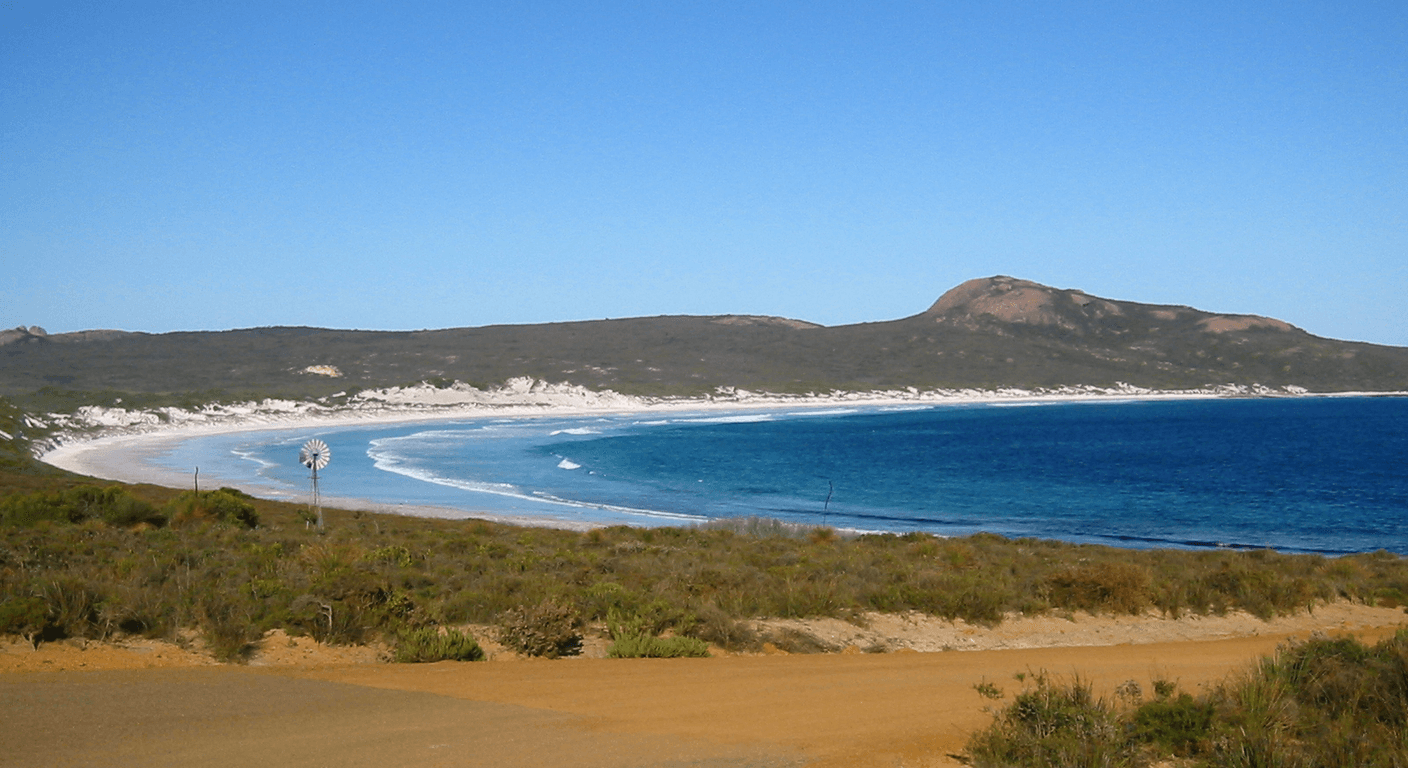
For those with an appetite for more, the Goldfields-Esperance region extends south to the spectacular coast at Esperance and the beaches of Cape Le Grand National Park. That's a different kind of trip, but the combination of outback art, mining history and southern coast makes for one of Western Australia's most varied and underappreciated road-trip routes.
Practical notes — health, insurance, and travelling smart in remote WA
The Goldfields is genuinely remote country. Mobile coverage is limited outside Kalgoorlie and the main highway; once you're on the unsealed road to Lake Ballard, don't count on it. Tell someone your plans and expected return time. Carry a paper map or download offline maps before you leave — the Main Roads WA website has useful resources. A personal locator beacon (PLB) is worth considering for any couple heading off the sealed road in remote WA, particularly if either traveller has a medical condition that might require emergency response.
Travel insurance with adequate medical evacuation cover is essential, and for travellers over 70 with pre-existing conditions — heart conditions, diabetes, respiratory concerns — read the policy terms carefully and disclose everything. Policies vary significantly in what they cover for remote travel in Australia, not just overseas. The Insurance Council of Australia's website (insurancecouncil.com.au) has guidance on what to look for. Confirm all cover details with your insurer before departure.
Fuel up in Kalgoorlie or Menzies before heading to the lake — there are no petrol stations on the lake road. Carry extra water beyond what you think you'll need. A basic first-aid kit, snacks, and a warm layer for the drive home in the late afternoon are small preparations that make a real difference in remote country.
Quick planning guide
| Ideal pace | Slow and deliberate, built around a dawn arrival |
|---|---|
| Best months | April to October, avoiding the 40-degree summer months |
| Suggested stay | Three to five days as part of a Goldfields itinerary |
| Mobility level | Easy — flat, firm salt crust with no hills or steps, though no shade |
| Cost level | Free entry; mid-range Kalgoorlie accommodation around $150–250 per night |
| Comfort level | Basic and remote — no facilities at the lake, self-sufficiency essential |
| Best for | Older couples and travellers seeking a quiet, reflective outback art experience |
| Main planning consideration | The unsealed 64km access road and hire-car insurance restrictions on it |
Key takeaways
- Lake Ballard's 51 Antony Gormley figures are free to visit and have been a permanent installation on the Western Australian salt lake since 2003.
- The 64-kilometre access road from Menzies is unsealed — check road conditions with Main Roads WA and confirm your hire-car agreement before driving it.
- Dawn is the defining experience at Lake Ballard: low light transforms the figures and the white crust in a way midday sun simply cannot.
- April to October is the recommended visiting window — summer temperatures in the Goldfields regularly exceed 40 degrees Celsius with no shade on the lake.
- There are no facilities at the lake itself; carry at least two litres of water per person, sunscreen, a hat, and a fully charged phone or locator beacon.
- Staying overnight in Menzies rather than driving from Kalgoorlie on the day makes a dawn arrival at the lake practical without a pre-dark 180-kilometre drive.
Recommended partners and links
Indicative prices only — always confirm with the operator before booking.
Frequently asked questions
Is Lake Ballard free to visit?
Yes. There is no entry fee to visit Lake Ballard or walk among Antony Gormley's sculptures. The installation is open to the public year-round at no cost.
Can you drive a regular hire car to Lake Ballard?
The sealed road from Kalgoorlie to Menzies is fine for any vehicle. The 64-kilometre unsealed road from Menzies to the lake is generally passable in a conventional two-wheel-drive vehicle during dry conditions, but many standard hire-car contracts prohibit unsealed roads and may void your insurance cover. Check your hire-car agreement carefully and confirm road conditions with Main Roads WA (mainroads.wa.gov.au) before setting out. A high-clearance or 4WD hire removes the uncertainty.
How long does it take to walk around the installation?
The 51 figures are spread across several square kilometres of salt lake. Visiting all of them involves walking roughly 4–6 kilometres in total, which takes around two to three hours at a relaxed pace. A shorter walk to the nearest cluster of figures takes about an hour and is still a genuinely worthwhile experience.
Is Lake Ballard suitable for travellers with mobility concerns?
The salt lake surface is flat and firm, with no steps or inclines, making the walking itself manageable for most older travellers. The main challenges are exposure — there is no shade — and the fact that the surface can be slightly uneven where the crust has cracked. Solid walking shoes and walking poles are recommended for anyone who finds uneven terrain tiring. The unsealed access road can be rough, which may be uncomfortable for those with significant back or joint issues.
What is the nearest town to Lake Ballard, and does it have accommodation?
Menzies is the nearest town, approximately 64 kilometres from the lake on an unsealed road. It has limited but genuine accommodation, most notably the historic Menzies Hotel. Confirm availability and current rates directly with the hotel before booking. Kalgoorlie-Boulder, around 130 kilometres south of Menzies on the sealed Great Northern Highway, offers a much wider range of accommodation and services.