Leeton is a walkable, flat heritage town in the NSW Riverina, laid out in 1914 by Walter Burley Griffin with the same radiating streets he used in Canberra. Its free self-guided walk (90 minutes to two and a half hours) and the restored 1930 Roxy Theatre make a rewarding one-to-two-day visit, best between April and October. There's no train station, so a car or a pre-arranged coach-and-taxi connection is essential.
Why Leeton Belongs on Any Serious Australian Architecture Itinerary
Most Australians know Walter Burley Griffin's name from Canberra, and leave it there. That's a loss. The Chicago-born architect — who won the 1912 international competition to design the Australian capital with his wife Marion Mahony Griffin — also left a quieter, less celebrated mark on the Riverina, in the form of Leeton. Commissioned by the NSW Water Conservation and Irrigation Commission, Griffin laid out the town in 1914, applying his characteristic organic geometry: streets radiating from a central civic core, curved crescents interrupting the grid, and generous tree-lined boulevards that create shade and a sense of civic dignity even a century on.
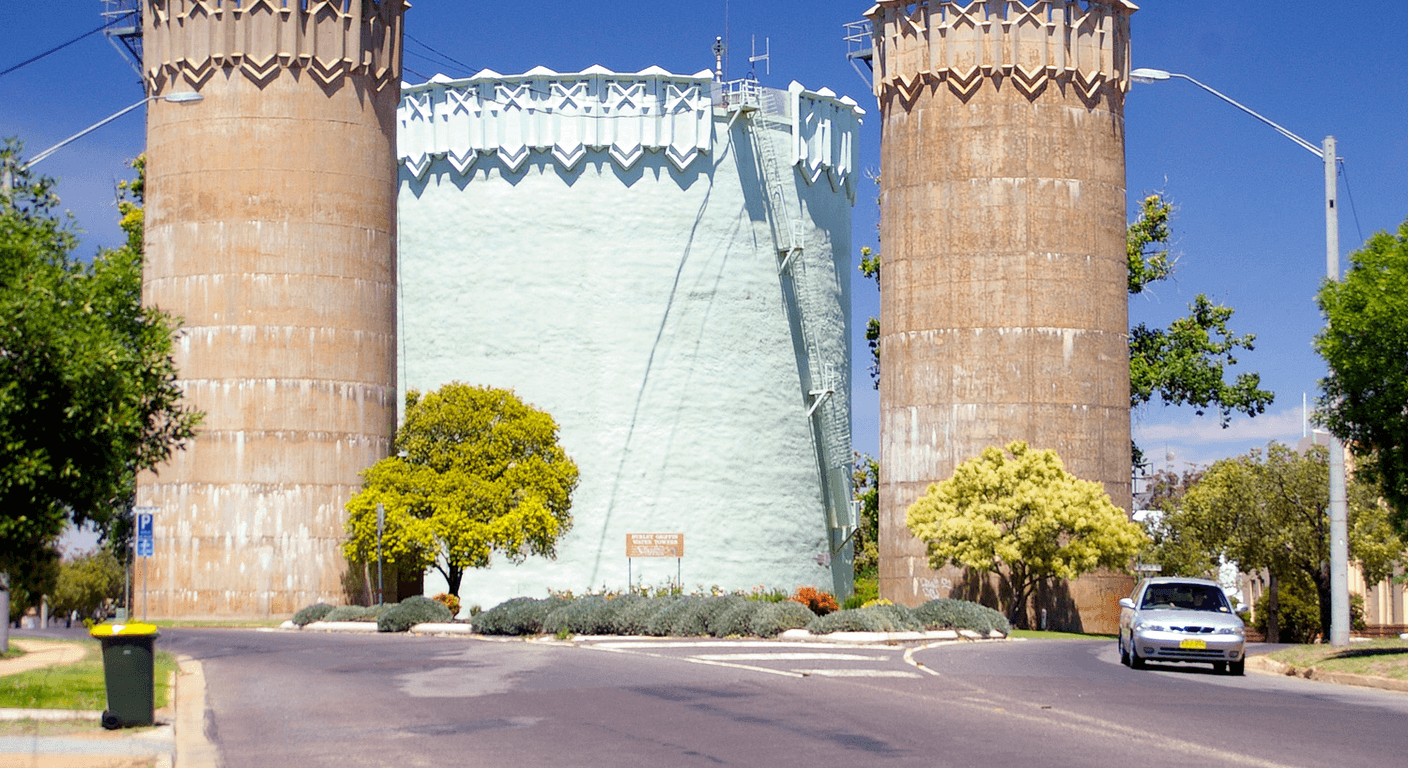
What makes Leeton worth a detour rather than just a footnote is that the bones of Griffin's plan are still legible. The town hasn't been overwhelmed by suburban sprawl in the way many regional centres have. You can stand at the water tower — which Griffin considered the centrepiece of his design, giving it decorative parapets with an almost medieval confidence — and read the radiating pattern of streets below you. For anyone with an interest in Australian planning history, urban design, or simply the pleasure of walking a town that was thought about, Leeton is a genuinely rewarding stop.
The Free Self-Guided Heritage Walk: What to Expect on the Ground
The heritage walk circuit covers the flat central precinct and takes most visitors between 90 minutes and two and a half hours, depending on how long you linger. The Leeton Shire Council publishes a free walking map — available from the Visitor Information Centre on Chelmsford Place and downloadable from the council website — that identifies around 20 points of interest, including the water tower, the former Hydro Hotel, the Pioneer Park war memorial, and a cluster of Federation-era civic buildings that sit comfortably alongside Griffin's later contributions.
The footpaths are sealed and the terrain is flat throughout, which matters when you're spending a warm morning on your feet. Comfortable walking shoes are sufficient; no poles or special equipment needed. The tree canopy along Pine Avenue and Kurrajong Avenue provides genuine shade, and the spacing of the streets — wider than you'd expect for a town of this size — gives the walk an unhurried, almost European quality. There are benches at several points, and the Visitor Information Centre has public amenities.
A detail worth pausing for: the water tower parapets. Griffin's decision to treat a utilitarian structure as a civic monument rather than hide it was deliberate and, at the time, quite unusual in regional New South Wales. The decorative brickwork and the tower's position at the visual terminus of several radiating streets rewards a second look. It's the kind of thing that becomes obvious once you know to look for it — and then you can't unsee it.
The Roxy Theatre: A Riverina Art-Deco Original
Leeton's Roxy Theatre opened in 1930 and has been operating, in various forms, ever since. The building is a confident piece of provincial art-deco — a facade of cream render, geometric ornament, and a marquee that still announces upcoming shows with physical lettering. Inside, the single-screen auditorium retains its original character: a balcony, decorative plasterwork, and the particular acoustic warmth that modern multiplexes have entirely given up on.
The Roxy screens a mix of current-release films and occasional special events, and the program is modest but consistent. It's worth checking the current schedule at roxyleeton.com.au before you arrive — a Roxy evening pairs very naturally with dinner at one of Leeton's small restaurants or a bottle from a local winery picked up that afternoon. For a solo traveller, the Roxy offers something a multiplex in a larger city can't: the easy sociability of a small-town cinema where the staff know the regulars and the interval is taken seriously.
Ticket prices are indicative around $15–$30 depending on the event; confirm directly with the theatre. The building is listed on the NSW State Heritage Register, and the community trust that manages it has invested in accessibility improvements in recent years — the ground-floor seating is accessible, though the balcony involves stairs. Worth confirming your requirements when you book.
Beyond the Town Centre: Orchards, Rice Fields, and the Irrigation Landscape
Leeton's setting in the Murrumbidgee Irrigation Area is part of the story. The town exists because of the irrigation infrastructure developed from the early twentieth century, and the agricultural landscape around it — citrus orchards, stone-fruit blocks, rice paddies in season, and the geometric lines of irrigation channels — is worth at least a slow drive in the late afternoon. The Riverina light at dusk has a particular quality: low, golden, and very still.
The rice fields are flooded from roughly October to November and drained by March or April, so the landscape changes dramatically depending on when you visit. Between April and June, the fields are dry and the harvest is recent; the orchards come into their own from late winter through spring. Wattle Flat Road and the roads heading toward Whitton give a good sense of the irrigation geometry without requiring any walking. A picnic at Pioneer Park or along the Murrumbidgee River foreshore at nearby Narrandera is an easy addition to a two-day itinerary.
Narrandera, 36 kilometres to the east, is worth the short drive: the Narrandera Wetlands support a koala population that's genuinely accessible from town, and the main street has a handful of National Trust-listed buildings. Griffith, 47 kilometres to the north-west, extends the itinerary into wine country if you have an extra day — the De Bortoli and McWilliam's cellar doors are long-established and well set up for visitors.
Getting to Leeton: The Honest Transport Picture
Leeton has no train station. The line that once served the town closed to passengers decades ago, and this is the central planning reality for the visit: you need a car, or you need to piece together a coach connection. NSW TrainLink operates services to Narrandera and Griffith from Sydney via Wagga Wagga, with coach legs on parts of the route — confirm the current timetable at nswtrainlink.info, as services and connections change. From either Narrandera or Griffith, a taxi or rideshare to Leeton is a practical option, though availability of rideshare in regional NSW is not guaranteed; it's worth arranging a local taxi in advance.
From Melbourne, the drive to Leeton takes around five hours via the Hume Highway and Wagga Wagga, or slightly longer via the Riverina Highway through Shepparton. It's a comfortable drive in stages and suits grey nomads with a caravan or motorhome. From Sydney, the drive is roughly 5.5 hours via the Hume or Sturt highways. Leeton itself is compact enough that once you've arrived, a car is useful mainly for the orchard and rice-field drives; the heritage walk and the Roxy are all on foot from the town centre.
Accommodation options in Leeton itself are modest but adequate — a small number of motels and a caravan park. Booking ahead during school holidays or local events is sensible, as the town's limited accommodation fills quickly. Griffith, with a wider range of hotels, is an easy base if you prefer more options and are happy to drive in for the day.
Practical Comfort: Timing, Heat, and Pacing the Visit Well
The Riverina in summer is not a gentle place. Leeton regularly exceeds 38°C from December through February, and the shade on Griffin's boulevards, while genuine, is not sufficient mitigation for a long morning on foot. The sweet spot for this visit is April through to October: warm enough to be pleasant, cool enough to walk comfortably, and with the added benefit of the autumn harvest colour in the orchards if you time it well.
For a solo traveller managing her own pace, the flat terrain and the self-contained nature of the heritage walk are real advantages. There's no pressure to keep up with a group, no steep sections to negotiate, and the Visitor Information Centre is a sensible first stop for a map, a conversation with staff who actually know the town, and a moment to plan the morning. The centre also stocks local produce and small gifts — Riverina olive oil and citrus products make practical, non-fragile souvenirs.
A two-night stay gives you one full day for the heritage walk, the water tower, and a Roxy evening, and a second morning for the orchard drives or a run to Narrandera. That pace leaves room for a long lunch and the kind of unhurried looking around that makes a regional town actually reveal itself. Rushing Leeton into a day trip from Wagga Wagga is possible, but you'd leave with only the surface of it.
Connecting Leeton to a Broader Riverina Cultural Journey
Leeton sits naturally within a Riverina circuit that has more cultural depth than its profile suggests. Griffith's immigration history — with its strong Italian-Australian community, established from the mid-twentieth century through agricultural labour migration — gives the region a food and wine culture that punches above its weight. The Griffith Regional Art Gallery at griffith.nsw.gov.au presents a serious program for a regional gallery. For a traveller with Italian-Australian heritage, the Riverina's Italian connections are not incidental; they're woven into the landscape through the vineyards, the family names on the cellar doors, and the particular way the town squares are used on a Sunday morning.
Wagga Wagga, 120 kilometres to the east, anchors the eastern end of a possible loop. The Museum of the Riverina and the Wagga Wagga Art Gallery — which holds the National Art Glass Collection — make it a cultural stop of genuine substance. The Botanical Gardens there are among the finest in regional NSW and entirely flat. A Riverina circuit combining Wagga Wagga, Leeton, Narrandera, and Griffith over five or six days is a coherent and satisfying itinerary, and one that doesn't require a single flight.
Quick planning guide
| Ideal pace | Slow and unhurried, with no steep sections to negotiate |
|---|---|
| Best months | April to October, avoiding the 38°C-plus summer heat |
| Suggested stay | Two nights — one full day for the walk and Roxy, a second morning for the orchards or Narrandera |
| Mobility level | Easy — flat, sealed footpaths with shade and benches throughout the heritage precinct |
| Cost level | Budget-friendly — the heritage walk is free and Roxy tickets run around $15–$30 |
| Comfort level | Comfortable in the recommended season; demanding in summer heat |
| Best for | Architecture and planning history enthusiasts, solo travellers, and grey nomads touring by car |
| Main planning consideration | No train station serves Leeton — you need a car or a coach-and-taxi connection via Narrandera or Griffith |
Key takeaways
- Leeton's 1914 street plan by Walter Burley Griffin — the architect of Canberra — is still clearly readable on the ground and entirely free to explore.
- The self-guided heritage walk is flat, sealed, and takes between 90 minutes and two and a half hours at a comfortable pace.
- The water tower, with its decorative Griffin parapets, is the centrepiece of the town design — not a utilitarian afterthought.
- Leeton has no train service; a car or pre-arranged coach-and-taxi connection is essential for the visit.
- April to October is the practical travel window; Riverina summers regularly exceed 38°C and are not suited to walking tours.
- The Roxy Theatre, open since 1930 and listed on the NSW State Heritage Register, pairs a heritage walk with a genuine cultural evening.
Recommended partners and links
Indicative prices only — always confirm with the operator before booking.
Frequently asked questions
Is the Leeton heritage walk suitable for older travellers with limited mobility?
Yes. The heritage walk circuit follows flat, sealed footpaths and bitumen streets throughout the central precinct. There are no significant inclines, steps, or uneven surfaces on the main route. Benches are available at several points, and the Visitor Information Centre has accessible amenities. The walk is rated Easy for mobility.
How do you get to Leeton without a car?
Leeton has no train service. NSW TrainLink operates coach services to nearby Narrandera (36 km) and Griffith (47 km) from Sydney via Wagga Wagga; from either town, a local taxi to Leeton is the practical option. Rideshare availability in regional NSW is not reliable. Confirm current timetables and connections at nswtrainlink.info before booking.
Is the Leeton heritage walk actually free?
Yes. The heritage walk itself is entirely free. The walking map is available at no cost from the Leeton Visitor Information Centre on Chelmsford Place and as a download from the Leeton Shire Council website at leeton.nsw.gov.au. There is no entry fee, guided tour cost, or ticketing for the self-guided circuit.
What is the best time of year to visit Leeton?
April through October is the recommended window. Summer temperatures in the Riverina regularly exceed 38°C, making a walking-focused visit uncomfortable from December to February. Autumn brings harvest colour to the orchards; spring sees the citrus and stone-fruit trees in blossom. The rice fields are flooded from around October to November and harvested by March or April, so the landscape changes noticeably with the season.
What connection does Leeton have to the design of Canberra?
Walter Burley Griffin, the Chicago architect who won the 1912 international competition to design the Australian capital, was commissioned to lay out Leeton in 1914 using the same principles of radiating streets, curved crescents, and civic focal points. The Leeton water tower, with its decorative parapets, was Griffin's intended centrepiece — a deliberate echo of the monumental civic thinking he applied to Canberra.