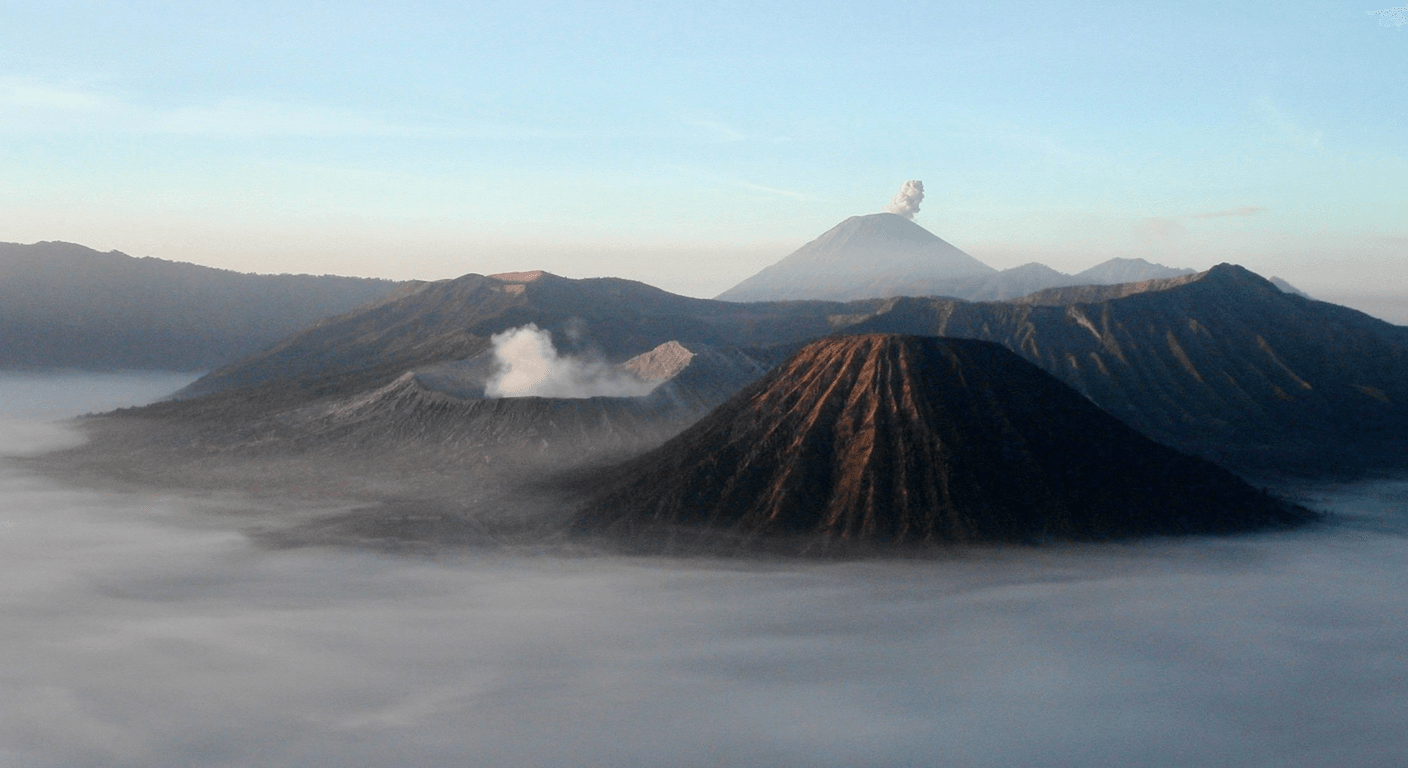
Mount Bromo's sunrise over the Tengger Caldera is best seen after an overnight stay in Cemoro Lawang village, following a recovery night in Surabaya reached via Bali. One to two nights in the highlands suits the pre-dawn jeep tour. The highlight is dawn light spreading across the ash-grey Sand Sea and smoking crater. Mobility is moderate: a bumpy jeep ride, a one-kilometre sand walk, and an optional 250-step climb, manageable with preparation despite genuinely cold conditions.
What makes Mount Bromo worth the early alarm
The Tengger Caldera is roughly ten kilometres across, a collapsed ancient volcano now filled with a sea of pale grey volcanic sand called the Sand Sea. Rising from it are several smaller volcanic cones, the most active being Bromo itself, which exhales a steady plume of sulphurous smoke from its crater rim. At sunrise, when the light shifts from cold blue to gold across the caldera, the scene is genuinely unlike anything else in South-East Asia.
For travellers who've done Bali many times and are ready to push a little further east, Bromo offers a completely different register of Indonesian experience. The Tenggerese people who live in the surrounding highland villages practise a form of Hinduism distinct from Bali's, and the landscape — high, cool, dramatic — feels more like a lunar plateau than a tropical island. That contrast is part of the pleasure.
The honest appeal for over-50 travellers is this: the spectacle is enormous, the actual physical demands are manageable with a little preparation, and the experience is largely organised for you by your jeep driver and local guide. You're not bushwalking into the wilderness. You're watching one of the world's great volcanic landscapes wake up at dawn.
Getting there from Australia: flights, stopovers and the sensible pace
The most practical route from Melbourne, Sydney or Brisbane is to fly to Bali (Denpasar) and connect to Surabaya, East Java's main city, from there. Surabaya's Juanda International Airport is well serviced from Bali, with the connecting flight taking around an hour. From Surabaya, it's roughly two to three hours by road to the Bromo highland area, or you can take an overnight train to Probolinggo and transfer from there — a slower but more comfortable option for those who find long road journeys tiring.
Total travel time from Melbourne to the Bromo region, including connections, is realistically fourteen to eighteen hours depending on layovers. A recovery night in Surabaya or at your highland guesthouse before the sunrise excursion is not indulgent — it's simply sensible. Arriving exhausted and then getting up at 3am for a jeep ride on rough volcanic tracks is the one thing that will flatten an otherwise excellent trip.
Travel insurance that covers pre-existing medical conditions is essential, not optional. Indonesian hospitals in regional areas are limited, and medical evacuation costs without insurance are significant. Compare policies carefully and declare all conditions. The Australian government's Smartraveller site at smartraveller.gov.au carries current health and safety advice for Indonesia and is worth checking in the weeks before departure.
What actually happens on a Bromo sunrise tour
Most tours begin with a jeep pickup from your guesthouse in Cemoro Lawang — the small village perched on the caldera rim — at around 3am to 3:30am. The 4WD vehicles are sturdy and the drivers experienced, but the tracks across the Sand Sea are rough and the ride is bumpy. If you have lower back concerns or find sustained vibration uncomfortable, mention this to your operator beforehand; some will pace the drive more gently or allow you to brace differently in the vehicle.
The jeep climbs to the Penanjakan viewpoint, where a short uphill walk — concrete steps, around ten to fifteen minutes — brings you to the main viewing platform. Arrive before sunrise and you'll find a crowd of other visitors and local vendors selling hot tea and coffee. The cold is real: temperatures at Penanjakan at 4am regularly sit between four and ten degrees Celsius, sometimes lower in July and August. Australians who packed for tropical Indonesia and forgot a layer are the ones shivering while everyone else is comfortable.
After sunrise at Penanjakan, the jeep descends back into the Sand Sea for the walk to Bromo's crater. Across the flat volcanic sand it's around one kilometre each way — walkable, but the surface is soft in places and can be uneven. Horses are available for hire for those who prefer not to walk this section; there's no judgement in using one. The final approach to the crater is a steep staircase of around 250 steps. This section is entirely optional. The views from the base of the stairs are still extraordinary, and many visitors choose to stop there.
How to dress for a four-degree dawn in a tropical country
This is where preparation separates a comfortable experience from a miserable one. The Tengger Highlands sit at around 2,200 metres above sea level, and the pre-dawn temperature at the viewpoint is genuinely cold by any standard. A thermal base layer, a mid-layer fleece or down jacket, and a wind-resistant outer shell are the practical minimum. Gloves and a beanie are not excessive — they're useful.
By mid-morning, as the jeep returns across the Sand Sea and the sun climbs, temperatures rise quickly. You'll be stripping layers by 9am. The key is packing clothing that compresses well and can be tied around a waist or stuffed into a daypack as the morning warms. Comfortable walking shoes with grip are far better than sandals on the volcanic sand, and a small daypack for water, snacks and those layers is worth carrying.
Volcanic dust and sulphur emissions near the crater can irritate eyes and throats. A simple buff or lightweight scarf pulled over the nose and mouth is enough for most visitors, though those with respiratory conditions should discuss this with their doctor before the trip and consider a proper particulate mask. The sulphur smell at the crater rim is strong — brief, but distinctive.
Where to stay: the case for Cemoro Lawang
Staying in Cemoro Lawang, the village on the caldera rim, means you're minutes from the jeep departure point and can watch the caldera change colour in the late afternoon light from your own guesthouse terrace. It's a small, quiet village with a handful of guesthouses and small hotels ranging from very basic to comfortable mid-range. The Lava View Lodge and Cafe Lava Hostel are among the established names — confirm current availability and pricing directly.
The road to Cemoro Lawang is steep and winding. If your driver is pushing speed on the hairpin bends, it's entirely reasonable to ask them to slow down. The village itself is compact and mostly flat once you arrive, making it easy to move between your accommodation, a meal spot and the viewpoint without much effort.
Some travellers prefer to base in Probolinggo, the larger town at lower elevation, and do the sunrise tour as an early-morning excursion from there. This is a reasonable option if highland accommodation feels too rustic, though it adds to the pre-dawn travel time. Surabaya-based operators run full-day tours from the city, but these are very long days and don't suit everyone — an overnight stay in the highlands is generally the more comfortable choice.
Entry requirements, health and travel insurance: what to confirm before you go
Indonesian entry requirements for Australians have changed several times in recent years and should be confirmed on smartraveller.gov.au and through the Indonesian Embassy in Canberra at kemlu.go.id/canberra before booking. At time of writing, Australians may be eligible for a Visa on Arrival or e-Visa on Arrival, but the rules, fees and processing steps should be verified directly — do not rely on information from third-party booking sites, which may be out of date.
The Bromo-Tengger-Semeru National Park charges a separate entry fee that has historically differed between weekdays and weekends and between foreign and domestic visitors. Fees change periodically; confirm current rates through the official park authority at bromotenggersemeru.org or with your tour operator before arrival. Having Indonesian rupiah in cash for smaller transactions in the highlands is practical — ATM access in Cemoro Lawang is limited.
Travel insurance with medical evacuation cover is strongly recommended. Confirm that your policy covers high-altitude environments, volcanic areas and any pre-existing conditions you hold. If you're travelling as a couple and one partner has a condition that might require evacuation, both of you need adequate cover — stranded-companion provisions vary significantly between policies. The DFAT Smartraveller site has a useful checklist.
Making the most of the experience: a few practical thoughts
Booking a reputable local tour operator through your accommodation or a well-reviewed agency matters more here than in many places. A good driver knows which track gives the smoothest ride for passengers with limited mobility, which spot at Penanjakan offers the clearest sightline without the worst crowd, and when to leave the viewpoint to reach the crater base before the sand fills with jeep traffic. Ask your guesthouse for a recommendation rather than booking blindly through an aggregator.
The Yadnya Kasada festival, when the Tenggerese community throws offerings into the crater as part of their annual ritual, is one of the most extraordinary cultural events in Indonesia. It falls on the fourteenth day of the Kasada month in the Tenggerese calendar — dates shift annually. If your travel dates align, the experience of witnessing this ceremony adds a dimension to Bromo that goes well beyond landscape tourism.
Finally, a word on pacing the broader East Java trip. Bromo pairs well with a day or two in Malang, a cool highland city with Dutch colonial architecture, good coffee and a genuine local character that most tourists pass through quickly. Yogyakarta, a short flight away, opens up Borobudur and Prambanan — a natural extension for those with two weeks. East Java rewards travellers who slow down and look sideways.
Quick planning guide
| Ideal pace | Slow-paced, with a recovery night built in before the pre-dawn tour |
|---|---|
| Best months | Comfortable year-round, though July–August dawns are the coldest |
| Suggested stay | 1-2 nights in Cemoro Lawang, plus a recovery night in Surabaya |
| Mobility level | Moderate — a bumpy jeep ride, a one-kilometre sand walk, and an optional 250-step climb |
| Cost level | Budget-friendly to mid-range guesthouses |
| Comfort level | Basic to comfortable, with genuinely cold pre-dawn conditions |
| Best for | Over-50 travellers wanting a dramatic volcanic landscape beyond Bali |
| Main planning consideration | Packing proper cold-weather layers and confirming current visa and insurance requirements before booking |
Key takeaways
- Temperatures at Mount Bromo's Penanjakan viewpoint regularly drop to four to ten degrees Celsius before dawn — a thermal layer and wind jacket are essential, not optional.
- The walk across the Sand Sea to Bromo's crater base is around one kilometre each way on uneven volcanic sand; horses are available for hire and the final crater staircase (around 250 steps) is optional.
- Fly Melbourne or Sydney to Bali, connect to Surabaya, then transfer by road to the highlands — build in a recovery night before the pre-dawn jeep tour.
- Indonesian entry requirements change: always confirm current visa rules on smartraveller.gov.au and the Indonesian Embassy website before booking.
- Stay in Cemoro Lawang village on the caldera rim for the most practical and atmospheric base — you're minutes from the jeep departure point.
- Travel insurance with medical evacuation cover and pre-existing condition declarations is essential; regional Indonesian hospitals have limited facilities.
Recommended partners and links
Indicative prices only — always confirm with the operator before booking.
Frequently asked questions
How fit do you need to be for a Mount Bromo sunrise tour?
A moderate level of fitness is helpful. The jeep ride across rough volcanic tracks lasts around 20–30 minutes and can be bumpy. The walk across the Sand Sea to the crater base is roughly one kilometre each way on uneven volcanic sand. The final ascent to the crater rim involves around 250 steep steps and is entirely optional — the views from the base are still impressive. Horses are available for hire across the Sand Sea for those who prefer not to walk that section.
How cold does it get at Mount Bromo before sunrise?
Very cold by tropical standards. The Penanjakan viewpoint sits at around 2,770 metres above sea level, and pre-dawn temperatures between four and ten degrees Celsius are typical, sometimes lower in July and August. A thermal base layer, fleece or down jacket, gloves and a beanie are all genuinely useful. Temperatures rise quickly after sunrise as you descend, so pack layers you can remove and carry.
What is the best time of year for Australian travellers to visit Mount Bromo?
The dry season, May to October, offers the clearest sunrise views and the lowest chance of cloud obscuring the caldera. July and August are peak season for clear skies but also the most visited months. May, June and September offer a balance of good weather and fewer crowds. The wet season, November to April, brings cloud and rain that frequently obscure the sunrise view entirely.
Do Australians need a visa to visit Indonesia and Mount Bromo?
Australian passport holders may be eligible for a Visa on Arrival or e-Visa on Arrival for Indonesia, but entry requirements change and should be confirmed on the Australian government's Smartraveller website at smartraveller.gov.au and through the Indonesian Embassy in Canberra before booking. Do not rely on third-party travel sites for current visa rules.
How do you get to Mount Bromo from Australia?
The most practical route is to fly from Melbourne, Sydney or Brisbane to Bali (Denpasar), then connect to Surabaya in East Java — a connecting flight of around one hour. From Surabaya, it's two to three hours by road to the Bromo highland village of Cemoro Lawang. Total journey time from Melbourne to the Bromo area is realistically fourteen to eighteen hours including connections. Building in a recovery night before the pre-dawn sunrise tour is strongly recommended.