Yogyakarta, Java, is best visited May to September during the dry season, which aligns with the Australian winter. Seven nights allows time for both Borobudur and Prambanan — two ninth-century temple complexes 17 kilometres apart — plus the old city's batik and silver crafts. Mobility is moderate: Borobudur's upper terraces involve steep, uneven stairs, though lower galleries suit less mobile travellers. Australians reach Yogyakarta via Jakarta or Bali, with no direct flights, totalling nine to twelve hours of flying plus layover.
Why Yogyakarta rewards the traveller who slows down
There's a tendency to treat Borobudur and Prambanan as a box-ticking exercise — arrive, photograph, leave. That approach misses almost everything. These two temple complexes, built within decades of each other in the ninth century by rival dynasties, are among the most ambitious feats of stone construction anywhere on earth. Seeing them properly means arriving when the light is right, walking slowly and reading the carved narrative panels that wrap around Borobudur's galleries like an illustrated scripture.
Yogyakarta — Jogja to everyone who's been — is the logical base. It's a genuine city with a living royal court, a university, thriving craft traditions and restaurants that don't exist solely for tourists. A week here feels like the right amount of time: two days allocated to the temples, the rest given over to the old city, the market lanes, an afternoon at a batik workshop where the craft is taken seriously. It's the kind of place that rewards curiosity over itinerary-ticking.
For travellers from regional Victoria or other parts of Australia, the journey is manageable rather than gruelling. It's not a short-haul hop, but it's well within what a fit, well-organised traveller in their sixties handles comfortably — particularly with a recovery night built in on arrival.
Getting there from Australia: flight routing and jet lag reality
Yogyakarta's Adisutjipto International Airport (or the newer Yogyakarta International Airport at Kulon Progo, depending on carrier) is not served by direct flights from Australia, so a connection is unavoidable. The two main routing options are via Jakarta (Soekarno-Hatta) or via Bali (Ngurah Rai). Garuda Indonesia operates both routes; Batik Air and other carriers also serve the Jakarta connection. Total journey time from Melbourne or Sydney, including the domestic leg, sits at roughly nine to twelve hours of flying, plus layover.
The Bali routing has the advantage of familiarity — many Australian travellers have done that leg before — and a Bali stopover of one or two nights is a reasonable way to break the journey and arrive in Yogyakarta rested rather than ragged. Jakarta connections tend to be quicker overall but the airport transit can feel hectic. Either way, booking an arrival day as a genuine rest day rather than a sightseeing day is not indulgence. It's strategy.
Jet lag on the Jakarta time zone (UTC+7) is relatively mild for Australians — typically two to three hours behind eastern states summer time, or around the same ahead in winter. The adjustment is usually quick. More relevant is the heat: Yogyakarta sits at low elevation and is warm year-round, so the body needs a day to recalibrate before tackling exposed stone terraces in the morning sun.
Borobudur: what to expect on the ground
Borobudur is a Buddhist stupa of extraordinary scale — nine stacked platforms rising to a central bell-shaped pinnacle, the whole structure dating to around 800 CE and restored over decades with UNESCO involvement. The upper circular terraces hold 72 latticed stone stupas, each containing a seated Buddha. Walking the full circuit of all nine levels involves climbing steep, narrow stone staircases. The steps are original — uneven, sometimes slippery after rain, and without handrails on the upper sections.
For travellers with knee concerns or limited mobility, the lower galleries are worth knowing about. The narrative relief panels — more than 2,500 metres of carved stone stories — are concentrated on the lower levels and are genuinely absorbing. You don't need to reach the summit to have a meaningful experience here. That said, the upper terraces offer the spatial drama that photographs cannot fully convey, and many travellers in their sixties and seventies manage them comfortably by taking their time.
The sunrise tour is the famous option: a 4am pickup, a dark climb by torchlight, and the moment the Merapi volcano silhouette emerges from the mist as dawn breaks. It's genuinely affecting. It also means a very early alarm, a pre-dawn drive and climbing stone steps in low light. The late afternoon visit — arriving around 3pm as tour groups thin out — is cooler, the light turns golden on the stone, and the pace is entirely your own. Both are valid. One is just kinder on the body.
Prambanan: the Hindu rival seventeen kilometres away
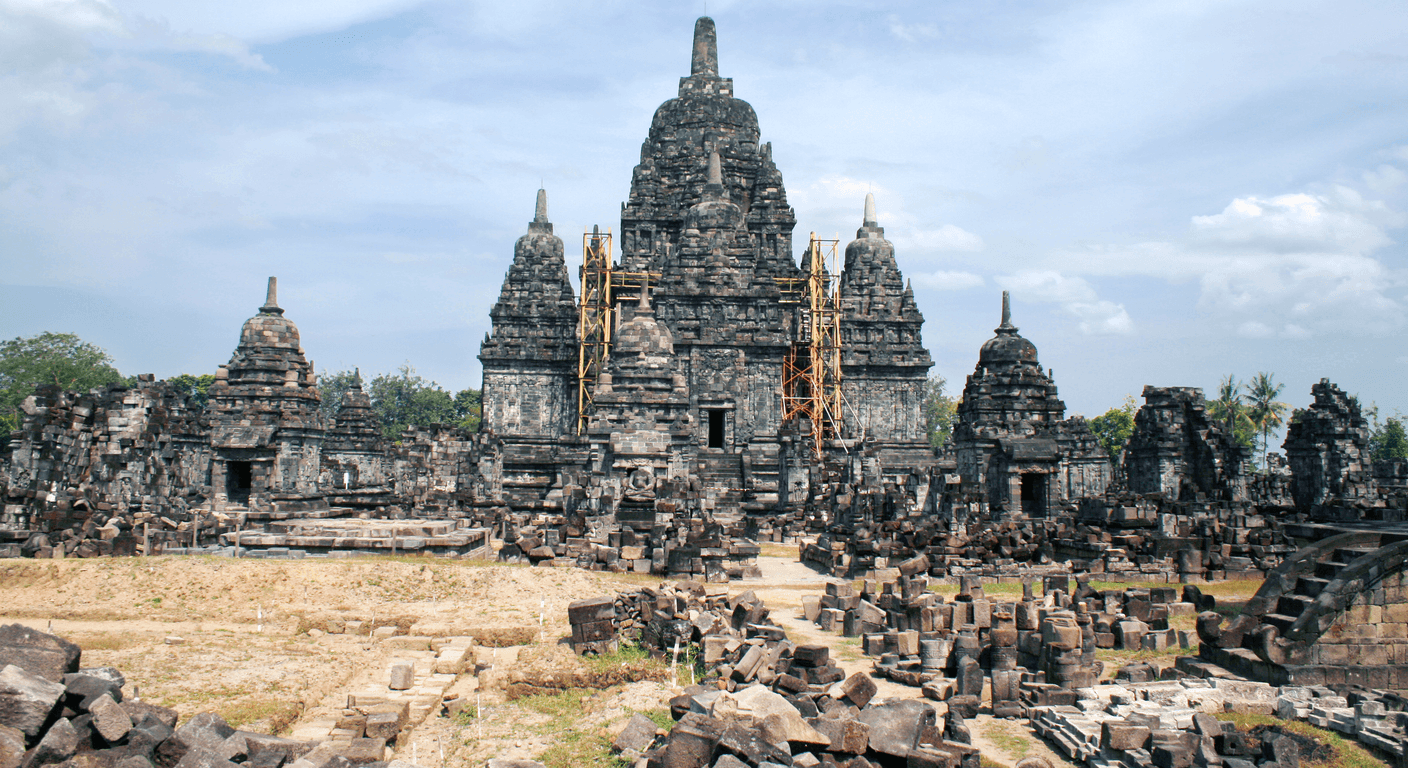
Where Borobudur is horizontal — a mountain you ascend — Prambanan is vertical. The three central towers dedicated to Brahma, Vishnu and Shiva rise more than 47 metres, their surfaces carved in dense decorative relief. Built by the Sanjaya dynasty in the mid-ninth century, the complex originally comprised hundreds of smaller shrines arranged around the great trio. An earthquake in the sixteenth century toppled most of them; restoration is ongoing, and the partially reconstructed smaller temples give the site a raw, archaeological quality that Borobudur — more completely restored — doesn't have.
The walking surfaces at Prambanan are generally flatter than Borobudur's upper terraces, though the inner chambers of the main temples involve short, steep internal staircases. Entry to the interior is possible for many travellers, but the outer circuit of the complex — which gives the best angles for understanding the full ensemble — involves considerable walking on uneven grass and stone paths. Comfortable, closed-toe shoes are not optional.
A combined ticket covering both Borobudur and Prambanan is available and represents reasonable value; confirm current pricing through the official Taman Wisata Candi site (twcandi.com) and the Borobudur Park site (borobudurpark.com) before travel. Touring both in a single day is possible but leaves both shortchanged. The more satisfying approach is Borobudur on one day — morning or late afternoon — and Prambanan the next, with time at each to sit, look and let the scale settle.
Yogyakarta's old city: batik, silver and the kraton
The days between temple visits are where Yogyakarta reveals its other self. The kraton — the walled palace precinct of the Sultan of Yogyakarta — is a working royal compound that admits visitors to its outer pavilions and museum galleries. The current sultan, Sri Sultan Hamengkubuwono X, remains an active political figure as well as the city's ceremonial head; the institution is not a relic but an ongoing presence. A guided walk through the precinct is worth the modest entry cost.
Jalan Malioboro, the main commercial street, is where the batik sellers and souvenir stalls concentrate, and it can feel overwhelming at peak hour. The more interesting batik is found a few streets back, in workshops where the wax-resist process is demonstrated and the fabric is made to order rather than mass-produced. Yogyakarta is one of the few places in the world where batik tulis — hand-drawn, painstaking, time-consuming — is still produced by skilled artisans. Watching the process, and understanding why a good piece costs what it does, changes how you look at the cloth.
The Kota Gede district, a short drive southeast of the centre, is Yogyakarta's silversmithing quarter. The workshops here produce intricate filigree work using techniques passed down through generations. Prices are reasonable by Australian standards, quality varies, and the better workshops welcome visitors who want to watch the craftspeople at work before buying anything. It's the kind of afternoon that feels unhurried and genuine — a sharp contrast to the sensory volume of Malioboro.
Practical matters: entry rules, health and travel insurance
Australian passport holders have generally been able to enter Indonesia on a visa on arrival, currently priced at around USD 35 for a 30-day stay, extendable once in-country. Rules and fees change, however, and the only reliable source is the Australian Government's Smartraveller site (smartraveller.gov.au) checked close to travel. Do not rely on information from travel forums or booking sites for visa requirements — confirm it officially.
Travel insurance for Indonesia is essential and, for travellers over 60 with any pre-existing conditions, requires careful attention. Most standard policies cover Indonesia, but the cover for pre-existing conditions — cardiac history, diabetes, joint replacements, respiratory conditions — varies significantly between providers. Declare everything, read the exclusions and carry a summary of your medical history and current medications. Medical facilities in Yogyakarta are adequate for routine care; for anything serious, evacuation to Bali or Singapore is the realistic option, which is exactly why evacuation cover matters.
The practical rhythm of a day in Yogyakarta suits older travellers well. Temples in the morning or late afternoon, a long lunch during the midday heat, a rest, then the old city in the cooler late afternoon. Taxis and ride-share apps (Gojek and Grab both operate here) are inexpensive and reliable. The city is not particularly walkable in the European sense — distances between sites require transport — but getting around is easy and cheap.
When to go and how long to stay
Java's dry season runs May through September. These months bring lower humidity, clearer skies and the best conditions for outdoor temple visits. October and November see the transition to wet season; December through April brings regular afternoon downpours that, while not necessarily trip-ending, make exposed stone terraces slippery and uncomfortable. For Australian travellers, May to August aligns with the southern winter — a practical bonus.
Five nights is the minimum to do justice to both temples and the city without feeling rushed. Seven nights is more comfortable and allows a day trip to the nearby Dieng Plateau — a high-altitude volcanic landscape with its own ancient Hindu temples, cool temperatures and views across the caldera that are a complete change of scene from the lowland heat. It's roughly two hours by road from Yogyakarta.
A suggested rhythm for seven nights: arrival day rest; Borobudur afternoon or sunrise; rest and old city exploration; Prambanan; Kota Gede silver district and kraton; optional Dieng Plateau day trip; final day at leisure before departure. That's a framework, not a prescription. The value of Yogyakarta is precisely that it doesn't demand a packed itinerary to justify itself.
Quick planning guide
| Ideal pace | Slow-paced — two days per temple complex, rest days built in |
|---|---|
| Best months | May to September, Java's dry season and the Australian winter |
| Suggested stay | Five nights minimum, seven more comfortable |
| Mobility level | Moderate — steep, uneven stone stairs at Borobudur; flatter but uneven paths at Prambanan |
| Cost level | Budget-friendly — combined temple ticket, inexpensive taxis and ride-share |
| Comfort level | Warm year-round low elevation; a recovery day on arrival is recommended |
| Best for | Culturally curious travellers over 60 who prefer depth over a packed itinerary |
| Main planning consideration | No direct flights from Australia — a connection via Jakarta or Bali is required, plus declared pre-existing conditions on travel insurance |
Key takeaways
- Borobudur and Prambanan are just 17 kilometres apart — two ancient temple complexes from rival ninth-century dynasties, best visited on separate days.
- The late afternoon visit to Borobudur is cooler, less crowded and easier on the body than the famous sunrise tour.
- Australians reach Yogyakarta via Jakarta or Bali; total journey time is roughly nine to twelve hours of flying including the domestic connection.
- May to September is Java's dry season and the most comfortable time for temple visits — coinciding with Australia's winter.
- Travel insurance with declared pre-existing conditions and evacuation cover is essential for Indonesian travel over 60.
- Check current Indonesian entry requirements at smartraveller.gov.au before booking — visa rules and fees are subject to change.
Recommended partners and links
Indicative prices only — always confirm with the operator before booking.
Frequently asked questions
How difficult are the temples at Borobudur and Prambanan for travellers with mobility concerns?
Both temples involve uneven stone steps and no handrails on upper sections. Borobudur's lower gallery levels — which contain the most significant carved reliefs — are accessible without climbing to the summit. Prambanan's outer circuit is mostly flat but on uneven ground. Closed-toe, non-slip shoes are essential at both sites. Travellers with significant knee or balance issues can still experience both temples meaningfully by staying on lower levels.
Is the Borobudur sunrise tour worth it for older travellers?
The sunrise experience — watching Merapi volcano emerge from mist as dawn breaks over the stupa — is genuinely moving. However, it requires a 4am departure, climbing stone steps in low light and arriving before the site is fully lit. The late afternoon visit, arriving around 3pm, offers cooler temperatures, thinning crowds and beautiful golden light on the stone. Both are worthwhile; the afternoon option is physically gentler.
How do Australians fly to Yogyakarta?
There are no direct flights from Australia to Yogyakarta. The two main routing options are via Jakarta (Soekarno-Hatta) or via Bali (Ngurah Rai), with Garuda Indonesia and other carriers operating connections. Total journey time from Melbourne or Sydney is roughly nine to twelve hours of flying including the domestic Indonesian leg. A Bali stopover of one or two nights is a practical way to break the journey.
What are the visa requirements for Australians visiting Indonesia?
Australian passport holders have generally been eligible for a visa on arrival in Indonesia, but requirements and fees are subject to change. The only reliable source for current rules is the Australian Government's Smartraveller website at smartraveller.gov.au. Check this close to your travel date and do not rely on travel forums or booking sites for visa information.
What is the best time of year to visit Yogyakarta?
May to September is Java's dry season and the most comfortable time to visit Yogyakarta and the surrounding temples. Humidity is lower, skies are clearer and mornings at the temples are pleasant rather than oppressive. This period coincides with the Australian winter, making it a natural fit for travellers looking to escape the cold. December through April brings regular rain and slippery temple surfaces.