The National Gallery of Australia in Canberra opens its permanent collection free to all visitors year-round, making it one of the best-value culture days in the country. Aim for a spring or autumn visit (September–November or March–May) to combine the gallery with a Lake Burley Griffin walk. Allow four to five hours. The Aboriginal and Torres Strait Islander galleries and the sculpture garden are the standout spaces. Mobility rating: Easy — lifts, free wheelchairs, plentiful seating. Direct coaches and flights connect from Melbourne, Sydney and Brisbane.
Why the NGA works so well for over-50 visitors
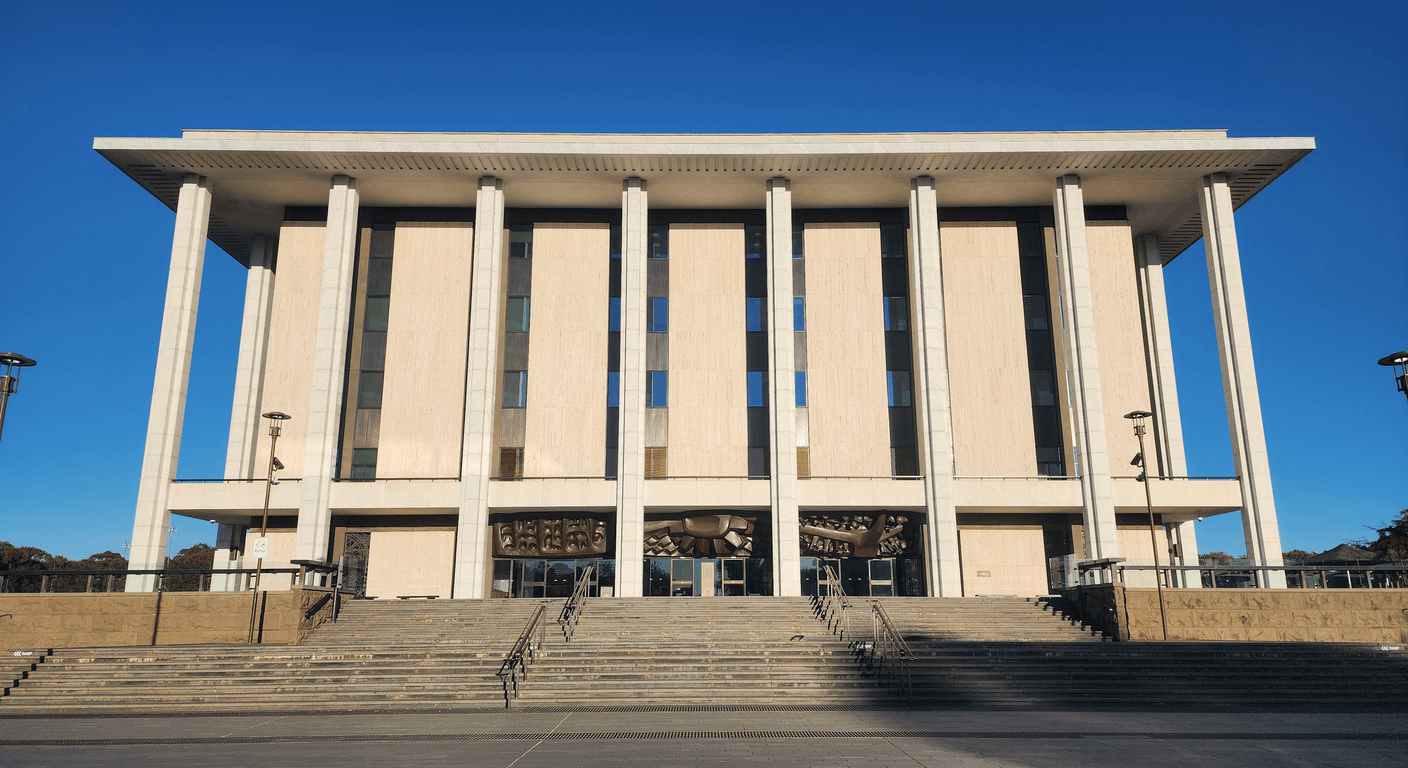
There's no admission charge at the door, no timed entry, and no pressure to see everything in one go. That's the immediate appeal. But the National Gallery of Australia earns its reputation beyond the price tag. The building itself — Brutalist concrete softened by extraordinary light wells and water features — is comfortable to move through at whatever pace suits you. Wide corridors, generous room spacing, and seating distributed throughout the galleries mean you can stop when you want to, linger over a painting, and then find a bench.
For a group of women travelling together from regional Victoria, Canberra often gets overlooked in favour of Melbourne or Sydney. That's a mistake worth correcting. The NGA sits about two hours from Albury by road, and coaches connect directly from Melbourne's Southern Cross Station. Fly from Tullamarine and you're there in under an hour. The city is compact, safe, and — once you're used to the roundabouts — surprisingly easy to move around on foot or by bus.
One practical note before you arrive: the permanent collection is free, full stop. But the NGA regularly hosts major touring exhibitions — international blockbusters, retrospectives, travelling national collections — and those carry a separate ticket price, typically around $25–$35 per adult. Confirm what's on and what it costs at nga.gov.au before you plan your day. It's not a hidden catch, just worth knowing in advance so the budget doesn't shift on you at the entrance desk.
The rooms worth your time: where to begin
Start with the Aboriginal and Torres Strait Islander galleries. Not because it's obligatory, but because the work is extraordinary — and because the NGA's collection here is the largest and most significant in the world. The Yirrkala church panels, bark paintings of rare scale and spiritual authority, stop most visitors in their tracks. So does Emily Kame Kngwarreye's 'Earth's Creation', a vast canvas of layered ochre and white that rewards a long, unhurried look. The 2026 rehang has added community-authored wall texts that transform the experience from 'looking at art' into something closer to listening.
From there, the Australian art galleries on the ground floor trace the country's visual history from colonial watercolours through to late-twentieth-century abstraction. The Sidney Nolan Ned Kelly series is here — smaller than many people expect, and more affecting for it. The international galleries upstairs hold surprises too: a Monet water lily panel, works by Warhol and Hockney, and a room of Southeast Asian ceramics that tends to be quieter than the main galleries. If your group has mixed interests, splitting up for an hour and reconvening at the café works perfectly well.
The sculpture garden is its own case entirely, and on a clear autumn or spring morning it's one of the better outdoor art experiences in Australia. Henry Moore bronzes, Antony Gormley figures, and a large Aristide Maillol nude are arranged across lawns that roll gently toward the lake. The paths are paved and mostly flat. There are benches. There's shade. It's the kind of place you end up staying longer than planned — which is the point.
What does the day actually look like? An honest hour-by-hour account
Aim to arrive around 10:00am, shortly after the gallery opens (10:00am daily, closed Christmas Day — confirm on the NGA website). The morning light in the main atrium is genuinely worth the early start, and the building is quieter before school groups arrive around 10:30. Pick up a free floor map at the entrance desk — the gallery is large enough that the map earns its place in your bag. Free audio guides are available via the NGA app if your group uses smartphones; otherwise, the wall texts have been substantially improved and stand on their own.
Allow roughly 90 minutes for the Aboriginal and Torres Strait Islander galleries and the Australian art collection — more if your group is the kind that reads every panel (no judgement). By 11:30 or so, most people are ready for a sit-down. The NGA Café on the ground floor serves coffee, light meals and cakes; a flat white runs around $5–$6, and a light lunch is roughly $18–$25 per person. It's decent without being remarkable. Alternatively, hold off and head outside to the sculpture garden from around noon — the light is good, the temperature in autumn is mild, and you can walk the lakefront path from there.
The sculpture garden takes 30 to 45 minutes at a relaxed pace, longer if the group wants to sit on the lakeside lawn. By 1:30pm, most visitors have done the core of what they came for. That leaves the afternoon free: a second pass through a gallery that caught your eye, a walk along Lake Burley Griffin (flat, paved, roughly 3km to the National Carillon and back), or a drive or bus across to Manuka for lunch at one of the strip's cafés. The gallery itself closes at 5:00pm. Genuinely skippable if you're time-pressed: the decorative arts and design galleries on level 2. Good work, but the collection is dense and fatigue sets in. If you skip them, the NGA gift shop near the entrance — one of the better museum shops in the country — is a reasonable alternative use of 20 minutes.
Accessibility at the NGA: the honest picture
The NGA is one of the more accessible major galleries in Australia, and it's worth saying that plainly. Lifts serve all levels, and the building has no significant stairs between the main gallery spaces. Free manual wheelchairs are available at the entrance — no booking required, first come first served, so arrive early on busy days. Companion card holders are admitted free to any paid exhibitions (confirm eligibility at nga.gov.au). The accessible toilets are well-located and clearly signed.
Seating is distributed throughout the galleries — not just in the café. The Aboriginal and Torres Strait Islander galleries have benches positioned to allow you to sit with the larger works, which is exactly the right curatorial decision. The sculpture garden paths are paved and have gentle gradients; the lawn areas between paths are grass, which is manageable for most but worth noting if you use a walking frame. The lakefront path adjacent to the gallery is sealed and flat.
One gap: the audio guide app requires a smartphone and reasonable eyesight to navigate. If your group includes members who prefer non-digital options, ask at the front desk — staff are genuinely helpful and can point you toward printed materials or guided highlights tours, which run on selected days (confirm the schedule on the NGA website before you visit).
Lunch and coffee: free-to-cheap options near the gallery
The NGA Café is the obvious choice for convenience — it's inside the building, the seating is comfortable, and you don't need to go back through any entry process to return to the galleries. Budget around $18–$25 for a light lunch per person, or around $10–$14 for a soup and bread situation. It's not the city's most exciting food, but it does the job and the service is unhurried.
A ten-minute walk along the lakefront path brings you to the Boat House by the Lake, a long-established Canberra institution on the water's edge. It's a step up in price — mains around $35–$45 — but the lake views are genuine and the pacing suits a long group lunch. Confirm current hours and bookings at boathousebythelake.com.au. For something cheaper and more casual, the Kingston Foreshore precinct is about a 15-minute drive or a short bus ride, with a range of cafés and bakeries in the $15–$25 range.
If your group is self-catering or budget-conscious, there's a grassed lakeside picnic area adjacent to the sculpture garden. Woolworths and Coles both have Canberra city locations a short drive away, or the Manuka village shops (about 10 minutes by car) have a good IGA and several deli-style options. Bringing your own lunch and eating by the lake, with the Brindabella Ranges visible to the west on a clear day, is not a bad way to spend an hour.
Pairing the gallery with a Lake Burley Griffin walk
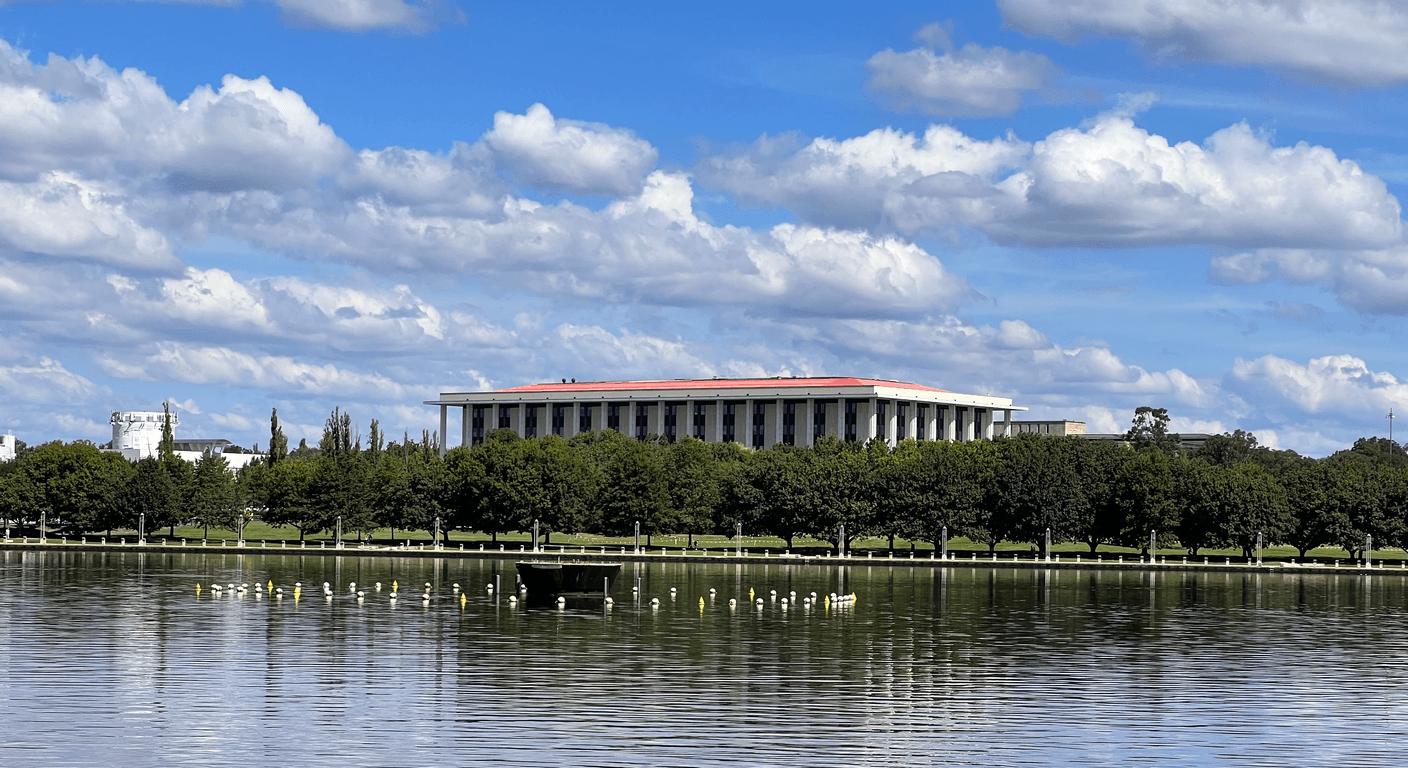
The NGA sits directly on the southern shore of Lake Burley Griffin, and the lakefront path is sealed, flat, and well-maintained — the kind of walk that suits most mobility levels without demanding anything strenuous. From the gallery's sculpture garden entrance, you can walk east toward the National Carillon (the bell tower on Aspen Island, visible from the path) in around 30 minutes at a comfortable pace. The Carillon is free to visit, and if you time it right you'll catch a recital — the schedule is published at nca.gov.au.
Walking west from the gallery takes you toward Commonwealth Park, a large open space that becomes spectacular during Floriade (September–October), Canberra's tulip and flower festival. Outside festival season it's a pleasant, uncrowded walk with water views. The full loop around the lake is around 35km and not what's being suggested here — but a 3–5km out-and-back section is entirely manageable and makes a satisfying physical counterpoint to a morning spent indoors.
For those who'd rather ride than walk, hire bikes are available from several operators near the lakefront. Canberra's cycling infrastructure is genuinely good, and the lakefront path is shared-use. If your group includes anyone who hasn't cycled in a while, the flat terrain is forgiving — but confirm with the hire operator that the bikes are step-through frames, which are easier to mount. Hire is roughly $15–$25 per hour per bike; confirm current rates with operators listed on visitcanberra.com.au.
Getting to Canberra from regional Victoria and other Australian cities
From regional Victoria — say, Bendigo, Ballarat, or the Latrobe Valley — the most comfortable approach is usually a coach or train to Melbourne, overnight in the city if you want a relaxed start, then a morning coach or flight to Canberra. Murray's Australia runs coaches from Sydney and the ACT border region; Greyhound connects from further afield. Fly from Tullamarine to Canberra Airport on Rex, Qantas or Virgin — fares vary considerably, so book ahead and compare. The flight is around 55 minutes.
From Sydney, the train to Canberra is a genuine option — the NSW TrainLink XPT runs from Central Station and takes around four hours. The scenery through the Southern Highlands and the descent to the ACT is worth the window seat. From Brisbane, fly — it's roughly two hours. From Perth, a direct flight is around four hours; confirm routes with your preferred airline.
Canberra Airport is about 8km from the city centre. A taxi or rideshare runs around $25–$35 to the NGA area; confirm current rates. The airport bus (route 11/11A) connects to the city and costs around $5 — check transport.act.gov.au for current timetables. Once in the city, the light rail connects the city centre to Gungahlin, and buses reach most major attractions including the parliamentary triangle. A day pass on Transport Canberra is worth considering if your group plans to move around — confirm pricing at transport.act.gov.au.
Quick planning guide
| Ideal pace | Relaxed — half-day gallery, half-day lakeside walk or lunch |
|---|---|
| Best months | March–May and September–November |
| Suggested stay | One full day; overnight in Canberra recommended |
| Mobility level | Easy |
| Cost level | Low — permanent collection free; budget around $20–$40 for lunch |
| Comfort level | High — climate-controlled, well-seated, accessible throughout |
| Best for | Friends groups, solo women travellers, culturally curious couples |
| Main planning consideration | Touring exhibitions carry a separate ticket fee — confirm current exhibitions and prices on the NGA website before you visit |
Key takeaways
- The National Gallery of Australia's permanent collection is free to enter every day of the year except Christmas Day.
- Touring exhibitions at the NGA carry a separate ticket fee — typically around $25–$35 — so confirm what's on and what it costs before you arrive.
- Free manual wheelchairs, lifts to all levels, and seating throughout the galleries make the NGA one of Australia's most accessible major art institutions.
- The Aboriginal and Torres Strait Islander galleries hold the world's largest public collection of First Nations Australian art — allow at least 90 minutes.
- The lakefront sculpture garden is paved, largely flat, and free — pair it with a short walk east to the National Carillon for a full morning.
- From Melbourne, a coach to Canberra takes around four hours; from Sydney, the TrainLink XPT runs in around four hours — both are comfortable alternatives to flying.
Recommended partners and links
Indicative prices only — always confirm with the operator before booking.
Frequently asked questions
Is the National Gallery of Australia free to enter?
The permanent collection at the National Gallery of Australia is free to enter year-round, with no booking required. Temporary and touring exhibitions carry a separate admission fee — typically around $25–$35 per adult — which varies by exhibition. Check nga.gov.au for current exhibition details and prices before your visit.
Is the NGA accessible for visitors with mobility considerations?
Yes. The NGA has lifts to all gallery levels, free manual wheelchairs available at the entrance (no booking required), accessible toilets throughout the building, and seating distributed across the galleries. The sculpture garden paths are paved with gentle gradients. Companion card holders are admitted free to paid exhibitions — confirm eligibility at nga.gov.au.
How long should you spend at the National Gallery of Australia?
Most visitors find four to five hours covers the permanent collection highlights comfortably, including the Aboriginal and Torres Strait Islander galleries, the Australian art collection, and the sculpture garden. If you're combining the gallery with a Lake Burley Griffin walk and lunch, plan for a full day.
What are the best months to visit Canberra for a gallery and outdoor day?
March to May (autumn) and September to November (spring) are the most comfortable months. Autumn brings clear skies and mild temperatures ideal for the sculpture garden and lakefront walk. September and October also coincide with Floriade, Canberra's flower festival in Commonwealth Park, a short walk from the gallery.
Are there free or low-cost lunch options near the National Gallery of Australia?
The NGA Café inside the gallery serves light lunches for roughly $18–$25 per person. The lakeside picnic area adjacent to the sculpture garden is free to use — the Manuka village shops, about 10 minutes by car, have deli-style options for self-catering. The Boat House by the Lake is a step up in price (mains around $35–$45) but sits directly on the water.