The National Library of Australia sits on the shore of Lake Burley Griffin, offering free, fully accessible exhibitions and a considered Bookplate café lunch beneath Leonard French's stained-glass windows. Best visited on a mild autumn or spring day, it suits a half day alone or a full day paired with the nearby National Portrait Gallery and National Gallery of Australia. Mobility throughout is easy, with lifts and step-free access, and Canberra is reached from Melbourne by a 45-minute flight or from Sydney by a three-hour drive or coach.
Why the National Library deserves more than a passing glance
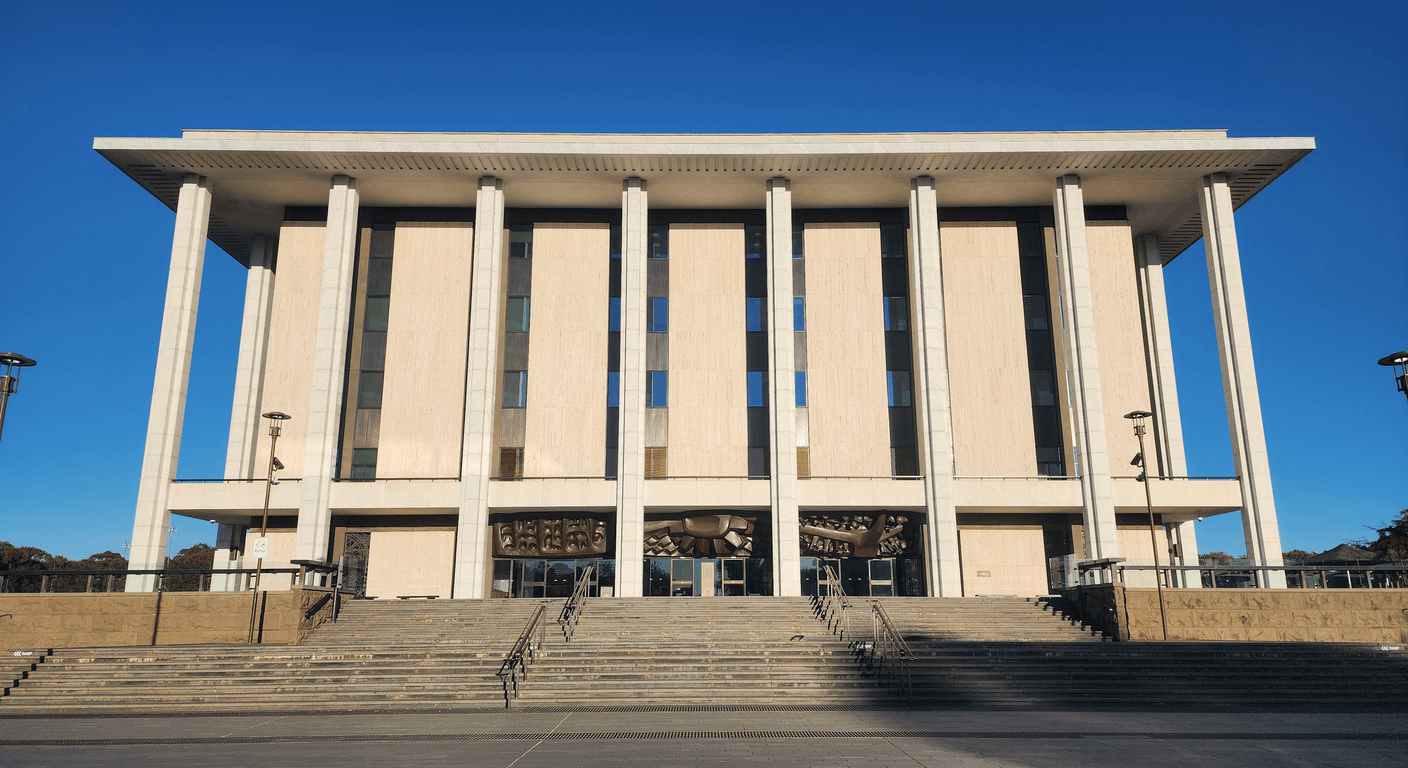
There's a particular kind of cultural institution that doesn't announce itself loudly — no queues around the block, no overpriced gift shop at the exit. The National Library of Australia is one of those places. Standing on the northern shore of Lake Burley Griffin, its colonnaded façade is imposing in a classical, unhurried way, and the interior rewards visitors who simply wander without agenda.
The Library holds more than ten million items: manuscripts, photographs, maps, newspapers, oral history recordings, and rare books accumulated since Federation. Most of that is in the vaults, of course, but the rotating exhibitions in the ground-floor galleries draw on those collections in ways that regularly surprise. A show might centre on Australian exploration journals, on wartime correspondence, or on the photographic archive of a single remarkable decade. The exhibitions are thematic, well-curated and — critically — free.
For a Greek-Australian traveller with an interest in community history or family records, the Library's collections include migrant correspondence, community newspapers and oral history recordings that document the postwar waves of migration from Greece and Cyprus. The Trove digital platform, developed and maintained by the Library, is also a remarkable tool for tracing family history through digitised Australian newspapers dating back to the nineteenth century.
What to expect from the ground-floor galleries
The main exhibition galleries sit on the ground floor, accessible directly from the entrance foyer without steps or obstacles. The displays are generally low-lit and quiet — conditions that suit both the preservation of documents and visitors who appreciate a calm environment. Seating is available within most exhibitions, and staff are present rather than hovering.
One important practical note: the galleries close between exhibitions while new shows are installed. The gap can be a week or several weeks. Visiting without checking the current program risks finding the gallery space temporarily dark. The Library's website at nla.gov.au lists current and upcoming exhibitions — check it before committing to travel, particularly if the exhibition is the primary reason for the visit.
Beyond the main galleries, the foyer itself is worth attention. The stained-glass windows — designed by Leonard French, the same artist responsible for the Great Hall ceiling at the National Gallery of Victoria — cast coloured light across the entrance in a way that changes through the day. It's the kind of detail you notice on the way out rather than the way in.
The Bookplate: one of Canberra's more considered lunches
The Bookplate café occupies a section of the Library's foyer, its tables set beneath those Leonard French stained-glass windows. The name is a small bibliographic joke — a bookplate being the decorative label pasted inside the front cover of a library book to indicate ownership — and the café carries that sensibility into its setting. It is, in the best sense, a room that takes its surroundings seriously.
The lunch menu leans toward seasonal Australian produce with a Mediterranean thread that feels appropriate rather than forced. Expect dishes that change with the season — a lamb dish, something with legumes, good bread, an honest cheese plate. Prices are reasonable for a national institution café: around $25–$40 per person for a two-course lunch with a glass of wine, though you should confirm current pricing directly. The pace is unhurried, which suits the setting entirely.
The Bookplate is open for breakfast and lunch on most days the Library is open, but hours can vary. It's worth checking current trading hours at nla.gov.au or calling ahead, particularly if you're planning the lunch as the centrepiece of the visit. Tables by the windows — where the light comes through the stained glass at its best — are worth requesting.
The lakefront terrace and the walk along the shore
After lunch, the lakefront terrace at the rear of the building earns its reputation. Lake Burley Griffin is not always given credit for how genuinely pleasant it is on a calm autumn morning or a mild spring afternoon. The water is still, the opposite shore is green, and the view across to the Carillon on Aspen Island has a quiet formality that suits Canberra's character.
The terrace is flat, paved and accessible from inside the building without steps. There are benches. Sitting here with a coffee, watching the lake, is not a consolation prize — it's a reason to visit in itself. The walk along the foreshore toward Commonwealth Avenue Bridge is flat and manageable, with the High Court and National Gallery of Australia both within comfortable reach on foot or by a short taxi or rideshare.
For a couple wanting a relaxed full day on the lakeside cultural precinct, the Library pairs naturally with the National Portrait Gallery (free entry, five minutes' walk) or the National Gallery of Australia (free for the permanent collection, a ten-minute walk). Neither requires booking for general admission, though special exhibitions at the NGA do.
Family history and reader access: what the Library offers beyond the galleries
For travellers with a serious interest in family history — and Canberra is worth a dedicated trip for this reason alone — the National Library offers reader registration that allows access to original materials in the reading rooms. The process is straightforward: register online or in person with photo identification, and a reader's card is issued. Staff in the reading rooms are experienced at helping visitors navigate collections they haven't used before.
The Trove platform, freely available at trove.nla.gov.au, digitises Australian newspapers, maps, photographs, government gazettes and other materials. For anyone tracing Greek-Australian family history, the platform holds community newspapers including the Greek-language press, as well as immigration records and wartime correspondence. It's genuinely useful rather than merely interesting, and a visit to the reading rooms can take what you've found online and go considerably further.
Reader sessions can be booked in advance through the Library's website. If family history research is part of the plan, it's worth contacting the Library's reference services team beforehand — they can advise on which collections are most relevant and whether prior notice is needed for specific materials.
Getting to the National Library from Melbourne and Sydney
From Melbourne, Canberra is roughly a 45-minute flight with Qantas or Virgin Australia, or a scenic five-to-six-hour drive via the Hume Highway and Monaro Highway — a drive that passes through some genuinely good country once you're south of Goulburn. The drive is manageable over two days with a night in Gundagai or Yass. Rex Airlines also operates the route; check current schedules and fares as these change seasonally.
From Sydney, Canberra is about three hours by car or coach — the Murrays coach service operates regularly between Sydney and Canberra and is a comfortable, practical option that avoids airport logistics. Confirm current timetables and fares at murrays.com.au. The drive via the Federal Highway is straightforward, with a good rest stop at Goulburn.
Once in Canberra, the Library is accessible by Transport Canberra buses from the city centre, and the light rail from Civic connects to bus routes that serve the lakeside precinct. A taxi or rideshare from Civic takes around ten minutes and costs roughly $15–$20 (indicative). The Library has car parking on-site, which suits visitors who've driven from interstate and want the convenience of their own vehicle.
Practical details: accessibility, hours and what to confirm
The National Library building is fully accessible. Lifts serve all floors, the entrance is level, and accessible toilets are available. The galleries, reading rooms, café and terrace are all reachable without stairs. The building is air-conditioned throughout — a meaningful consideration during Canberra's summer heat or winter cold.
General opening hours are broadly Monday to Thursday 9am–8pm, Friday to Sunday 9am–5pm, though these do vary on public holidays and during gallery changeovers. The Bookplate café operates on shorter hours. Confirm current hours at nla.gov.au before visiting — the Library's website is well-maintained and reliable for this purpose.
Entry to the building and the exhibitions is free. There is no booking required for general gallery visits. Reading room access requires registration, which can be done on arrival or in advance online. Guided tours are available on selected days — check the website for current tour schedules. Photography is permitted in most areas of the building, including the galleries, unless signage indicates otherwise for particular items.
Quick planning guide
| Ideal pace | Slow-paced and unhurried |
|---|---|
| Best months | Autumn or spring for the terrace and lakefront walk |
| Suggested stay | Half day for the Library alone; a full day combined with nearby galleries |
| Mobility level | Easy — fully accessible with lifts, level entry and no stairs |
| Cost level | Free entry; budget-friendly café lunch (around $25–$40 per person) |
| Comfort level | High — air-conditioned, seated galleries and a quiet, unhurried atmosphere |
| Best for | Family history researchers, culture lovers and couples seeking a relaxed cultural day |
| Main planning consideration | Check nla.gov.au for the current exhibition program and café hours, as galleries close between shows |
Key takeaways
- The National Library of Australia offers free entry to its rotating exhibitions drawn from one of the country's most significant archival collections.
- The Bookplate café, set beneath Leonard French's stained-glass windows, serves a genuinely considered lunch in one of Canberra's more civilised settings.
- Gallery spaces close between exhibitions — always confirm the current program at nla.gov.au before making the trip.
- The building is fully accessible with lifts, flat terrace and accessible toilets throughout — one of the more comfortable cultural venues in Canberra.
- Trove, the Library's free digital platform, is an exceptional resource for Australian family history research, particularly for those tracing migrant community records.
- The lakeside cultural precinct places the Library within easy walking distance of the National Portrait Gallery and National Gallery of Australia, making a full day of free culture straightforward.
Recommended partners and links
Indicative prices only — always confirm with the operator before booking.
Frequently asked questions
Is the National Library of Australia free to visit?
Yes. Entry to the National Library of Australia, including its ground-floor exhibitions, is free. There is no admission charge for general visitors. The Bookplate café and any ticketed special events are the exception — confirm current details at nla.gov.au.
Is the National Library of Australia accessible for visitors with mobility considerations?
The National Library of Australia is fully accessible. The building has lifts to all floors, a level entrance from the carpark and street, accessible toilets, and the lakefront terrace is flat and paved. Seating is available in the galleries and café.
Do I need to book to visit the National Library's exhibitions?
No booking is required for general gallery visits or entry to the building. Reading room access requires registration with photo identification, which can be done in person on arrival or in advance online at nla.gov.au. Some guided tours may require prior registration — check the website.
How do I find out what exhibitions are currently showing at the National Library?
The National Library's website at nla.gov.au lists all current and upcoming exhibitions. It's essential to check before visiting, as the galleries close between shows during installation periods, which can last from a few days to several weeks.
Can I research Greek-Australian family history at the National Library of Australia?
Yes. The National Library holds community newspapers, migrant correspondence, oral history recordings and other materials relevant to Greek-Australian history. The free Trove digital platform at trove.nla.gov.au also digitises historical Australian newspapers including Greek-language community press. For access to original materials, register for a reader's card and consider contacting the Library's reference services team in advance.