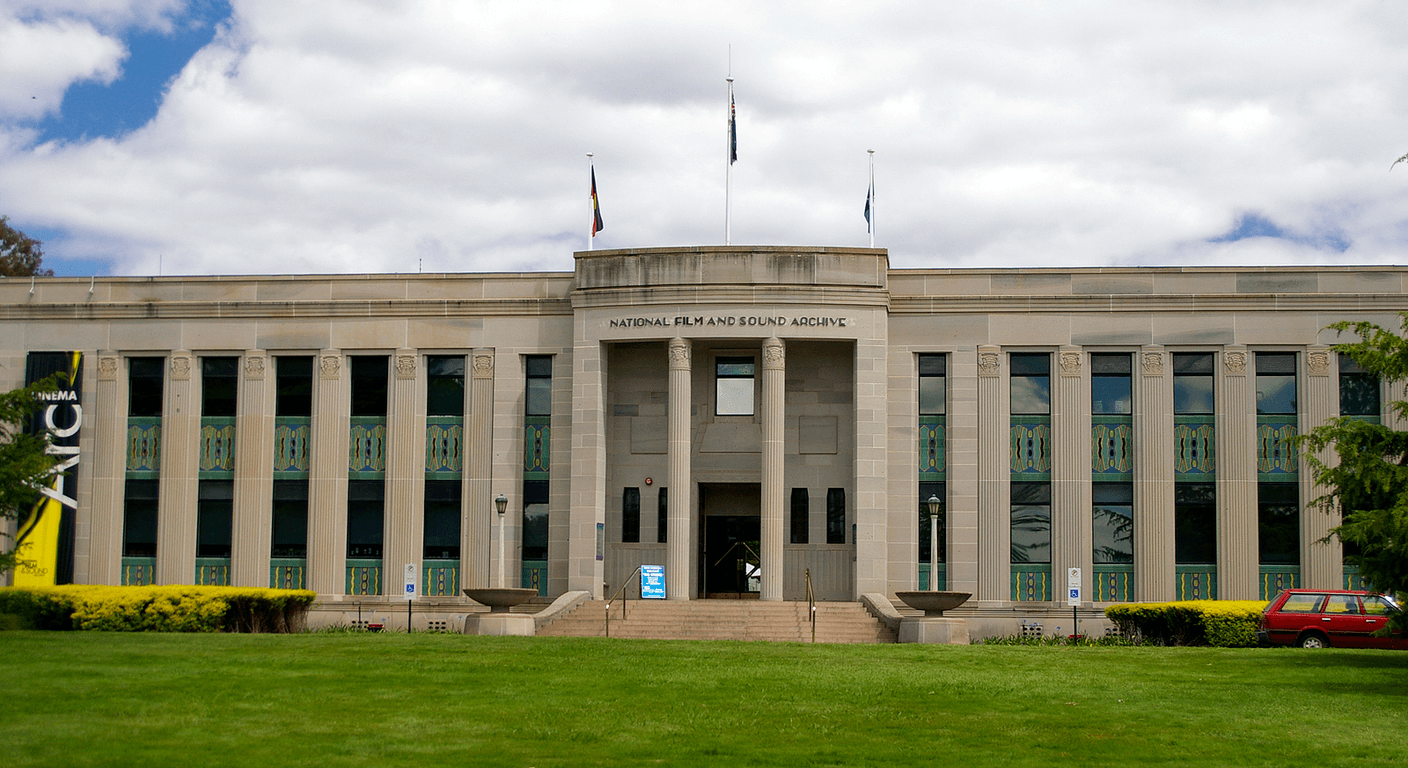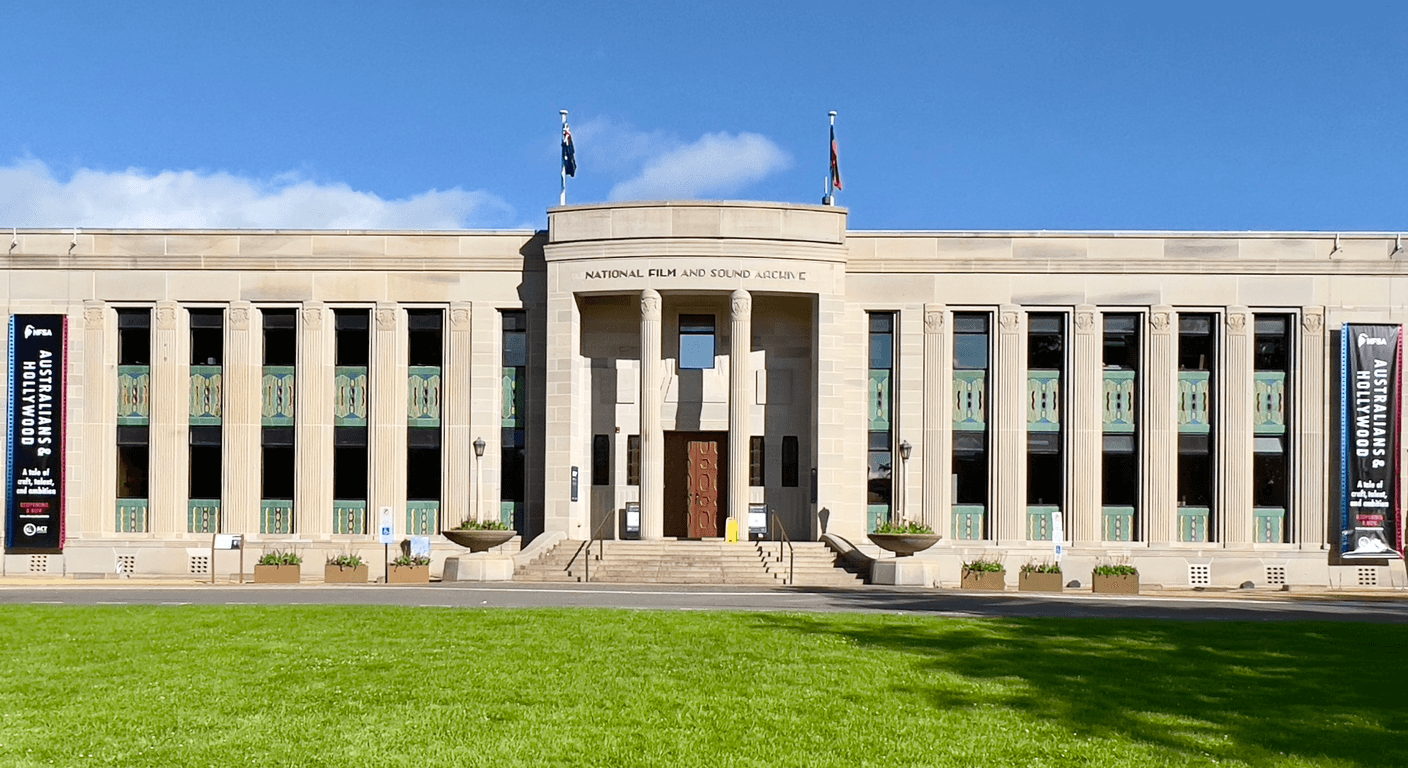
The National Film and Sound Archive occupies a 1930 art deco former Institute of Anatomy building in Canberra's Acton precinct, holding more than three million items of Australian screen and sound heritage. Autumn (March–May) brings the best light and walking weather. A half-day suits the galleries; add a full day for an Arc Cinema session. Access is flat and step-free throughout, rating Easy for mobility. Canberra is under an hour's flight from Melbourne or Sydney, with buses and light rail serving Acton, plus on-site parking.
What is the National Film and Sound Archive, and why does it matter?
The National Film and Sound Archive of Australia — the NFSA — is the custodian of the country's moving image and recorded sound heritage. Its collection runs to more than three million items: feature films, newsreels, home movies, radio broadcasts, television programs, oral histories, posters and production documents. Not everything is on display, of course. But what the NFSA chooses to exhibit, and how it frames that material, makes it one of the more thoughtful cultural institutions in the country.
For travellers who grew up with Australian cinema and television, the archive functions as something closer to a personal archive than a public institution. The moment you encounter a fragment of a newsreel you half-remember, or a clip from a television serial that played in your living room, the experience shifts from cultural to biographical. That's a particular kind of travel reward — one that doesn't depend on physical stamina or a packed itinerary.
The NFSA also takes its preservation role seriously in a way that's become increasingly urgent. Film stock degrades, magnetic tape deteriorates, and digital formats become obsolete. The archive's conservation work — much of it invisible to visitors — is what makes the public program possible. It's worth pausing on that when you walk through the door.
The building itself: why the art deco setting matters
The NFSA occupies the former Institute of Anatomy building in Acton, completed in 1930 in a stripped classical and art deco style. The building was designed by Emil Sodersten, one of the architects behind the Australian War Memorial, and it carries that same sense of civic seriousness. The exterior is handsome without being showy — cream render, strong geometric lines, a formal garden forecourt that slows you down before you even reach the door.
Inside, the building has been sensitively adapted for its current purpose. The proportions are generous, the light is good, and the original fabric sits alongside contemporary exhibition design without the two fighting each other. For anyone who has spent time in older Australian institutional buildings — a state library, a country courthouse, a mid-century cinema — there's a familiar warmth to the materiality here.
The Acton precinct itself is part of the Australian National University campus, which means the surroundings are green, walkable and quiet by Canberra standards. The ANU's cafes and the university grounds are a short stroll away, making it easy to extend the visit into a leisurely afternoon without feeling rushed or stranded.
What's on: exhibitions, screenings and how to plan your visit
The NFSA runs a mix of permanent and temporary exhibitions. Some are free; others require a ticket. The split changes depending on what's currently showing, so checking nfsa.gov.au before you travel is genuinely important — not a throwaway suggestion. The Arc Cinema, the archive's purpose-built screening room, presents a program of restored Australian and international films, documentary seasons and special events. Sessions can sell out, particularly for popular titles or one-off events.
A half-day is enough to move through the galleries at a comfortable pace and take in the context panels, listening stations and archival footage on display. If you're planning to add a cinema session, allow a full day — and factor in time to sit with a coffee beforehand rather than rushing from gallery to screen. The Arc is a proper cinema: good acoustics, comfortable seating, and a program that takes the films seriously.
Temporary exhibitions at the NFSA have covered subjects from the history of Australian documentary filmmaking to the television coverage of major national events. The common thread is always the archive itself — the actual objects, the actual recordings — rather than a generic survey. That specificity is what distinguishes a visit here from reading a Wikipedia article on the same subject.
Access and comfort: what older travellers need to know
Flat access throughout is the honest summary. The building is step-free from the forecourt through to the galleries and the cinema, with accessible parking on site. Seating is available within the galleries, and the Arc Cinema has standard cinema accessibility provisions. If you have specific mobility requirements, it's worth contacting the NFSA directly before your visit to confirm current arrangements.
The galleries are climate-controlled, which matters more than it might seem — Canberra's temperature swings are real, and a warm afternoon in summer or a cold morning in winter can make an indoor cultural program feel like a genuinely good decision rather than a fallback. The pace of the NFSA suits unhurried visitors. There's no pressure to move quickly, no crowds queueing behind you, and no sense that you're being processed through an attraction.
ANU cafes are within a few minutes' walk of the archive, and the university's general precinct has seating areas and greenery that make a mid-visit break pleasant rather than perfunctory. Canberra's broader dining options — particularly in the Braddon and New Acton precincts — are a short drive or taxi ride away if you're building the NFSA into a longer day out.
Getting to the NFSA: from Melbourne, Sydney and beyond
From Melbourne, the flight to Canberra is around an hour, with multiple services daily from Qantas, Virgin Australia and Rex. From Sydney, it's under an hour. Both routes make Canberra a genuine weekend destination rather than a long-haul commitment. If you're driving from Sydney, the journey is roughly three hours via the Federal Highway; from Melbourne, allow around seven hours via the Hume Highway — a reasonable road trip if you break it at Gundagai or Yass.
Within Canberra, the NFSA is accessible by Transport Canberra bus services; the Acton precinct is well-served from the city centre and from Civic. Light rail connects the city to Gungahlin, and bus connections from the light rail stops reach Acton. Confirm current routes and fares at transport.act.gov.au. Taxis and rideshare services are available throughout Canberra and are the simplest option if you're carrying bags or prefer door-to-door travel.
Parking on site is available and generally straightforward outside peak ANU academic periods. If you're combining the NFSA with other Acton or ANU precincts visits — the ANU Art and Music facilities, for example — a single park and walk works well. The Australian War Memorial and National Portrait Gallery are a short drive across the lake if you're building a multi-institution day.
Combining the NFSA with Canberra's broader cultural circuit
Canberra is compact enough to treat as a cultural circuit over two or three days without ever feeling hurried. The NFSA pairs naturally with the National Portrait Gallery — both deal in Australian identity through different lenses — and the Australian War Memorial, which has its own substantial film and photography collection. The National Museum of Australia at Acton Peninsula is a short walk from the NFSA and offers a broader sweep of national history if you want to extend the afternoon.
For culturally curious couples who enjoy a mix of gallery time and good food, the New Acton precinct is directly adjacent to the NFSA's neighbourhood. Nishi Gallery, the Ovolo Nishi hotel's public spaces, and several well-regarded cafes and restaurants make New Acton a pleasant base of operations. It's the kind of precinct that rewards wandering without a fixed agenda.
Canberra's autumn is worth mentioning specifically. The deciduous trees planted throughout the parliamentary triangle and the ANU campus turn in March and April, and the light in those months is particularly good. The NFSA's program doesn't change seasonally, but the experience of walking between institutions in autumn Canberra is one of the more underrated pleasures of the national capital.
A note on why this resonates for travellers with long memories
There's a particular quality of recognition that comes from encountering archival material from your own lifetime. A newsreel from the 1960s, a television commercial from the 1970s, a radio broadcast that played in the background of a childhood home — these aren't abstractions. They're triggers for a very specific kind of remembering that's different from learning about history and different again from nostalgia in its sentimental form. The NFSA understands this.
For Indian Australians and for multicultural communities more broadly, the archive's collection also raises interesting questions about whose stories were recorded and whose were not — which voices the national media chose to amplify and which it left out. The NFSA has been working to expand its collection in this direction, and some exhibitions have begun to reflect that broader scope. It's an honest institution, and that honesty is part of what makes it worth a visit.
Travel at any age is partly about finding the places that speak to who you are, not just where you happen to be standing. The NFSA does that quietly, without fanfare. It's the kind of institution you find yourself thinking about on the drive home.
Quick planning guide
| Ideal pace | Slow-paced and unhurried |
|---|---|
| Best months | March to May (autumn foliage and mild weather) |
| Suggested stay | Half-day for the galleries; a full day if adding an Arc Cinema session |
| Mobility level | Easy — flat, step-free access throughout with on-site accessible parking |
| Cost level | Budget-friendly — many exhibitions free, with some ticketed exhibitions and cinema sessions |
| Comfort level | Climate-controlled galleries with seating and a proper cinema setup |
| Best for | Travellers with personal memories of Australian film, television and radio, and culturally curious couples |
| Main planning consideration | Check nfsa.gov.au ahead of time, as free/ticketed exhibitions and Arc Cinema sessions change and can sell out |
Key takeaways
- The NFSA holds more than three million items of Australian screen and sound heritage in a beautifully preserved art deco building in Acton, Canberra.
- Entry to many exhibitions is free; the Arc Cinema and some ticketed exhibitions require advance booking — confirm the current program at nfsa.gov.au.
- Flat, step-free access throughout makes the NFSA one of the most accessible cultural institutions in Canberra for older travellers.
- A half-day suits the galleries comfortably; add an Arc Cinema session and you have a full, unhurried day.
- Canberra is under an hour by air from Melbourne or Sydney, and the NFSA pairs naturally with the National Portrait Gallery and Australian War Memorial.
- Autumn in Canberra (March–May) combines the NFSA's year-round program with some of the best walking weather and foliage in the national capital.
Recommended partners and links
Indicative prices only — always confirm with the operator before booking.
Frequently asked questions
Is the National Film and Sound Archive free to enter?
Many of the NFSA's permanent exhibitions are free to enter. Some temporary exhibitions and all Arc Cinema sessions are ticketed. Prices and the current program change regularly, so confirm what's on and what costs apply at nfsa.gov.au before your visit.
Is the NFSA accessible for visitors with limited mobility?
Yes. The NFSA has flat, step-free access from the forecourt through to all galleries and the Arc Cinema. Accessible parking is available on site. Contact the NFSA directly at nfsa.gov.au if you have specific mobility requirements to confirm current arrangements.
How long should you spend at the National Film and Sound Archive?
A relaxed half-day is enough to move through the current exhibitions without feeling rushed. If you're planning to attend an Arc Cinema session, allow a full day and check session times in advance, as popular screenings can book out.
How do you get to the NFSA from central Canberra?
The NFSA in Acton is accessible by Transport Canberra bus services from Civic and other city stops. Rideshare and taxis are straightforward alternatives. On-site parking is generally available outside peak ANU academic periods. Confirm current bus routes and fares at transport.act.gov.au.
What other cultural attractions are near the NFSA in Acton?
The National Museum of Australia is a short walk from the NFSA on Acton Peninsula. The New Acton precinct — with galleries, cafes and restaurants — is directly adjacent. The National Portrait Gallery and Australian War Memorial are a short drive across Lake Burley Griffin.