Rainbow Beach, on Queensland's Cooloola Coast about 90 minutes from Noosa, is best visited April to October when humidity drops and days stay clear. A half-day to full-day visit suits most travellers, centred on the coloured sand cliffs — over seventy ochre and rust hues best seen at low tide — and the Carlo Sand Blow lookout. Mobility is moderate, with an uphill, shadeless dune climb; the town is drive-in only, reached via Gympie with no public transport, and serves as the barge point for K'gari.
Why Rainbow Beach deserves more than a passing glance
Most visitors treat Rainbow Beach as a staging post — a place to board a barge to K'gari and little else. That's a genuine oversight. The town itself is compact and unshowy, the kind of Queensland coastal settlement that hasn't yet been smoothed into a resort. There's a main street with a handful of good cafes, a bottle shop, a bakery and a petrol station. The surrounding Great Sandy National Park begins almost at the footpath's edge.
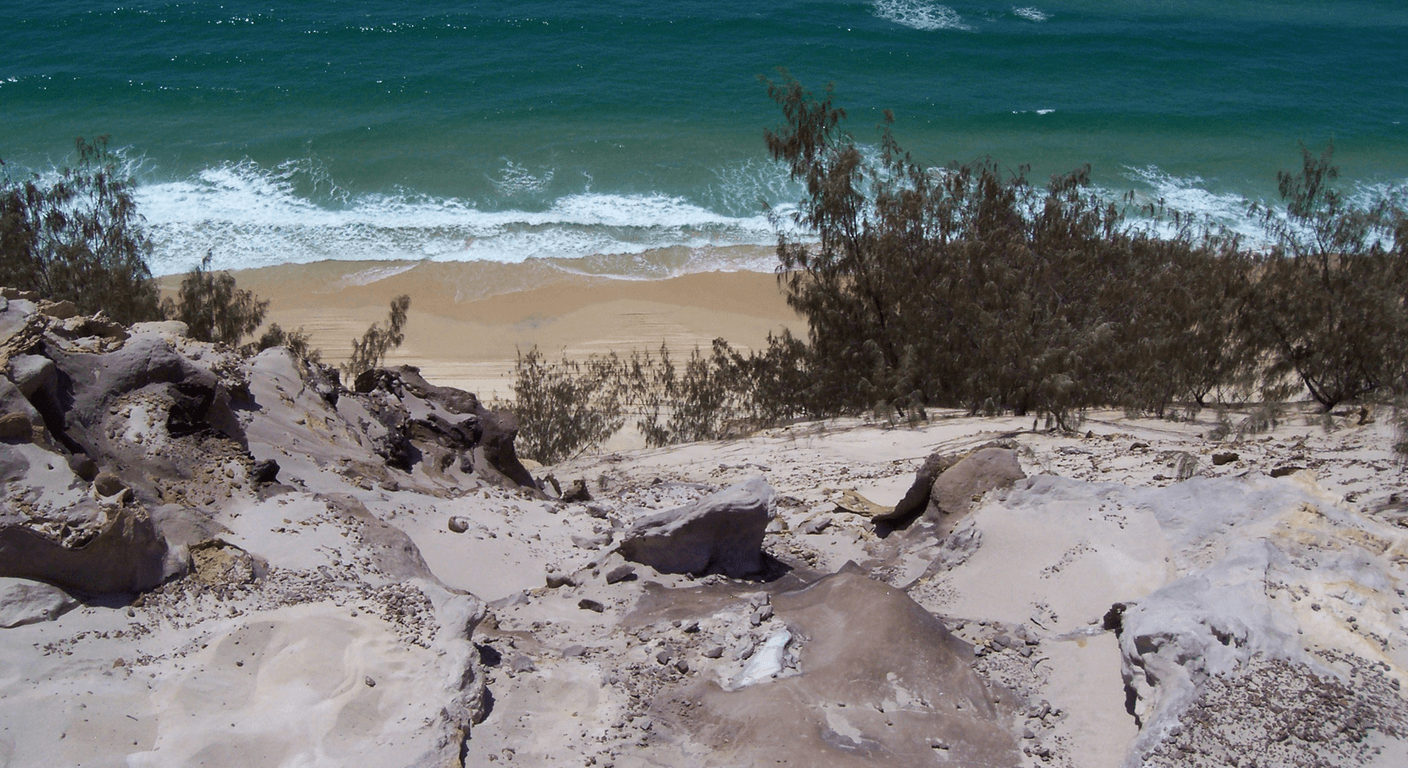
The coloured sand cliffs — the feature that gives the town its name — run for several kilometres along the beachfront and are best appreciated on foot at lower tide, when you can walk close to the base and look straight up at the striations. Seventy-odd distinct hues have been recorded, from pale cream and lemon through to deep rust and almost burgundy. The geology is ancient: minerals leaching through the sand over millennia created a natural palette that no photographer quite does justice to in midday light. Early morning or late afternoon, the ochres practically glow.
For a group of friends travelling together, Rainbow Beach has a particular ease about it. Nothing is rushed, nothing is crowded (outside school holidays), and the scale of the place means you can cover the main highlights without a car shuffle or a long walk between sites. It's the kind of day that feels quietly eventful rather than exhausting — which is exactly what a good day trip should be.
Getting there: the drive via Gympie from Brisbane or Noosa
Rainbow Beach is not on a main highway, and that's partly why it retains its character. From Brisbane, the standard route runs north on the Bruce Highway to Gympie, then east on the Rainbow Beach Road — roughly 240 kilometres and around three hours in normal traffic. From Noosa Heads, cut west to Cooroy, join the Bruce Highway briefly at Pomona, then head north to Gympie and east. That's closer to 90 minutes. From the Sunshine Coast hinterland, allow two hours comfortably.
The Rainbow Beach Road from Gympie is sealed all the way and straightforward to drive, though the last stretch winds through national park country with some undulation. There's no public transport to Rainbow Beach township itself — this is a drive-in destination. If you're based regionally in Victoria and flying in, the most practical approach is to fly into Brisbane, hire a car and build Rainbow Beach into a Sunshine Coast road trip of three to four days.
Parking in town is plentiful and free. One important note: the beach itself is an active 4WD highway for vehicles heading to and from K'gari. Pedestrians walking the sand need to stay aware of traffic, particularly near the barge ramp. It sounds alarming but in practice it's manageable — just don't wander in a daydream near the water's edge when a convoy of loaded 4WDs is moving through.
The Carlo Sand Blow: what to expect on the climb
The Carlo Sand Blow is the centrepiece of a visit, and it earns that status. The track begins near the northern end of town and climbs steadily for around 600 metres through coastal scrub before opening onto a vast bare dune that sits above the surrounding landscape like a natural amphitheatre. The views take in the Coral Sea, the coloured cliffs to the south and the forested dunes of the Cooloola section of the national park stretching inland.
Be honest with yourself about the climb. It is not technical — there are no steps or fixed ropes — but the path through the scrub involves some soft sand underfoot and a consistent uphill gradient. On a warm day, even in autumn or winter, you'll want water and a hat. There is no shade at all once you reach the open dune, and the reflective sand amplifies the sun. Go in the morning before the heat builds. Allow around 40 minutes return at a comfortable pace, more if you want to sit at the top and take it in properly.
For travellers with knee concerns or low stamina, it's worth knowing that the first section of the track — through the scrub — is the most sheltered and the gradient is gentler. Some people go partway and turn back, which still offers a decent perspective. The full experience, though, is up top: standing on open sand with nothing but sea and sky. That's worth the puff.
Walking the coloured sand cliffs: tide, light and pace
The beach walk along the base of the coloured sand cliffs is the other essential. At low tide, the hard-packed sand near the waterline makes for easy, flat walking — no special footwear required, though older sandshoes with grip are sensible. Check a tide chart before you go; the Bureau of Meteorology (bom.gov.au) publishes tide predictions for the region. At high tide, the cliffs come close to the water and the walk becomes cramped and sometimes impossible.
The best light for the cliffs is in the hour after sunrise or in the late afternoon when the sun is low and raking. Midday light flattens the colours considerably. If you're staying overnight, an early morning walk before breakfast is hard to beat — the beach is usually empty, the air is cool and the cliffs catch the first light in a way that feels almost theatrical without trying to.
The walk from the southern end of the main beach to the most vivid cliff sections and back is roughly two to three kilometres return — a comfortable hour for most travellers. The sand near the cliffs is soft in places; stick closer to the waterline for firmer footing. And keep an eye out for 4WD traffic, particularly on the return leg when vehicles coming off the barge ramp pick up speed heading south.
Watching the K'gari barges: a surprisingly engaging hour
The barge ramp at the northern end of Rainbow Beach is busier than you'd expect. Vehicles heading to K'gari — campervans, 4WDs stacked with gear, the occasional tour bus — queue and load at intervals throughout the day. Watching the operation from a nearby vantage point or the foreshore is, in a low-key way, genuinely absorbing. There's a particular satisfaction in watching a well-organised logistical process unfold, and the mix of travellers — families, grey nomads, tour groups — is a cross-section of Queensland road-tripping life.
The Manta Ray Barge runs regular crossings from Rainbow Beach to K'gari and back; you can confirm the current timetable and passenger fares on their website. Foot passengers can cross without a vehicle, which opens up a day trip to K'gari's southern beaches if the group is keen — though that's a separate, more ambitious undertaking requiring planning around return crossings. For the purposes of a Rainbow Beach day trip, simply watching the comings and goings from the foreshore is entertainment enough.
A group of friends will find the barge area a natural gathering point for a mid-morning break. There's a small kiosk nearby, and the foreshore has shade trees and benches. It's the kind of unscripted pause that often becomes the thing people remember most clearly — standing in the sea breeze, watching a loaded barge reverse into the sand while someone goes to get coffees.
Where to eat and what the town offers
Rainbow Beach's dining scene is modest and better for it. The main street has a handful of cafes and casual restaurants that do good work with local seafood and standard Queensland cafe fare. Rainbow Beach Hotel serves reliable pub meals with an outdoor area. Several cafes along Rainbow Beach Road are popular for breakfast and brunch; Plantation Cafe has a loyal following among locals. Confirm current trading hours before you go — small coastal towns sometimes adjust hours outside peak season.
There's no fine dining here, and that's not a gap. After a morning of walking the cliffs and climbing the Sand Blow, what you want is a good flat white, a decent fish burger and a table in the shade. The town delivers that without fuss. Provisions for a picnic are available from the local IGA-style store if you'd rather eat on the foreshore.
For a group of six or so travelling together, the town's scale is actually an advantage. You can walk between the barge area, the Sand Blow trailhead and the main street in under ten minutes. There's no need to move cars between stops. By early afternoon, most groups have covered the key highlights and are ready to drive back — or, if staying the night, to find a shaded verandah and let the afternoon pass slowly.
Practical matters: timing, comfort and what to bring
April through October is the sweet spot. Humidity drops, temperatures sit in the mid-twenties and the days are reliably clear. The summer months (December through February) bring heat, humidity and the possibility of storms — not ideal for open-dune walking or beach time. School holiday periods in July and late September see the town noticeably busier, particularly around the barge ramp; if the group prefers quiet, aim for May, June or early October.
What to bring: water (more than you think for the Sand Blow), sunscreen, a hat with a brim, comfortable walking shoes with grip, and a light layer for the drive home. A tide chart printed or saved on a phone is genuinely useful. If anyone in the group has mobility concerns, the beach walk on firm sand is the most accessible option; the Sand Blow climb can be attempted partially or skipped without missing the beach's defining character.
Travel insurance is always worth confirming covers the activities planned, particularly for any pre-existing conditions — standard advice for travellers over 50 regardless of destination. Rainbow Beach has a small medical centre; the nearest hospital is in Gympie. For a day trip of this nature, none of that should give pause — it's simply sensible to know.
Quick planning guide
| Ideal pace | Relaxed, half-day of walking easily covers the highlights |
|---|---|
| Best months | April to October, for lower humidity and clear skies |
| Suggested stay | Half-day to full day; overnight optional for early morning light |
| Mobility level | Moderate — the beach walk is flat and easy, but the Sand Blow track is a steady, shadeless climb |
| Cost level | Budget-friendly, as most highlights are free |
| Comfort level | Casual and unpretentious, with simple cafes and no fine dining |
| Best for | Groups of friends, road-trippers and travellers heading on to K'gari |
| Main planning consideration | Drive-in access only via Gympie, with tide timing important for the cliff walk |
Key takeaways
- The coloured sand cliffs at Rainbow Beach show more than seventy distinct hues and are best seen on a low-tide beach walk in early morning or late afternoon light.
- The Carlo Sand Blow track is 600 metres uphill with no shade at the top — go in the morning, carry water and allow around 40 minutes return at a comfortable pace.
- Rainbow Beach is a drive-in destination with no public transport; the most practical access is via Gympie, around three hours from Brisbane or 90 minutes from Noosa.
- The beach doubles as a 4WD highway for K'gari-bound vehicles — pedestrians should stay alert, particularly near the barge ramp at the northern end.
- April to October offers the best conditions: lower humidity, clear skies and temperatures in the mid-twenties.
- Most highlights — the cliffs, the Sand Blow, the barge-watching foreshore — are free, making this one of Queensland's most rewarding low-cost day trips.
Recommended partners and links
Indicative prices only — always confirm with the operator before booking.
Frequently asked questions
Is the Carlo Sand Blow suitable for older travellers or those with joint concerns?
The Carlo Sand Blow track involves a steady 600-metre uphill climb on a mix of packed earth and soft sand, with no shade at the top. It is manageable for most active travellers over 50 who are comfortable with a sustained uphill walk. Those with knee or hip concerns may prefer to walk partway and turn back, which still offers good views through the coastal scrub. Trekking poles can help on the return descent. Go in the morning before heat builds and carry more water than you think you'll need.
When is the best time to visit Rainbow Beach to see the coloured sand cliffs?
The cliffs show their richest colour in the hour after sunrise or in the late afternoon when the sun is at a low angle. Midday light flattens the ochres significantly. For the best experience, plan the beach walk for early morning or around 3–4pm. In terms of season, April through October offers the most comfortable conditions — lower humidity, clear skies and manageable temperatures.
Can you visit Rainbow Beach without a 4WD?
Yes. The town itself, the Carlo Sand Blow trailhead and the coloured sand cliff walk are all accessible in a standard two-wheel-drive vehicle. A 4WD is only required if you intend to drive on the beach itself or cross to K'gari with a vehicle. Day visitors arriving by conventional car can cover all the main highlights without any beach driving.
How far is Rainbow Beach from Brisbane, Noosa and the Sunshine Coast?
Rainbow Beach is roughly 240 kilometres from Brisbane, around a three-hour drive via the Bruce Highway to Gympie and then east on Rainbow Beach Road. From Noosa Heads it is closer to 90 minutes. From the Sunshine Coast (Maroochydore area), allow around two hours. There is no public transport to Rainbow Beach; a hire car or private vehicle is necessary.
Is there an entry fee for Rainbow Beach or the Carlo Sand Blow?
There is no entry fee for the Rainbow Beach township or for walking the Carlo Sand Blow track as a day visitor. Vehicle permits are required for beach driving and for some camping areas within Great Sandy National Park. Confirm current permit requirements and fees with Queensland National Parks (parks.des.qld.gov.au) before your visit, as these can change.