Slovenia's Soča Valley sits about two hours west of Ljubljana by car and is best visited June to September, when the valley is warm and mountain passes are clear of snow. Allow two to three nights to properly see Kobarid's WWI museum and the turquoise Soča River. Mobility is moderate — valley-floor walks are easy, though some viewpoints involve steep climbs. There are no direct flights from Australia; travellers connect via Dubai, Doha or Frankfurt to Ljubljana, then self-drive or arrange a private transfer.
Why the Soča Valley deserves its own chapter
Lake Bled is, by any fair measure, genuinely beautiful. It's also genuinely busy. Tour coaches queue from mid-morning, the lakeside path can feel more like a promenade than a walk, and by early afternoon the light on those famous photographs has already gone flat. The Soča Valley, two hours west by car over the Predil Pass or through the Vršič Pass road, operates at an entirely different register.
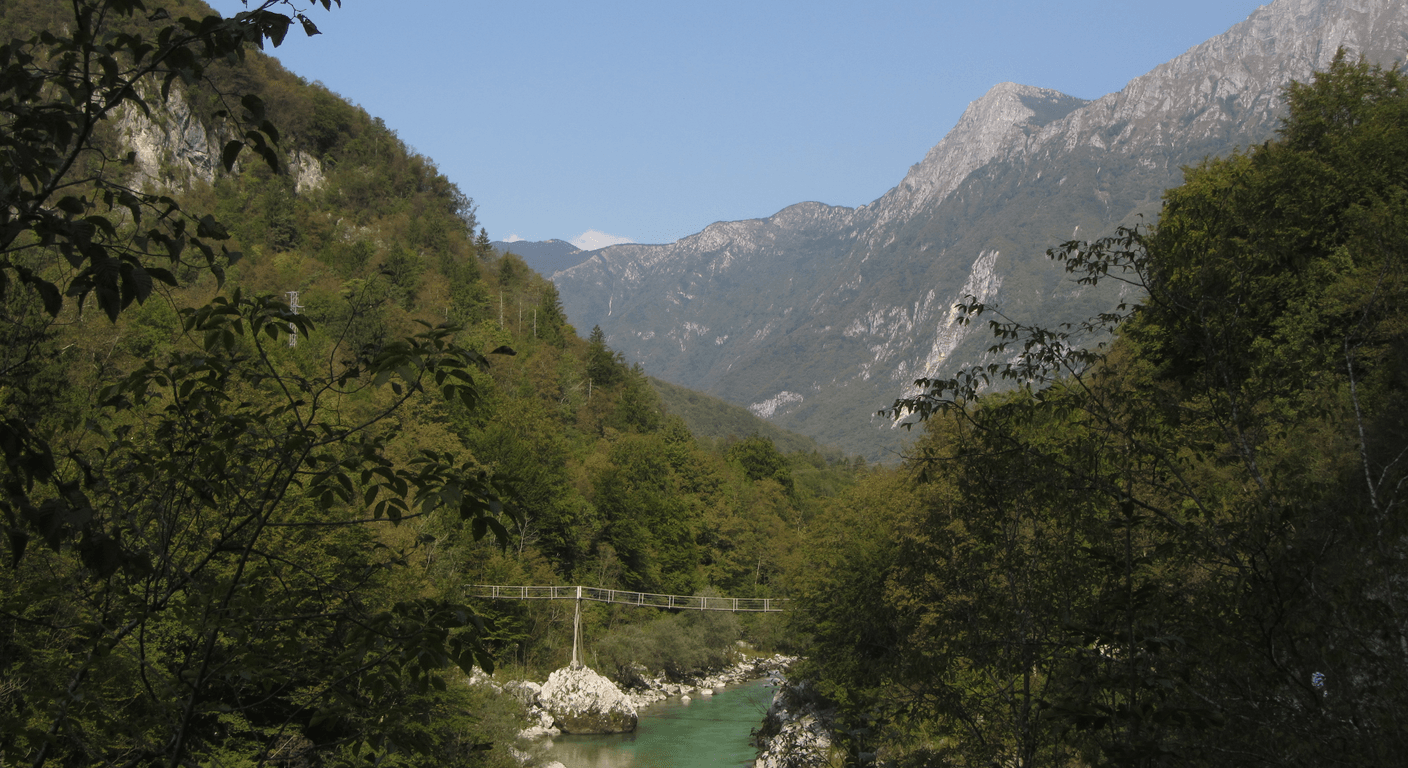
The valley follows the Soča River — known as the Isonzo in Italian, a name that carries enormous weight for anyone who has read about the First World War — from the high mountains near Trenta south through Bovec and on to Kobarid. The river's colour is the first thing that stops you. It's not the blue-green of a swimming pool or a tourist brochure exaggeration; it's something stranger and more specific, caused by glacial sediment and the particular limestone geology of the Julian Alps. You'll find yourself stopping at bridges and lay-bys just to confirm it's real.
For a group of friends travelling together — particularly those who've done the standard Ljubljana-Bled loop before or want something with more substance — the Soča Valley offers history, scenery, excellent local food and wine, and a pace that rewards lingering rather than ticking. Two nights is the minimum. Three is better.
Getting there from Australia: the honest logistics
There are no direct flights from Australia to Slovenia. From Melbourne, Sydney or Brisbane, the most common routing goes via Dubai (Emirates), Doha (Qatar Airways) or Frankfurt (Lufthansa), connecting to Ljubljana's Jože Pučnik Airport. Total travel time is typically 22 to 26 hours door-to-door depending on your connection. Ljubljana is a compact, manageable airport — a relief after a long haul.
A recovery night in Ljubljana before heading west is genuinely worthwhile, not just a nice idea. Jet lag on an eastward return from Europe (you're crossing roughly eight to nine time zones from Melbourne) can be disorienting, and arriving in the Soča Valley already tired takes the edge off the first day. Ljubljana's old town is pleasant for a slow morning before you collect your hire car.
And that hire car is the key practical point. There is no direct public transport connection from Ljubljana to Bovec or Kobarid that suits a relaxed traveller's schedule. Local buses exist but involve changes and long waits. A rental car — automatic transmission widely available, confirm when booking — gives you the freedom to stop at the Soča viewpoints, pull over for the Vintgar-adjacent gorge walks, and set your own pace. If driving on mountain roads isn't your preference, pre-booked private transfers from Ljubljana are available through several local operators; the Slovenia Tourism website is a reasonable starting point. Indicative transfer costs to Bovec run roughly €150–€250 each way for a private vehicle — confirm current rates before booking.
Kobarid: a WWI site that stays with you
Kobarid is a small town of a few thousand people, with a main square, a church on a hill, and a museum that is, without overstating it, one of the most thoughtfully curated First World War sites in Europe. The Isonzo Front — eleven brutal offensives between 1915 and 1917 — was fought across this valley and these mountains. The Kobarid Museum tells that story through maps, personal effects, photographs and contextual history that places the local landscape into the sweep of the wider war. Ernest Hemingway set part of A Farewell to Arms here. The Battle of Caporetto (the Twelfth Battle of the Isonzo, October 1917) was fought just outside town. The museum makes all of this legible without overwhelming.
The Walk of Peace — a 100-kilometre trail along the former front line — passes through Kobarid, and shorter sections of it are accessible to walkers with moderate fitness. The Italian Charnel House on the hill above town (a short but steep climb — around 15 minutes up, with some uneven stone steps) holds the remains of more than 7,000 Italian soldiers and offers a wide view over the valley. Anyone with knee concerns or who prefers flat terrain can view the ossuary from the road below and still absorb its scale.
The town itself has a handful of good restaurants serving local trout, cured meats and the Goriška Brda wines from just to the south-west. Prices are reasonable by European standards — a two-course dinner with wine for two runs indicatively around €50–€80, but confirm current pricing locally. The Kobarid Museum charges a modest entry fee; current pricing is listed at kobariski-muzej.si.
Bovec and the river: what to actually do
Bovec sits at the head of the valley, surrounded by peaks of the Julian Alps, and is primarily known as an adventure-sports hub in summer — rafting, canyoning, paragliding. None of that needs to concern a traveller over fifty who's simply after good scenery and a comfortable base. What Bovec offers at a gentler pace is the Soča Trail, a partially paved path that follows the river for several kilometres through gorge scenery, accessible to most walkers with reasonable fitness. The river here is wide and clear over its gravel bed; in early summer the snowmelt makes it run fast and loud.
The Boka Waterfall, Slovenia's tallest, is a 20-minute drive from Bovec followed by a 30-minute walk on a forest path with some elevation gain. It's genuinely impressive and the path, while not difficult, is uneven in places — poles are helpful, and anyone with unstable knees should assess the trail notes from the Slovenia Tourism website before committing. The Soča Gorge near Trenta, further up the valley, is a short and almost flat walk to a narrow canyon where the river forces itself through limestone — one of those places where the scale of water versus rock is quietly astonishing.
Accommodation in Bovec ranges from guesthouses to small hotels. Standards are generally good; book ahead for July and August. Indicative mid-range hotel rates in Bovec run roughly €100–€160 per night for a double room — verify directly with properties, as rates have shifted with increased demand.
Practical matters: entry, insurance and staying comfortable
Slovenia is a Schengen Area member state, and Australian passport holders can enter without a visa for stays of up to 90 days within any 180-day period — but always confirm current entry requirements on the Australian Government's Smartraveller website (smartraveller.gov.au/destinations/europe/slovenia) before booking, as rules can change and Smartraveller is the authoritative source for Australians travelling abroad.
Travel insurance is non-negotiable for a trip of this length from Australia, and for travellers over 60 or with pre-existing conditions, the policy details matter. Declare everything. Policies that cover emergency medical evacuation from a European destination are worth the additional cost — medical care in Slovenia is generally good, but repatriation to Australia is expensive without cover. Several Australian insurers specialise in over-50 travel; compare policies carefully and read the exclusions.
The valley can be cool even in summer at altitude — pack a light layer for evenings and mountain walks. The Predil and Vršič passes (both scenic driving routes into the valley) can have snow as late as May and as early as October; check road conditions before driving. In the valley itself, the climate in June to September is warm and pleasant, with the mountains providing afternoon shade. Comfortable walking shoes with ankle support are more useful than hiking boots for most of the accessible trails described here.
How to fit the Soča Valley into a wider Slovenia itinerary
A practical 10–12 day Slovenia itinerary for Australian travellers might look like this: one night in Ljubljana on arrival to recover, two nights in Bled or Bohinj (Lake Bohinj is quieter and equally lovely), then two to three nights in the Soča Valley, then a return to Ljubljana for the flight home. That's a manageable loop without excessive driving — the Ljubljana to Bled leg is around 55 kilometres, Bled to Kobarid around 80 kilometres via the Predil Pass, and Kobarid to Bovec is 20 minutes.
Some travellers extend the itinerary to include the Karst region — Postojna Cave and Predjama Castle are accessible on the drive between Ljubljana and the coast — or cross briefly into Trieste or Gorizia in Italy. The Goriška Brda wine region, just over the Italian border from Kobarid, is worth half a day if wine and rolling hills are your idea of a good afternoon. These additions work best for travellers with 14 days or more.
The Soča Valley does not need to be a complex undertaking. Two nights, a rental car, the Kobarid Museum, a walk along the river, and dinner with a local Rebula or Pinot Grigio from the nearby Brda hills — that's already a trip with more texture than a fifth postcard photograph of Lake Bled.
Honest terrain notes for travellers with knee or mobility concerns
The Soča Valley is not uniformly flat, and it's worth being straightforward about this. The valley floor walks — the Soča Trail sections near Bovec, the approach to the Soča Gorge, and the Kobarid town centre itself — are accessible to most travellers with moderate fitness and no significant mobility aids required. These are the experiences that make the valley worthwhile, and none of them are off-limits to someone who simply wants a comfortable pace.
The steeper sections — the Italian Charnel House climb above Kobarid, the Boka Waterfall path, and any of the Walk of Peace sections that venture up into former trench systems — involve uneven ground, some loose stone, and noticeable elevation gain. These are short by alpine standards but can be hard on knees, particularly on the descent. Trekking poles make a material difference. The Slovenia Tourism website (slovenia.info) publishes trail information with difficulty ratings; checking these before committing is straightforward and worth doing.
For travellers using a walking frame or wheelchair, the valley's highlights are partially accessible — the museum in Kobarid has level entry, and several river viewing points are reachable by car with short, paved approaches. It's worth contacting accommodation providers directly to discuss specific needs, as accessibility information online is sometimes incomplete.
Quick planning guide
| Ideal pace | Slow-paced, built around lingering rather than ticking off sights |
|---|---|
| Best months | June to September, when the valley is warm and mountain passes are clear of snow |
| Suggested stay | Two nights minimum, three preferred |
| Mobility level | Moderate — valley-floor walks are easy, but some viewpoints require steep, uneven climbs |
| Cost level | Mid-range (indicative dinners around €50–€80, hotels around €100–€160/night) |
| Comfort level | Comfortable guesthouses and small hotels, book ahead for July–August |
| Best for | Travellers over fifty seeking WWI history, scenery and food/wine beyond the Lake Bled crowds |
| Main planning consideration | No convenient public transport — a rental car or pre-booked private transfer is essential |
Key takeaways
- The Soča Valley is a two-hour drive west of Ljubljana and requires a rental car or private transfer — there is no convenient direct public transport.
- Kobarid Museum is one of Europe's most considered WWI interpretation sites and the cultural centrepiece of any visit to the valley.
- The Soča River's turquoise colour is a result of glacial limestone sediment — it looks improbable in photographs and more so in person.
- A two-night minimum stay in the valley is realistic; rushing it as a day trip from Bled means missing the point entirely.
- Some viewpoints and trail sections involve steep, uneven terrain — travellers with knee concerns should check trail notes on slovenia.info before committing.
- Australian travellers must confirm current Schengen entry requirements and take out comprehensive travel insurance with pre-existing condition cover before booking.
Recommended partners and links
Indicative prices only — always confirm with the operator before booking.
Frequently asked questions
How do Australians get to the Soča Valley from Ljubljana?
The Soča Valley has no convenient direct public transport connection from Ljubljana suited to independent travellers. A rental car (automatic transmission available — confirm when booking) is the most practical option, with the drive taking around two hours via the Predil Pass. Pre-booked private transfers from Ljubljana to Bovec or Kobarid are also available; the Slovenia Tourism website (slovenia.info) is a useful starting point for finding operators. Indicative private transfer costs run roughly €150–€250 each way — confirm current rates before booking.
Do Australians need a visa to visit Slovenia?
Australian passport holders can enter Slovenia — a Schengen Area member — without a visa for short stays of up to 90 days within any 180-day period. Always confirm current entry requirements on the Australian Government's Smartraveller website (smartraveller.gov.au/destinations/europe/slovenia) before booking, as rules can change.
Is the Soča Valley suitable for travellers with knee problems or limited mobility?
The valley floor walks, including sections of the Soča Trail near Bovec and the Soča Gorge approach near Trenta, are manageable for most travellers with moderate fitness. Steeper sections — including the Italian Charnel House climb above Kobarid and the Boka Waterfall path — involve uneven ground and noticeable elevation gain, which can be hard on knees. Trekking poles help significantly. Trail difficulty ratings are published on the Slovenia Tourism website (slovenia.info); checking these before committing is straightforward.
What is the best time of year to visit the Soča Valley from Australia?
May to September is the reliable window, with late May and June offering fewer crowds, wildflowers and good river colour. July and August are the busiest months; accommodation books out ahead of time. The mountain passes into the valley can carry snow in early May and from October — check road conditions before driving. April and October are possible but require flexibility.
How much does a trip to the Soča Valley cost for Australian travellers?
All costs are indicative and should be confirmed before booking. Flights from Australia to Ljubljana (typically via Dubai, Doha or Frankfurt) run indicatively from around AUD 2,000–AUD 3,500 return depending on airline, season and booking lead time. Mid-range accommodation in Bovec or Kobarid runs roughly €100–€160 per night for a double room. A two-course dinner with wine for two is indicatively €50–€80. Rental car costs vary; compare via major aggregators and confirm directly.