Sydney and Brisbane are the two cities most Australians think of when planning an interstate escape, and for over-50 travellers the choice is more nuanced than harbour versus river. Climate rhythms, terrain, transport ease, and the particular texture of daily life differ more than postcards suggest. This guide compares them honestly — without real-estate advice, without hype — so you can decide which city actually suits the way you travel.
Two Cities, Two Personalities — What the Comparison Is Really About
The question of Sydney or Brisbane comes up constantly among over-50 Australians planning a week away, considering a longer stay, or simply wanting to understand a city better before they commit. It's a fair question, and a surprisingly hard one to answer without falling back on clichés. Both cities have the harbour-or-river drama, the good food, the cultural institutions, the warm weather. But the experience of moving through them, day after day, is quite different.
Think of it this way: Sydney asks something of you. Its topography is hilly and its scale is large. The rewards are proportionally grand — the harbour really is one of the great urban waterfronts on earth, and the cultural life is deep and layered. Brisbane is more immediately generous. The inner city is flatter, the pace is unhurried, and the subtropical winter light has a quality that makes even a slow afternoon on the riverbank feel like a considered choice rather than a compromise.
For a traveller in her 70s who values both cultural depth and physical ease, the honest answer is that neither city is wrong — but each suits a different kind of visit, and a different kind of traveller. This guide unpacks that distinction with enough specificity to be useful.
Climate and Humidity: What the Numbers Don't Tell You
Both cities are warm by Melbourne standards, which can make Victorians over-confident about timing. The critical variable is summer humidity. Brisbane's subtropical climate means December through February is hot and genuinely sticky, with afternoon thunderstorms that arrive with conviction. Sydney's summer is humid too, particularly in the western suburbs, though the harbour breezes moderate the inner east. For over-50 travellers who feel heat more acutely — and most do — both cities are best visited between May and September.
Brisbane's winter is the closer thing to perfection Australia offers in a major city. Daytime temperatures in June and July hover around 21–22°C, evenings are crisp but rarely cold, and the humidity drops to the point where you can walk for hours without wilting. It's the kind of weather that makes a leisurely riverside morning feel genuinely restorative. Sydney in winter is cooler — expect 12–18°C — and the occasional southerly can be bracing. Neither is a hardship, but Brisbane's winter mildness is a genuine advantage for anyone who wants to be outdoors.
One honest note on Brisbane's shoulder seasons: September and October can surprise visitors with sudden humidity spikes before summer properly arrives. And Sydney's spring, while beautiful, brings unpredictable rain. Neither city is reliably sunny year-round — confirm forecasts before packing your lightest linen.
Walkability and Getting Around: Seniors Card, Ferries and the Terrain Question
Walkability is where the two cities diverge most sharply for older travellers. Brisbane's inner precinct — South Bank, the CBD, Fortitude Valley, New Farm — is remarkably flat. The City Cat ferry on the Brisbane River is one of the genuine pleasures of the city: frequent, air-conditioned, and a sightseeing experience in itself. Holders of a Queensland Seniors Card travel at concession rates across the Translink network, which covers bus, train, ferry and the free City Loop bus. Confirm current eligibility at translink.com.au, but the practical effect is that getting around Brisbane's inner suburbs costs very little and requires minimal planning.
Sydney's terrain is a different proposition. The harbour's beauty is inseparable from its geography — headlands, coves, and hills — and that geography means some walks that look short on a map involve more climbing than expected. The good news is that Sydney's public transport network is extensive, and NSW Seniors Card holders travel free on most services outside peak weekday hours and all weekend. The Metro City & Southwest line, now operational, makes getting between the CBD, Surry Hills, and Sydenham considerably easier than it once was. Ferries to Manly, Watsons Bay, and Taronga Zoo are scenic and flat-access, making them natural choices for a day out.
A practical tip for Sydney: the Opal card system is simple and the tap-on, tap-off convenience means you never need to work out exact fares. For Brisbane, the go card functions identically. Both are available at convenience stores and major stations. If you're doing more than two or three trips a day, the daily fare cap on both networks means costs stay reasonable — confirm current caps directly with each operator.
Cultural Depth Versus Outdoor Lifestyle: Honest About What Each City Delivers
Sydney's cultural infrastructure is formidable. The Art Gallery of NSW — now expanded with the new Sydney Modern building on the harbour — holds one of the country's strongest collections, with dedicated Aboriginal and Torres Strait Islander galleries that offer context you won't find summarised in a guidebook. The Australian Museum, the Museum of Contemporary Art on Circular Quay, and the Opera House's year-round performance program together constitute a cultural depth that's genuinely hard to exhaust in a week. For travellers with a serious interest in Australian art, history, or performance, Sydney is the stronger city.
Brisbane's cultural scene has matured substantially. GOMA — the Gallery of Modern Art at South Bank — is one of the best modern art galleries in the country, full stop. The Queensland Museum, the State Library, and the Powerhouse (now relocated to Albion) add considerable substance. But Brisbane's real strength is the integration of outdoor and cultural life. South Bank Parklands sits directly opposite the CBD across the river, with free outdoor pools, markets, restaurants, and performance spaces that feel lived-in rather than curated for tourists. On a warm winter afternoon, it's a genuinely lovely place to be.
For travellers of Indian heritage, both cities have well-established Indian communities with excellent restaurants, cultural events, and temples. Parramatta in Sydney's west and Darra in Brisbane's south are the respective heartlands — both accessible by public transport, both worth a half-day. Neither city requires you to eat fusion if you'd rather not.
Harbour Versus River: The Daily Experience of Water in Each City
Sydney's harbour is not a background feature. It's the city's organising principle. From Circular Quay you can reach Manly by ferry in thirty minutes, or Watsons Bay in twenty, and both trips are as scenic as anything in Australian travel. The harbour walk from Bondi to Coogee is famous, but the shorter, flatter walks around Balmoral, Cremorne Point, or along the Parramatta River offer the same water proximity without the cliff-edge drama. The harbour makes Sydney feel expansive even when you're staying still.
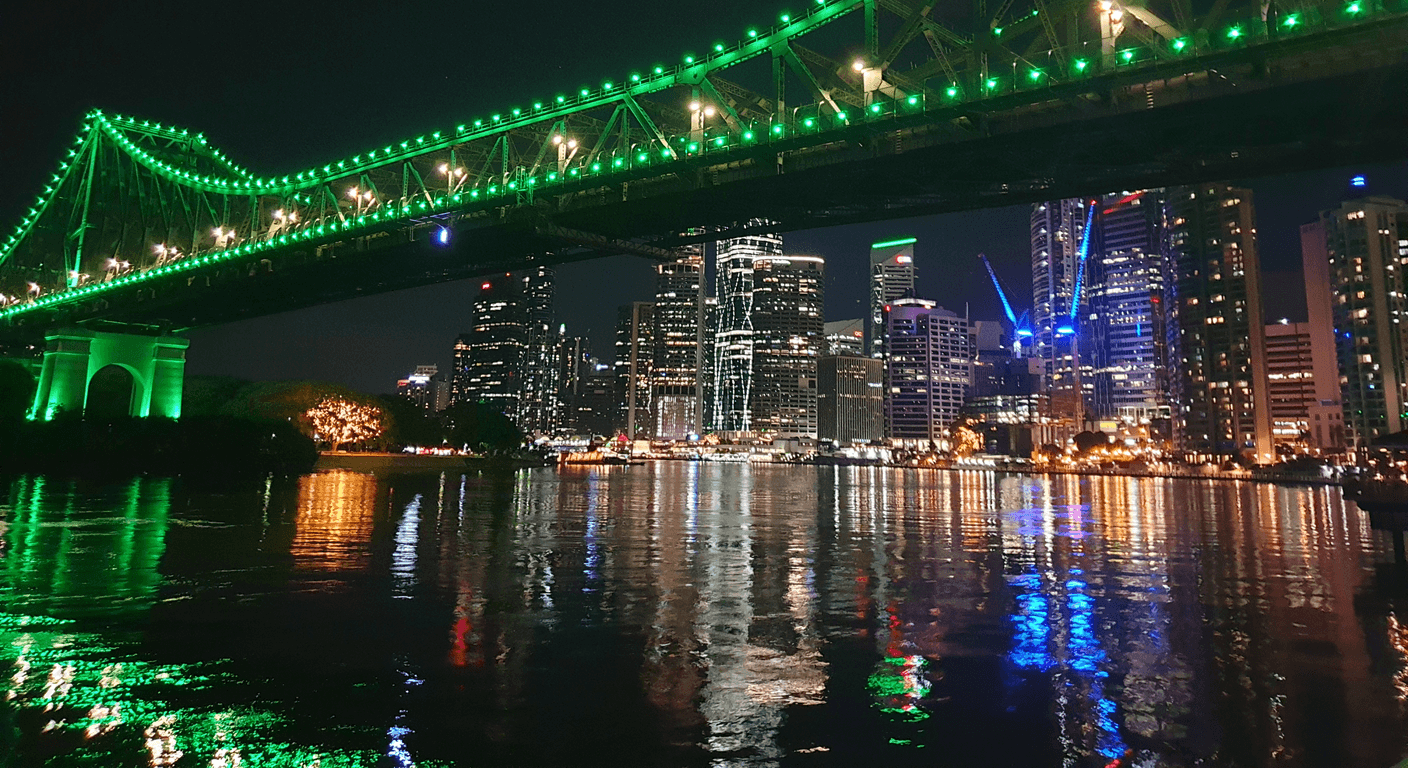
Brisbane's river is quieter and more intimate. The City Cat and the smaller CityHopper (which is free) connect South Bank, the CBD, New Farm, and beyond in a way that turns a commute into a pleasure. The river bends and the mangroves and the modest skyline visible from the water give Brisbane a different kind of beauty — less grand, more personal. For travellers who find Sydney's scale a little overwhelming after a few days, the Brisbane River is a genuine antidote.
Neither body of water is swimmable from the city itself — Sydney's harbour beaches are the exception, and the Brisbane River is not a swimming destination. But as organising geography, as the thing that gives each city its shape and its daily rhythm, both are exceptional. The question is whether you want grandeur or intimacy.
Day Trips: What the Hinterland Looks Like From Each City
Sydney's day-trip options are extraordinarily varied. The Blue Mountains — Katoomba is roughly two hours by train from Central Station on the Blue Mountains Line — offer cool air, dramatic escarpments, and the Three Sisters lookout at Echo Point, which is accessible by wheelchair and easy walking. The Southern Highlands (Bowral, Berrima) are an hour and a half by train or car, with good antiques, gardens, and the kind of unhurried main street that rewards an afternoon. The Hunter Valley is further — around two and a half hours — but its combination of wine, gardens, and comfortable accommodation makes it a natural overnight extension.
Brisbane's hinterland is equally compelling, and in some respects easier to navigate. The Gold Coast is an hour by train on the Citytrain network — confirm timetables at translink.com.au — and while Surfers Paradise itself is not to everyone's taste, the hinterland behind it (Tamborine Mountain, Springbrook) is lush, cool, and beautiful. The Sunshine Coast is roughly ninety minutes north, with Noosa offering one of the more civilised beach towns in the country. For something more immersive, the Scenic Rim — including Lamington National Park — rewards a two-night stay and has lodge accommodation designed for comfort rather than camping.
From a practical perspective, Brisbane's day trips tend to be more accessible by public transport than Sydney's — the train networks extend further into the regions. But Sydney's Blue Mountains train service is one of the great underused pleasures of Australian travel, and it runs directly from the CBD.
Cost, Comfort and the Honest Verdict: Who Should Choose Which City?
Sydney is broadly more expensive. Accommodation in the inner city — Circular Quay, the Rocks, Surry Hills, Potts Point — is indicatively higher than equivalent Brisbane options. Dining and transport costs are roughly comparable, though Sydney's premium restaurants pitch themselves at a national level that Brisbane is still approaching. For travellers on a comfortable but not unlimited budget, Brisbane offers more value per night, particularly in the South Bank and Kangaroo Point areas. Neither city requires you to spend extravagantly to have a good time, but Sydney rewards a slightly larger accommodation budget.
Comfort and medical access are high in both cities. Major hospitals, specialist medical centres, and pharmacies are accessible by public transport in both. If you have a pre-existing condition and are planning an extended stay, ensure your travel insurance covers the full duration — this applies even for interstate travel if your private health arrangements have limitations. Both cities have excellent accessible accommodation stock; ask specifically about lift access, roll-in showers, and proximity to public transport when booking.
The honest verdict: Sydney suits travellers who want cultural density, harbour drama, and are prepared to pace themselves through a city that rewards effort. It's the better choice if art, performance, history, and the particular pleasure of a great world harbour are the priority. Brisbane suits travellers who want warmth, ease, outdoor life, and a city that doesn't demand anything of you before breakfast. It's the better long-stay base for anyone who finds large-scale cities tiring, or who simply wants to sit by a river in the sun with a good coffee and nowhere particular to be. For a first visit to Australia, Sydney. For a considered return, or a longer stay, Brisbane deserves serious attention.
Key takeaways
- Brisbane's flat inner precinct and mild winters make it the easier physical base for over-50 travellers; Sydney's hills reward effort with proportionally grander experiences.
- Both cities offer Seniors Card public transport concessions — confirm current conditions with Translink (Brisbane) and Transport for NSW (Sydney) before travelling.
- May to September is the optimal window for both cities; Brisbane's June–July is particularly comfortable, with temperatures around 21–22°C and low humidity.
- Sydney's cultural infrastructure — the expanded Art Gallery of NSW, the Australian Museum, the Opera House — is deeper and denser; Brisbane's GOMA and South Bank Parklands are genuinely world-class.
- Brisbane's day trips (Gold Coast, Sunshine Coast, Scenic Rim) are broadly more accessible by public transport; Sydney's Blue Mountains are reachable directly by train from Central Station.
- Sydney accommodation runs broadly higher than Brisbane's — for equivalent comfort, budget more per night in Sydney's inner east or harbour-adjacent suburbs.
Recommended partners and links
Indicative prices only — always confirm with the operator before booking.
Frequently asked questions
Which city is easier to get around for seniors — Sydney or Brisbane?
Brisbane is generally easier for older travellers due to its flatter inner-city terrain and the City Cat ferry network, which covers major precincts comfortably. Sydney has excellent public transport and free travel for NSW Seniors Card holders outside peak hours, but its hills and larger scale require more planning. Both cities have good accessibility on public transport; Brisbane's walkability is the practical advantage.
Can I use my Seniors Card on public transport in Sydney and Brisbane?
Yes, with conditions. NSW Seniors Card holders travel free on most public transport outside peak weekday hours and all weekend. Queensland Seniors Card holders receive concession fares on Translink services, including buses, trains, ferries and trams. Confirm current eligibility and any restrictions directly with Transport for NSW (transport.nsw.gov.au) and Translink (translink.com.au) before travelling, as conditions can change.
What is the best time of year to visit Sydney or Brisbane for over-50 travellers?
May to September suits both cities well. Brisbane's June and July are particularly comfortable — mild days around 21–22°C, low humidity, and reliable sunshine. Sydney's autumn (March–May) and spring (September–November) are pleasant, though spring brings unpredictable rain. Both cities are best avoided in January and February, when heat and humidity are at their peak.
Is Brisbane or Sydney better for day trips from the city?
Both cities offer excellent day-trip options. From Brisbane, the Gold Coast is an hour by train, the Sunshine Coast around ninety minutes north, and the Scenic Rim a comfortable two-night extension. From Sydney, the Blue Mountains are roughly two hours by train from Central Station, the Southern Highlands an hour and a half, and the Hunter Valley a two-to-three-hour drive. Brisbane's regional rail network tends to make day trips more accessible without a car.
Which city is more affordable for a week-long stay?
Brisbane is broadly more affordable, particularly for accommodation. Inner-city hotels and apartments in Brisbane's South Bank and CBD areas are indicatively less expensive than equivalent Sydney options near the harbour or in Surry Hills and Potts Point. Dining costs are roughly comparable in the mid-range. Sydney rewards a larger accommodation budget; Brisbane offers strong value at a comfortable mid-range. Confirm current pricing directly with accommodation providers.
- Transport for NSW — Seniors Card travel information
- Translink Queensland — go card and seniors concessions
- Art Gallery of NSW — Sydney Modern
- Gallery of Modern Art (GOMA) — Queensland Art Gallery
- South Bank Parklands — Brisbane
- Visit NSW — Sydney travel information
- Visit Brisbane — official tourism information
- Australian Museum — Sydney
- Queensland Museum — Brisbane