Townsville's Strand and Castle Hill suit an easy, self-guided day best timed for the dry season (May to September), when clear skies and low humidity make walking comfortable. The flat, shaded two-kilometre Strand promenade and free stinger-safe rock pool pair naturally with a sealed-road drive to Castle Hill's 286-metre summit, where views stretch over Cleveland Bay to Magnetic Island. Mobility demands are minimal throughout, and direct flights from Melbourne, Brisbane and Sydney put Townsville within easy, independent reach.
Why Townsville works so well for travellers over 50
There's a particular pleasure in arriving somewhere and finding that the city has already done the thinking for you. Townsville's Strand is exactly that kind of place. The foreshore path runs flat for more than two kilometres along Cleveland Bay, wide enough for two people to walk side by side without stepping onto grass, shaded at regular intervals by purpose-built shelters, and punctuated with seating, public amenities, cafes and barbecue areas. It's the kind of infrastructure that gets built when a local council actually uses the place.
For travellers based in Victoria — particularly those who've spent decades navigating the seasonal grey of Melbourne winters — the dry tropics in June or July feel quietly miraculous. Townsville averages around 300 days of sunshine a year, and the winter months deliver clear skies, temperatures in the low-to-mid twenties and almost no humidity. It's warm without being oppressive. That distinction matters enormously when you're planning a day on your feet.
The city is also genuinely easy to reach. Jetstar, Qantas and Virgin all fly direct from Brisbane, and there are connections from Sydney, Melbourne and Cairns. Flight time from Melbourne is roughly three hours. Townsville's airport sits close to the city centre, and taxis and rideshares are readily available. For grey nomads travelling by road, the Bruce Highway brings you directly in.
Walking the Strand: what to expect and where to pause
The Strand is best approached without a rigid plan. Start at the southern end near the Townsville Entertainment and Convention Centre and walk north at whatever pace suits the morning. The path is sealed and level throughout — no steps, no significant gradients. The ocean is always to your left, Magnetic Island sitting on the horizon like a low green ridge. On a clear winter morning, the light on the Coral Sea is quite something.
Along the way, you'll pass memorials, sculptures and small gardens that reward slow walking rather than brisk exercise. The Vietnam Veterans' Memorial and the Honour Avenue plantings near Jezzine Barracks give the foreshore a layered character — it's not just a beach walk, it's also a quiet record of the city's relationship with its military history. Townsville has a long connection to the Australian Defence Force, and this is woven into the Strand without being heavy-handed.
Shade shelters appear frequently enough that you're never far from a place to sit and rest. Cafes at the northern end of the Strand — including options near the Rockpool precinct — serve decent coffee and light meals. The Strand is popular with locals on weekday mornings, which gives it an authentic neighbourhood feel rather than the slightly performative quality of some tourist foreshore developments. You'll share the path with elderly residents doing their daily walk, young families and the occasional cyclist. It's a lived-in place.
The rock pool and stinger-safe swimming: what you need to know
Townsville's rock pool is one of the Strand's most practical features. It's a large, free, saltwater pool open to the sea but protected from marine stingers — the box jellyfish and Irukandji that make open-water swimming in North Queensland genuinely dangerous between roughly October and May. The pool is maintained by the council, has no entry fee, and includes change facilities and nearby seating.
During the dry season (May to September), stinger risk drops significantly, and the netted swimming enclosures along the Strand allow ocean swimming with a reasonable level of protection. That said, conditions vary and the council's signage at each enclosure is worth reading rather than ignoring. If you're uncertain, the rock pool is the sensible choice — and it's a genuinely pleasant swim, not a consolation prize.
For travellers who haven't swum in the tropics before, it's worth understanding that the stinger situation is real and not exaggerated. Travel insurance that covers medical evacuation is always advisable in remote or regional Queensland. Wear a stinger suit or lycra if you're swimming in the enclosures — they're available to hire or buy at local sports shops, and the mild embarrassment of wearing one is considerably preferable to the alternative.
Jezzine Barracks: the heritage precinct at the northern end
At the northern tip of the Strand, the headland rises gently into the Jezzine Barracks precinct — the former home of the 3rd Brigade of the Australian Army, now transformed into a public heritage park. The transformation has been handled with real care. Heritage buildings have been retained, walking paths wind through tropical gardens and clifftop lookouts, and interpretive panels explain the site's military history from the Boer War through to more recent deployments.
The views from the Jezzine headland are among the best on the Strand — looking back along Cleveland Bay with Castle Hill rising behind the city, and Magnetic Island across the water. The paths within the precinct are mostly flat or gently graded, though there are some uneven surfaces near the older heritage structures. Comfortable walking shoes are sufficient; this isn't a bushwalk.
The precinct is free to enter and relatively unhurried — it's the kind of place where you might spend an hour without quite realising it. The combination of military history, tropical gardens and sea views gives it a layered quality that suits curious travellers. There's seating throughout, and the shade from mature trees is generous.
Driving Castle Hill: the summit view without the climb
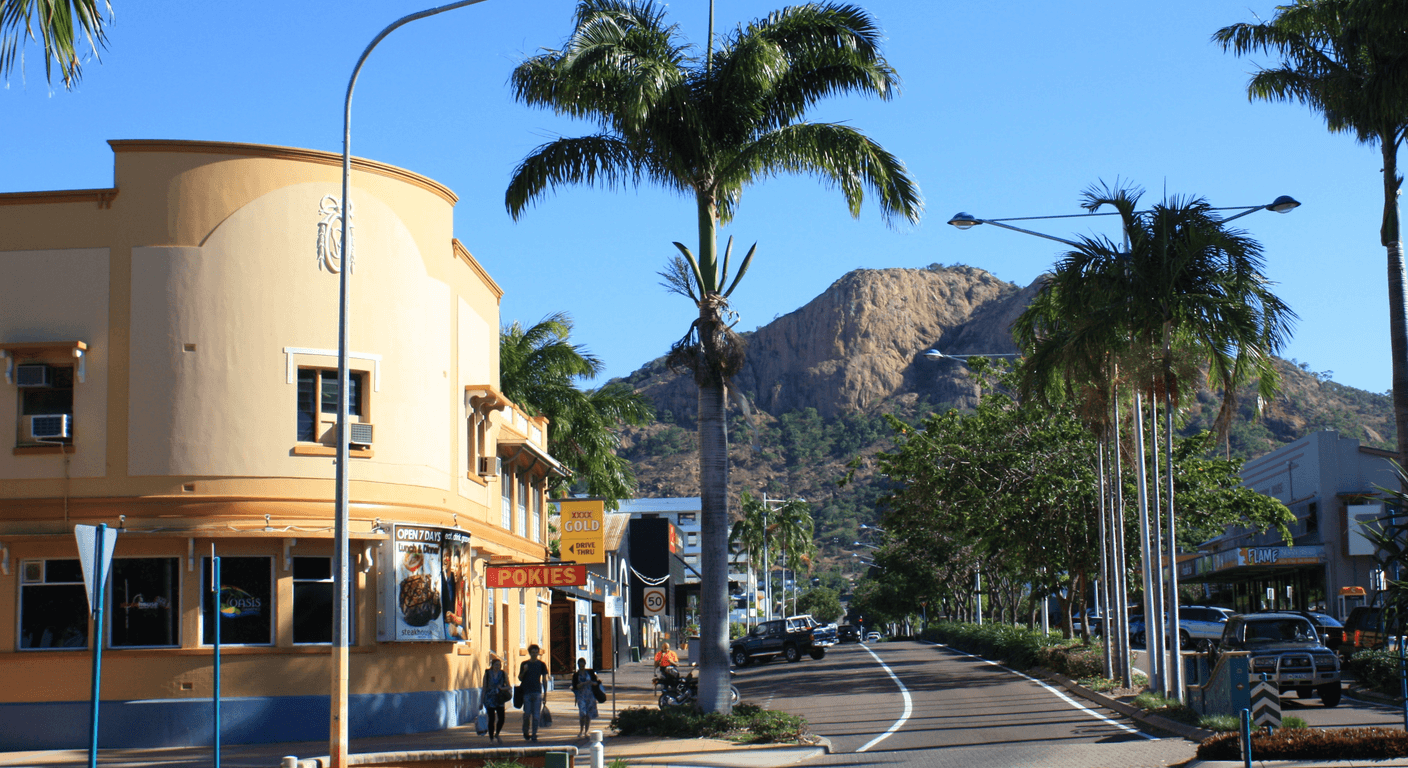
Castle Hill is the pink-granite monolith that rises 286 metres directly behind Townsville's city centre — visible from virtually everywhere on the Strand, and difficult to ignore. Many locals walk or run its trails for exercise, and good for them. For most visitors over 50, the more sensible approach is to drive to the summit, which is entirely possible via Castle Hill Drive, a sealed road that winds to a car park near the top.
The summit view is genuinely rewarding. On a clear winter day you can see across Cleveland Bay to Magnetic Island, south along the coast, and inland toward the ranges. The pink-granite boulders give the summit a distinctive character — this isn't a generic hilltop lookout. There are short, flat paths around the summit area, and the car park itself has a good vantage point if you'd prefer not to walk further.
Allow around thirty to forty minutes for the drive up, a wander at the top, and the return. The road is narrow in places and requires care, but it's sealed and manageable in a standard hire car. Go in the morning before the midday heat builds, or in the late afternoon when the light on the bay turns golden. Either way, it's a highlight of any Townsville visit — and the kind of thing you'd kick yourself for skipping.
Planning your day: a practical sequence
A sensible day on the Strand starts early — by eight in the morning, the light is beautiful, the path is quiet, and the heat is still manageable. Walk south to north along the foreshore, pausing at the memorials and shelters as the mood takes you. Reach Jezzine Barracks by mid-morning and allow an hour to explore the precinct. A coffee and a light lunch at one of the Strand cafes follows naturally.
After lunch — and a rest if needed — drive Castle Hill in the early afternoon before the day's warmth peaks. Return to your accommodation or base by mid-afternoon. If you're staying overnight in Townsville, the Strand foreshore precinct is pleasant again in the early evening, when locals gather and the light on the island softens.
Townsville's accommodation ranges from mid-range hotels near the city centre to self-contained apartments that suit couples who prefer a kitchen and a slower pace. The city centre is a short walk or taxi ride from most Strand entry points. For grey nomads, caravan parks within reasonable distance of the foreshore are available — confirm current options and availability through Tourism and Events Queensland or direct with operators, as the market changes.
Getting there and travelling sensibly
From Melbourne, Brisbane or Sydney, direct flights to Townsville are the most practical option. Flight times are roughly three hours from Melbourne, two from Brisbane, and under an hour from Cairns. The airport is close to the city centre. Townsville is also accessible by the Spirit of Queensland train service from Brisbane — a long but scenic journey suited to those who genuinely enjoy train travel and have the time for it. Confirm current schedules and fares with Queensland Rail before booking.
Travel insurance is non-negotiable for any traveller over 50, particularly those with pre-existing conditions. North Queensland's remote distances mean that medical evacuation cover matters. Ensure your policy covers any activities you plan — even a casual swim in an enclosure counts. The Australian Government's Smartraveller site (smartraveller.gov.au) has guidance on insurance considerations for domestic travel with health conditions.
Hiring a car in Townsville is straightforward and gives you the flexibility to drive Castle Hill at your own pace. If you prefer not to drive, local taxi services and rideshares cover the city. The Strand itself requires no transport — once you're on the foreshore, you're walking.
Quick planning guide
| Ideal pace | Slow and unhurried |
|---|---|
| Best months | May to September (dry season, clear skies and low humidity) |
| Suggested stay | One full day, with an overnight option for a slower pace |
| Mobility level | Easy — flat, sealed paths on the Strand and a drivable road to the Castle Hill summit |
| Cost level | Budget-friendly — the Strand, rock pool and Jezzine Barracks are all free |
| Comfort level | High — regular shade, seating, amenities and cafes along the route |
| Best for | Independent travellers who want a low-effort, self-organised day without tours or boat transfers |
| Main planning consideration | Swim only in the netted enclosures or free rock pool, as marine stingers make open-water swimming risky outside the dry season |
Key takeaways
- Townsville's Strand is flat, shaded and free — one of the most accessible foreshore walks in regional Australia.
- The dry season (May to September) delivers clear skies, low humidity and temperatures around 25°C — ideal for over-50 travellers.
- Castle Hill's summit is reached by a sealed drive, not a climb — the panoramic views over Cleveland Bay require nothing more than a car.
- The Strand's free rock pool offers stinger-safe saltwater swimming year-round, with no entry fee.
- Jezzine Barracks is a clifftop heritage precinct with military history, tropical gardens and sea views — allow at least an hour.
- Direct flights from Melbourne, Brisbane and Sydney make Townsville easy to reach, with the city centre a short transfer from the airport.
Recommended partners and links
Indicative prices only — always confirm with the operator before booking.
Frequently asked questions
Is the Strand in Townsville suitable for travellers with limited mobility?
Yes. The Strand path is sealed, flat and wide for its entire length of more than two kilometres, with regular seating and shade shelters. There are no steps along the main foreshore path. The Jezzine Barracks precinct at the northern end has mostly flat or gently graded paths, though some areas near heritage structures have uneven surfaces. Castle Hill is accessed by a sealed drive to a car park near the summit, so no climbing is required.
When is the best time to visit Townsville's Strand?
May to September is the best time to visit. Townsville's dry season brings clear skies, low humidity and daytime temperatures around 23–27°C. The wet season (roughly November to April) brings significant humidity, rainfall and the highest risk from marine stingers, which limits open-water swimming. The rock pool is available year-round but the overall experience is considerably more comfortable in the dry months.
Can you drive to the top of Castle Hill in Townsville?
Yes. Castle Hill Drive is a sealed road that winds to a car park near the summit at 286 metres. It's suitable for standard hire cars. The road is narrow in sections, so take care, particularly when passing other vehicles. From the car park, short flat paths lead to viewpoints over Cleveland Bay, Magnetic Island and the city. Allow around 30–40 minutes for the drive up, a look around and the return.
Is swimming safe on the Strand in Townsville?
During the dry season (May to September), stinger risk is significantly reduced, and netted swimming enclosures along the Strand allow ocean swimming with a reasonable level of protection. The free rock pool is available year-round and is protected from marine stingers. During the wet season (October to May approximately), box jellyfish and Irukandji are a genuine risk in open water — the rock pool or stinger-suit swimming in the enclosures is advisable. Always read council signage at each enclosure before entering the water.
How do you get from Melbourne or Sydney to Townsville?
Jetstar, Qantas and Virgin Australia operate flights to Townsville. From Melbourne, direct flights take roughly three hours. From Sydney, flight time is approximately two and a half hours. From Brisbane, direct flights are under two hours. Connections from Cairns are under an hour. Townsville Airport is close to the city centre, with taxis and rideshares readily available. The Spirit of Queensland train service from Brisbane is an alternative for those who prefer rail travel — confirm current schedules and fares with Queensland Rail.