Vientiane suits a two-day stopover for travellers who prefer a slow pace over a packed itinerary. October to March is the most comfortable window, avoiding the heavy heat of April to September. The golden stupa of Pha That Luang, framed by colonial streetscapes and evening food stalls along the Mekong, is the city's defining draw. Mobility is easy, with flat, compact streets ideal for walking, though there are no direct flights from Australia — travellers connect via Bangkok or Ho Chi Minh City, with total journeys running 12 to 16 hours.
Why Vientiane Works as a Two-Day Stopover
Most travellers fly past Vientiane on their way to Luang Prabang or northern Thailand. That's their loss. The Laos capital rewards a short, deliberate stop — not because it packs in dozens of sights, but because it asks almost nothing of you. The streets are wide, the traffic is light by Southeast Asian standards, and the central area is compact enough to cover on foot without ever feeling rushed.
For a couple from Melbourne or any other Australian city, the logistics are straightforward. You'll connect through Bangkok's Suvarnabhumi Airport or Ho Chi Minh City's Tan Son Nhat — both have regular onward services to Wattay International Airport, Vientiane's modest but functional terminal. Total travel time from Melbourne, including a stopover, is typically around 12 to 15 hours depending on the connection. A recovery night in a decent hotel before exploring is sensible, not indulgent.
Two days is genuinely sufficient. Vientiane has perhaps four or five sights worth your attention, and none of them demands more than an hour or two. The pleasure here is in the rhythm between them — a slow breakfast, a tuk-tuk ride, a long lunch, an afternoon stupa, a riverside beer at dusk. That rhythm suits travellers who've earned the right to move at their own pace.
Getting There from Australia: Flights and Connections
There are no direct flights from Australia to Vientiane. The most common routes connect through Bangkok (Thai Airways, Bangkok Airways) or Ho Chi Minh City (Vietnam Airlines). From Melbourne, Sydney or Brisbane, expect a total journey of 12 to 16 hours gate-to-gate including transit time. The Bangkok connection is generally the smoothest — Suvarnabhumi has clear signage and accessible transit facilities.
Jet lag from Southeast Asia is relatively mild compared with European or American travel — the time difference from Victoria is around three hours (Laos is UTC+7, AEST is UTC+10, AEDT UTC+11). Most travellers find they adjust within a day. Still, arriving in the early evening and spending the first night quietly at the hotel makes the following morning far more enjoyable.
Confirm all current visa requirements and entry conditions on the Australian Government's Smartraveller website (smartraveller.gov.au/destinations/asia/laos) before booking anything. Laos has historically offered visa-on-arrival for Australian passport holders at Wattay Airport, but conditions change. Travel insurance that covers pre-existing medical conditions is essential — compare policies carefully and declare everything.
Pha That Luang: The Sight Worth Building Your Day Around
Pha That Luang is the national symbol of Laos — a 45-metre golden stupa rising from a walled compound about four kilometres from the city centre. In morning light, particularly between October and February, the gold catches the sun in a way that no photograph quite captures. It's worth the short tuk-tuk ride out, and worth arriving by 8am before tour groups (such as they are — Vientiane doesn't attract crowds the way Luang Prabang does).
The surrounding cloisters are quiet, the entry fee modest, and the whole visit takes around an hour at a comfortable pace. There are benches inside the compound for those who want to sit and take it in without hurrying. The stupa was substantially restored in the 20th century, so its gleam is deliberate rather than ancient — but its cultural and spiritual significance to Laotians is genuine and visible in the way worshippers move through the space.
Nearby, the Patuxai monument — a Lao interpretation of the Arc de Triomphe, built with American-supplied concrete originally intended for a runway — stands along Lane Xang Avenue. It's an odd, endearing piece of history. You can climb it for a modest fee and look out over the city's wide boulevards. The view is pleasant rather than dramatic, but the story behind it is worth knowing.
Walking the French-Colonial Streets
Central Vientiane's streetscape reflects its layered colonial history — French-era villas in varying states of elegant decay, Buddhist temples tucked between café-bars, and broad tree-lined avenues that feel more provincial French town than Asian capital. The Setthathirath Road and Samsenthai Road area repays a slow morning walk. It's flat, the footpaths are reasonable, and there's usually a shaded café within five minutes when the heat builds.
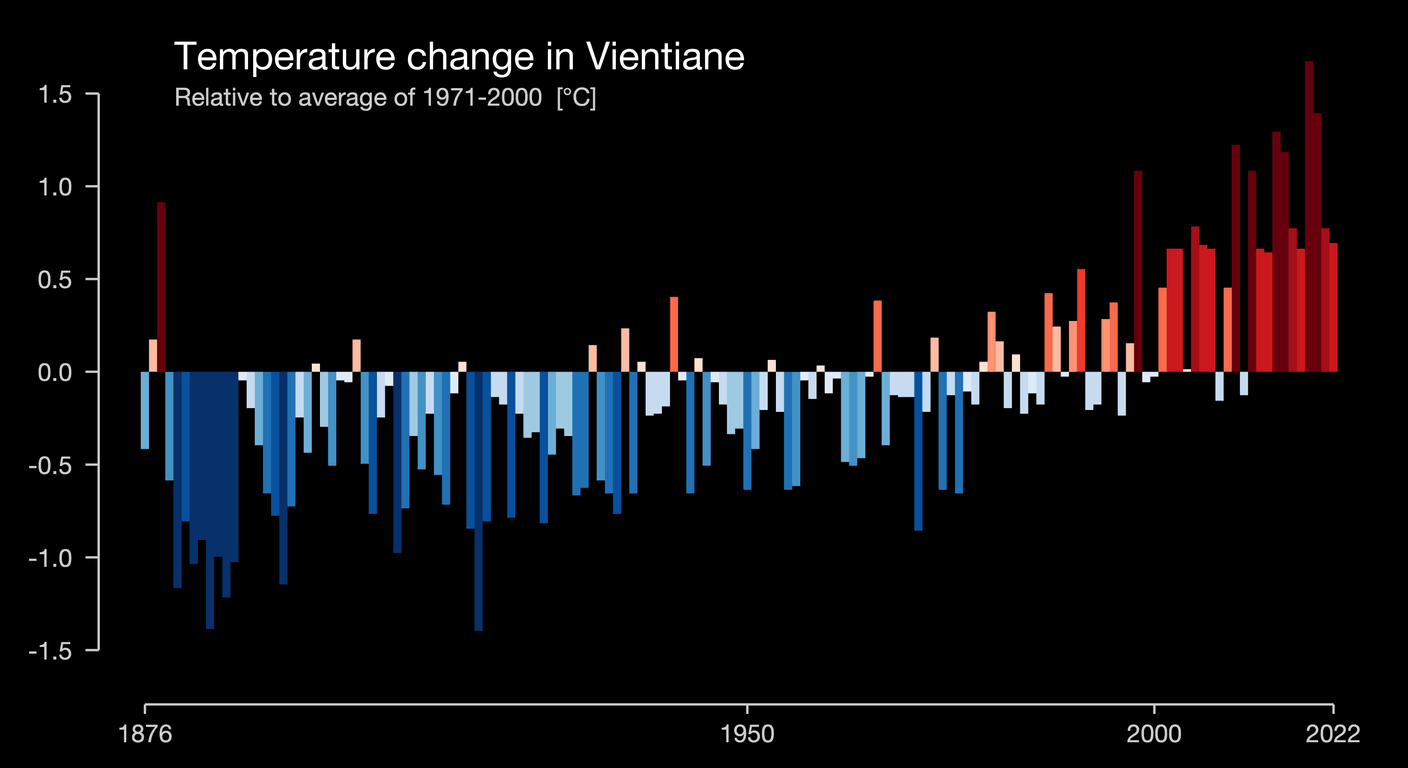
The heat is worth noting. Between April and September, midday temperatures can reach 35°C or above with high humidity. October to March is the sensible window — warm, but rarely oppressive before noon. A hat, sunscreen and a water bottle are non-negotiable. Plan the walking for the morning, retreat for lunch and a rest during the hottest part of the afternoon, and re-emerge around 4pm when the light softens and the riverside comes alive.
COPE Visitor Centre, near the National Cultural Hall, offers a sobering and important exhibit on the legacy of unexploded ordnance in Laos — a consequence of the Secret War of the 1960s and 70s. It's not a cheerful hour, but it's one of the most affecting and informative cultural experiences in the city. Entry is free (donations welcomed). The centre is accessible and air-conditioned.
Evenings on the Mekong: Food Stalls and a Quiet Beer
The Mekong riverfront — locally called the Quai Fa Ngum — is where Vientiane unwraps itself in the evenings. From around 5pm, food stalls and small restaurants set up along the promenade. The cooking is simple, the prices are low, and the setting — wide river, Thai bank visible across the water, sky going through its sunset colours — is genuinely lovely. A cold Beerlao, Laos's clean, light local lager, costs roughly the equivalent of AUD 1–2 at a stall; confirm current pricing locally.
The night market along the riverfront runs most evenings and is worth a browse — textiles, silverware, handicrafts. It's low-pressure by market standards; vendors are generally relaxed rather than persistent. For dinner, the riverfront restaurants serve a mix of Lao and Thai dishes. Laap (a minced meat salad with herbs and toasted rice) and mok pa (fish steamed in banana leaf) are the dishes to try if you're ordering Lao rather than the safer international menu.
Couples will find the riverfront atmosphere easy and companionable. Tables are close to the water, the noise level is comfortable for conversation, and the whole scene winds down by around 10pm — which, after a day of gentle sightseeing, tends to feel exactly right.
Getting Around: Tuk-Tuks, Walking and a Few Practical Notes
The central area of Vientiane — say, a rectangle between the Mekong, Patuxai, Pha That Luang and the National Museum — is walkable if you're comfortable with 20 to 30 minutes on flat ground in moderate heat. For the stupa run or any trip further afield, tuk-tuks are the standard option. They're everywhere, easy to flag, and the drivers are generally good-natured.
Agree on the fare before you get in. This isn't a negotiation trap — it's just the custom, and the numbers involved are small. A tuk-tuk from the central hotel district to Pha That Luang should cost roughly 30,000 to 50,000 Lao Kip each way — indicative only, confirm locally and expect variation. Most drivers quote in Kip; some will accept Thai Baht or US dollars, though Kip is the appropriate currency for small transactions. ATMs dispensing Kip are available near the main hotel strips.
Ride-hailing apps have limited coverage in Vientiane compared to Bangkok or Ho Chi Minh City — don't rely on them as your primary transport plan. Your hotel can usually arrange a reliable tuk-tuk driver for a half-day, which is a sensible option if you want to cover Pha That Luang, Patuxai and the riverfront in a single loop without the negotiation each time. Wheelchair access across the city is inconsistent; footpaths can be uneven in older areas, though the main boulevards are generally manageable.
Staying Well and Travelling Smart
Vientiane's medical facilities are limited compared to Bangkok or major Australian cities. For anything beyond a minor issue, evacuation to Thailand is the realistic option — which is exactly why comprehensive travel insurance, with medical evacuation cover, is not optional. Declare pre-existing conditions fully when purchasing; a 73-year-old traveller with any cardiac, respiratory or mobility history needs a policy written to match. The Australian Government's Smartraveller site links to resources for finding appropriate cover.
Food and water safety: drink bottled water throughout, including for brushing teeth if you're cautious. The riverfront food stalls are generally fine — look for stalls with high turnover and visible cooking — but if your stomach is sensitive to new cuisines, the first day is not the moment to experiment with everything. The hotels in the mid-range and above tier typically have restaurants with safer kitchen standards for the first night.
Currency and payments: Laos is still largely a cash economy at the street level. Larger restaurants and hotels accept cards, but food stalls, tuk-tuks and markets do not. Carry sufficient Kip for daily expenses and keep a small reserve of US dollars for emergencies. The exchange rate fluctuates — check xe.com or your bank before departure, and always confirm current rates in Vientiane rather than exchanging large amounts at the airport.
Quick planning guide
| Ideal pace | Slow-paced and unhurried, built around two or three key sights |
|---|---|
| Best months | October to March, before the heavy pre-monsoon heat |
| Suggested stay | Two days |
| Mobility level | Easy — flat, compact central area, though footpaths can be uneven in older streets |
| Cost level | Budget-friendly, with mid-range hotels recommended for comfort |
| Comfort level | Comfortable with a sensible recovery night on arrival |
| Best for | Couples and older travellers wanting a low-key, slow-paced stopover |
| Main planning consideration | Confirm current Laos visa rules on Smartraveller and secure travel insurance with medical evacuation cover, given limited local medical facilities |
Key takeaways
- Two days is the right amount of time in Vientiane — the city rewards a slow pace, not a long itinerary.
- Pha That Luang, the Mekong riverfront and the colonial streetscape are the three pillars of a Vientiane stopover.
- Central Vientiane is flat and compact — one of the more physically accessible capitals in Southeast Asia.
- Always agree on a tuk-tuk fare before departure; the amounts are small but the habit avoids any awkwardness.
- Check current Laos entry requirements on smartraveller.gov.au before booking — conditions can change.
- October to March is the most comfortable window for visiting; midday heat between April and September is significant.
Recommended partners and links
Indicative prices only — always confirm with the operator before booking.
Frequently asked questions
Do Australians need a visa to enter Laos?
Australian passport holders have historically been eligible for a visa on arrival at Vientiane's Wattay International Airport, but entry requirements can change. Always confirm the current rules on the Australian Government's Smartraveller website (smartraveller.gov.au/destinations/asia/laos) before booking your trip.
Is Vientiane safe for older Australian travellers?
Vientiane is considered one of the safer capitals in Southeast Asia, with low levels of violent crime and a relaxed atmosphere. The main practical concerns are traffic (motorbikes can be unpredictable), uneven footpaths in older areas, and the need for comprehensive travel insurance given limited local medical facilities.
How long does it take to fly from Australia to Vientiane?
There are no direct flights from Australia to Vientiane. Connecting through Bangkok or Ho Chi Minh City, total travel time from Melbourne or Sydney is typically 12 to 16 hours including transit. A rest night on arrival before sightseeing is sensible.
What is the best time of year to visit Vientiane?
October to March is the most comfortable period — temperatures are warm rather than oppressive, and rainfall is low. April to September brings intense heat and the wet season, with July and August seeing the heaviest rain. Most Australian travellers find the October–March window suits both comfort and travel schedules.
Is Vientiane suitable for travellers with limited mobility?
The central area of Vientiane is flat and relatively walkable, which makes it more accessible than many Asian capitals. However, footpaths can be uneven in older neighbourhoods, and formal wheelchair infrastructure is limited. Tuk-tuks are the standard alternative to walking, and a half-day driver arranged through your hotel removes most logistical friction.