Warrumbungle National Park, in New South Wales, is Australia's only International Dark Sky Park, prized for stargazing beneath the Milky Way from Camp Blackman's campground or the lookouts along Timor Road. The cooler months from April to October bring the clearest skies, and a stay of two to three nights allows for both a ranger-guided Dark Sky Discovery tour and daytime walks. Access is a five-and-a-half-hour drive from Sydney, or a flight to Dubbo followed by a short drive to Coonabarabran. Mobility is moderate, mixing easy lookouts with a demanding signature walk.
Why the Warrumbungles earned their Dark Sky status
The International Dark-Sky Association granted Warrumbungle National Park its Dark Sky Park status in 2016 — the first such designation in Australia, and the only one the country currently holds. The certification isn't ceremonial. It reflects genuine, measurable darkness: a night sky largely free of the artificial light pollution that washes out the Milky Way from almost every city and large town on the continent. The Warrumbungles sit far enough from Sydney, Newcastle, and even Dubbo that the horizon stays dark in all directions on a clear, moonless night.
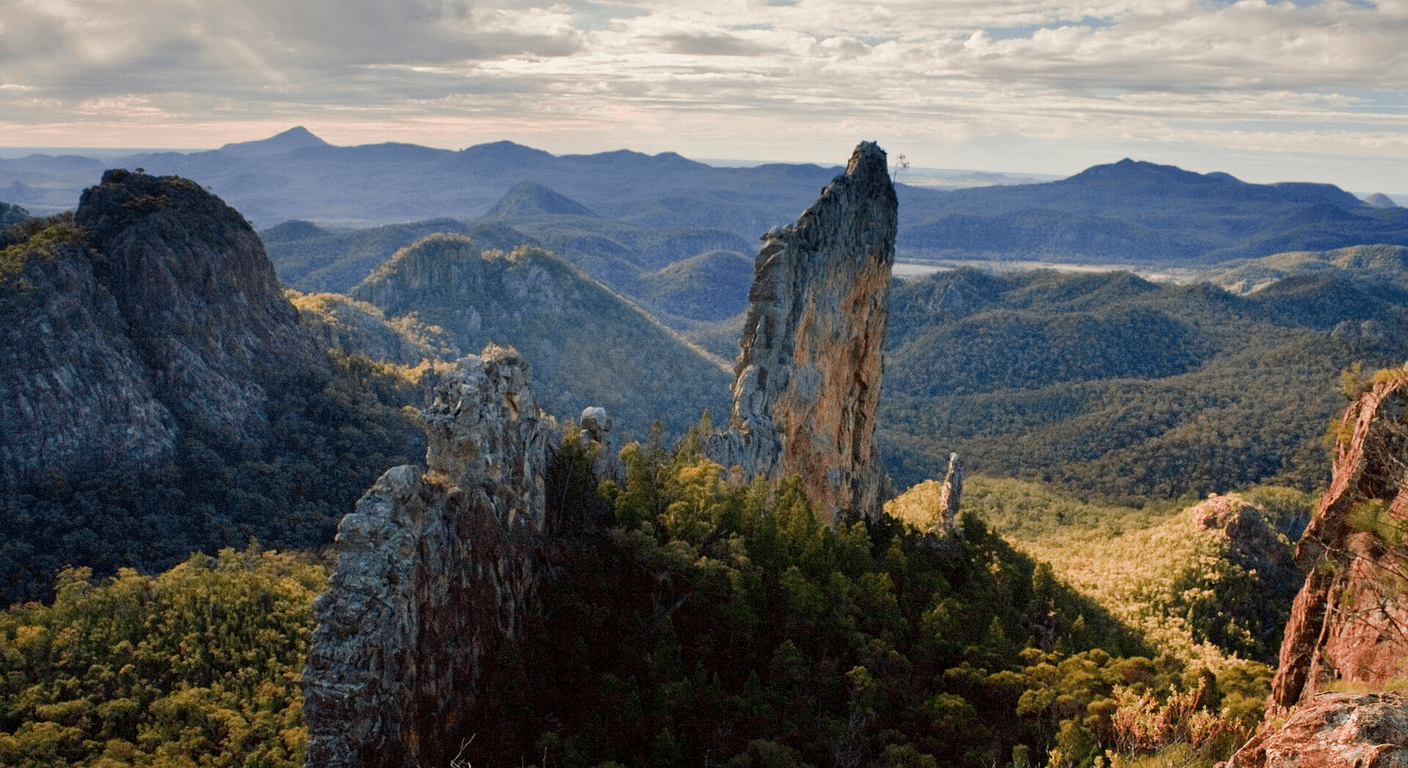
The park's geology adds to the drama. The Warrumbungles are the eroded remains of a shield volcano active around 17 million years ago. The jagged peaks — Breadknife, Belougery Spire, Crater Bluff — catch the last of the alpine glow at dusk, then disappear into silhouette as the stars arrive. It's an unusual combination of landscape spectacle and astronomical excellence, and it's the reason Siding Spring Observatory, one of Australia's most significant research facilities, was built on the park's eastern edge.
For a group of friends who appreciate both the science and the spectacle, the Warrumbungles offer something genuinely different from a beach holiday or a wine-region weekend. The pace is slow, the landscape is ancient, and the darkness after sunset is something most Australians haven't experienced since childhood.
Getting there: the drive from Sydney, regional flights to Dubbo, and what to expect on the road
Coonabarabran, the nearest town and the logical base, sits roughly 480 kilometres north-west of Sydney. The drive takes around five and a half to six hours without stops, following the Great Western Highway through the Blue Mountains before heading north through Bathurst, Mudgee, and Gilgandra. It's a long day, and for a group travelling together it's worth splitting the journey — Mudgee makes a comfortable overnight stop with good accommodation and a reasonable restaurant scene. Arriving rested matters when you plan to be outside looking at the sky until midnight.
The more comfortable option for those who'd rather not drive from Victoria or Sydney is to fly to Dubbo — Rex Airlines connects Dubbo to Sydney, Melbourne, and Brisbane — then hire a car for the 100-kilometre drive north-west to Coonabarabran on the Newell Highway. That road is flat, well-sealed, and unremarkable, which is exactly what you want after a flight. The drive takes just over an hour. Confirm current flight schedules and hire car availability with Rex Airlines (rex.com.au) and national hire car companies before booking.
The roads inside the park itself are a mix of sealed and well-maintained gravel. A standard vehicle handles them comfortably in dry conditions, though after heavy rain some sections can become muddy. If anyone in the group has concerns about gravel roads, the key lookouts and the main campground at Camp Blackman are accessible via sealed road. Check current road conditions with the park before you set out — the NSW National Parks website lists closures and alerts.
Ranger-guided Dark Sky Discovery tours: what to expect
Parks NSW runs Dark Sky Discovery tours at Warrumbungle as part of its nature-based program. These ranger-guided evening sessions typically include an introduction to the night sky, telescope viewing, and context about why the park's darkness matters — both for astronomy and for nocturnal wildlife. Rangers know how to read the sky for a mixed group, explaining what you're seeing without requiring any prior knowledge of astronomy. For a group of friends, the social dimension of a guided tour works well: you're looking at the same things, asking questions together, and the ranger keeps the pace comfortable.
Sessions are generally held on or near new moon weekends, when the lunar light that would otherwise wash out fainter stars is absent. Booking is essential — numbers are limited and these sessions fill quickly around school holidays. Confirm current tour dates, times, and bookings directly with NSW National Parks, as the program schedule changes seasonally. Indicative cost has historically been modest — around $15–$25 per person — but verify current pricing at the time of booking.
Dress for the cold, regardless of the time of year. Even in summer, temperatures at the Warrumbungles drop sharply after dark; in winter, overnight lows regularly fall to single digits or below. The practical kit for an evening tour includes thermal underlayers, a warm mid-layer, a wind-proof jacket, a beanie, gloves, and a red-light torch (red light preserves night vision far better than white light — rangers will remind you of this). Comfortable, closed-toe shoes with grip matter on uneven ground in the dark.
Self-guided stargazing: campgrounds, lookouts, and going at your own pace
The beauty of staying inside the park is that the dark sky is available every clear night, not just on ranger-tour evenings. Camp Blackman, the main campground near the visitor centre, has powered and unpowered sites, flushing toilets, and hot showers — a reasonable level of comfort for those who haven't camped in a while. The campground's open aspect and low surrounding terrain make it one of the better spots in the park for naked-eye sky watching. A reclining camp chair and a thermos of tea are the only equipment required for a satisfying hour under the Milky Way.
For those who prefer a bed, Coonabarabran has a reasonable range of motel and self-contained cabin accommodation at mid-range prices. The trade-off is a 30-minute drive into the park each evening, but that's manageable and means you can choose your viewing spot — the park's lookouts along Timor Road offer car-accessible vantage points with wide horizons. Whitegum Lookout and the area around the John Renshaw Parkway are popular self-guided spots. A basic star map or a free astronomy app like Stellarium (stellarium.org) on a phone with brightness turned to minimum helps identify constellations and planets.
One practical note for the group: coordinate who's driving back to town on any given night before the evening begins, rather than after a couple of hours in the cold. The roads inside the park are unlit, and kangaroos are active after dark — driving slowly and staying alert is simply good sense.
Siding Spring Observatory: the daytime visit worth making
Siding Spring Observatory sits on the park's eastern edge at around 1,165 metres elevation, housing the Anglo-Australian Telescope and several other research instruments operated by the Australian National University and international partners. The site is one of the most significant optical astronomy facilities in the southern hemisphere. During the day, the visitor centre runs guided tours that explain the telescopes, the research conducted there, and the history of the site. For a group with even a passing interest in science, it's a genuinely engaging few hours.
Evening public sessions at Siding Spring allow visitors to observe through telescopes with commentary from staff. These sessions are separate from the Parks NSW ranger tours and bookings are made directly with the observatory. Confirm current session availability, pricing, and booking requirements at sidingspringobservatory.com.au well ahead of your visit — evening sessions are popular and capacity is limited.
The drive up to the observatory from the main park entrance is a winding, partly steep road with spectacular views over the park. It's sealed throughout. Those with any concern about heights or winding mountain roads should be aware that the ascent involves some exposure — though nothing severe by alpine standards. The views from the observatory grounds across the volcanic landscape are worth the drive in their own right, even if telescopes aren't the main draw.
Daytime in the Warrumbungles: walks, wildlife, and the landscape itself
The park is worth a full visit in daylight, not just after dark. The Breadknife and Grand High Tops walk is the signature longer route — a 14.5-kilometre circuit with significant elevation gain that's classified as hard and takes most walkers six to eight hours. It's genuinely demanding and not suited to every member of every group. The shorter Pincham Trail to Balor Hut (around 5 kilometres return, relatively easy) and the Dogrock walk give access to the park's distinctive volcanic formations without requiring strong fitness or sure-footedness on steep terrain.
Wildlife in the park is varied and often visible during the day: eastern grey kangaroos are common around the campgrounds, wedge-tailed eagles circle the ridgelines, and the birdlife is particularly rich — the park sits within a zone where eastern and western species overlap. Bring binoculars. The wildflower season in spring (August to October) brings colour to the slopes around the main walking trails. After rain, the whole landscape smells of eucalyptus and damp volcanic soil in a way that's worth experiencing slowly.
For a friends group, the rhythm of the Warrumbungles suits a mix of energy levels well. One or two people can tackle a longer walk while others explore the visitor centre, drive the scenic roads, or simply sit with a book in the campground. Reconvene for dinner in Coonabarabran — the town has a handful of cafes and a pub that serves solid counter meals — then head back into the park for the night sky.
Practical planning: what to book, what to pack, and what to confirm
Park entry fees and campsite bookings are handled through the NSW National Parks website. Book campsites well ahead for new moon weekends and school holidays — the park's reputation for dark-sky tourism has grown, and the main campground fills. If the group prefers motel accommodation in Coonabarabran, the town's options are modest but comfortable; check Coonabarabran's visitor information site for a current list. Travel insurance is worth reviewing before any regional trip if members of the group have pre-existing health conditions — confirm that your policy covers you for activities in remote national parks.
The packing list for a Warrumbungle visit is skewed toward warmth and practicality rather than style. Beyond the layering essentials already mentioned, pack a red-light torch (available cheaply at camping or astronomy retailers), a reclining chair for extended viewing sessions, a good thermos, and a basic star chart or downloaded astronomy app. If anyone in the group uses a telescope, even a modest beginner's instrument will reveal detail that naked-eye viewing misses — but it's not necessary to invest in one, given the ranger-guided sessions use park equipment.
A word on timing: the new moon falls on different dates each month, and planning your stay around it makes a significant difference to the quality of the sky. A full or near-full moon will wash out fainter stars and the Milky Way entirely. Lunar calendars are freely available online — Time and Date (timeanddate.com) is reliable. The cooler months from April to October generally offer the clearest skies and the most comfortable conditions for extended outdoor evenings. Summer visits are possible but the heat during the day can be intense, and summer storms can obscure the sky at short notice.
Quick planning guide
| Ideal pace | Slow-paced, mixing daytime exploration with evening stargazing |
|---|---|
| Best months | April to October for cooler, clearer skies; time visits around the new moon |
| Suggested stay | 2-3 nights to allow for tours, walks and multiple clear-sky evenings |
| Mobility level | Moderate — easy lookouts and campground access, but the signature walk is hard |
| Cost level | Budget-friendly, with modest tour and accommodation costs |
| Comfort level | Basic-to-moderate, from camping to simple motel stays, with cold nights year-round |
| Best for | Small groups of friends with an interest in astronomy, nature and slow travel |
| Main planning consideration | Book Dark Sky Discovery tours and campsites ahead, and plan around the new moon for the darkest skies |
Key takeaways
- Warrumbungle National Park is Australia's first and only International Dark Sky Park, certified for exceptional natural darkness by the International Dark-Sky Association.
- Ranger-guided Dark Sky Discovery tours run on or near new moon weekends — book directly with NSW National Parks and confirm current dates before planning your trip.
- Siding Spring Observatory, on the park's eastern edge, offers daytime tours and separate evening public sessions with telescope access — book in advance.
- Cold nights are a reality year-round; thermal layers, a wind-proof jacket, gloves, and a red-light torch are essential kit for any evening session.
- The most comfortable approach from Victoria or Sydney is to fly into Dubbo then drive the 100 kilometres to Coonabarabran, arriving rested and ready.
- Plan your stay around the new moon — a full or near-full moon will significantly reduce the darkness that makes this park extraordinary.
Recommended partners and links
Indicative prices only — always confirm with the operator before booking.
Frequently asked questions
What makes Warrumbungle National Park a Dark Sky Park?
Warrumbungle National Park was designated Australia's first International Dark Sky Park by the International Dark-Sky Association in 2016. The certification recognises the park's exceptionally low levels of artificial light pollution, which allow the Milky Way and thousands of stars to be visible to the naked eye on clear, moonless nights. The park's remote location in central-western New South Wales, far from major cities, is central to its dark-sky quality.
How do you book a ranger-guided stargazing tour at Warrumbungle?
Ranger-guided Dark Sky Discovery tours at Warrumbungle are booked through NSW National Parks. Sessions are typically scheduled on or near new moon weekends. Visit nationalparks.nsw.gov.au to check current tour dates and availability, and book ahead — capacity is limited and popular dates fill quickly.
Is Warrumbungle National Park suitable for over-50 travellers with varying fitness levels?
Yes, with some planning. The park's key stargazing sites — including the main campground at Camp Blackman and several lookouts — are accessible by car on sealed or well-maintained roads. Evening ranger tours involve walking on uneven ground in the dark, so sturdy footwear with grip is important. The longer walking tracks, such as the Grand High Tops circuit, are demanding and optional; shorter walks suit a wider range of fitness levels.
What is the best time of year to visit Warrumbungle for stargazing?
April to October generally offers the clearest, most stable skies and cooler temperatures that are more comfortable for extended outdoor evenings. Summer (December to February) can bring heat, storms, and bushfire smoke that affect visibility. Regardless of the month, plan your stay around the new moon phase — a full or near-full moon significantly reduces sky darkness.
Can you visit Siding Spring Observatory without being an astronomer?
Yes. Siding Spring Observatory runs daytime visitor tours that are accessible and informative for anyone with general curiosity about science and space. Staff explain the telescopes and the research conducted at the facility in plain language. Evening public viewing sessions are also available separately. Confirm current tour times, session availability, and booking requirements directly at sidingspringobservatory.com.au before your visit.
- NSW National Parks & Wildlife Service — Warrumbungle National Park
- Siding Spring Observatory — Public Visits
- International Dark-Sky Association — Dark Sky Places Program
- Coonabarabran Visitor Information
- NSW National Parks Campsite Booking
- Rex Airlines — Dubbo routes
- Stellarium — Free online star map
- Time and Date — Moon phase calendar